Cheers

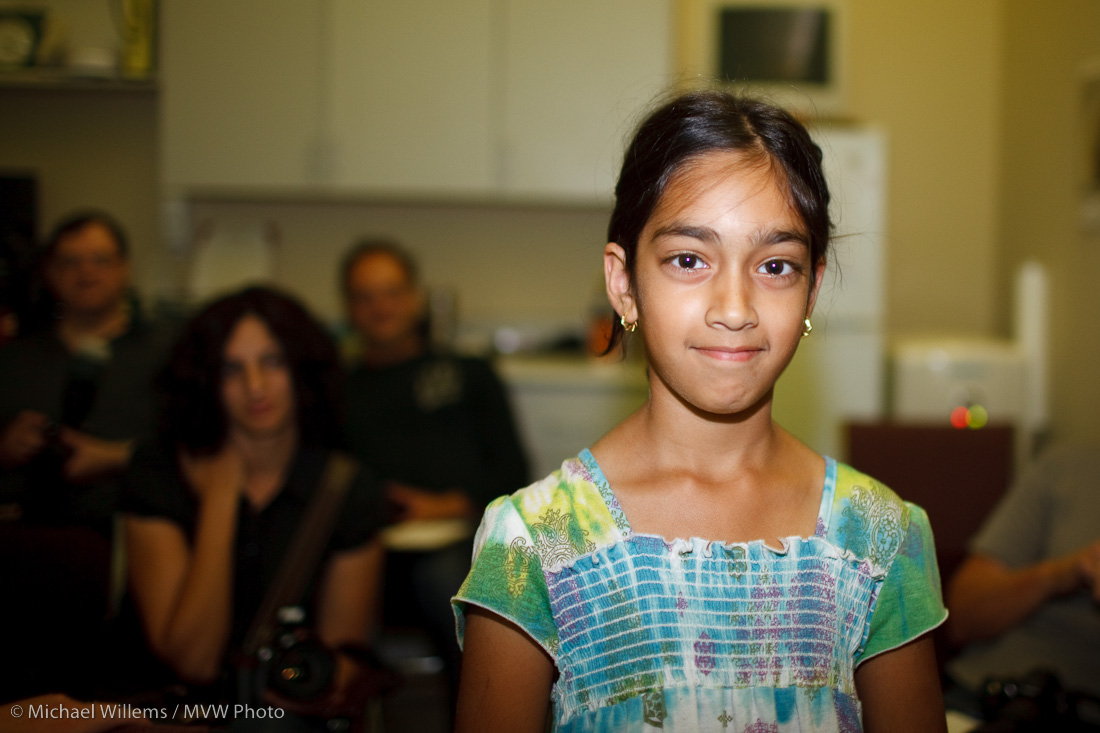
This is one of my standard party shots:

MVW_1690

It is three-dimensional, shows fun, and shows the subject well. If the subject is the worse for wear, the blurring hides that, which subjects tend to like for some reason.

You get a picture like this by:

  • Using an external flash.
  • Bouncing that flash behind you, off a wall or ceiling.
  • Using a wide lens : <24mm on a crop camera, or <35 on full frame.
  • Getting close. No, closer. No, even closer!
  • Using aperture or manual mode with a wide-open aperture (small “F”-number).

Oh dear, I seem to have given away another secret.

Guess what.  The days that “giving away secrets” was a bad thing are long gone. We call this The Internet. You can come here every day in the secure knowledge that I will never “hold back information”. My mission is to fill the world with better photographers, and to show you all how simple this is. Because it is.

7D – post two

Okay… so I own a brick, until Adobe or Canon start waking up and fixing the fact that Lightroom, my core tool, cannot yet properly read 7D images. They come up noisy and with awful colour, using a “beta” camera profile and no way to select another. Adobe say they “hope” to get a fix for this into the next update (when? They say they are a long way off). See here.

MVWS9808

Also, I just figured out that movies are ignored by Lightroom. Fair enough but since I use Lightroom to copy stuff off my memory card, which is then ejected and formatted (by me), that ignoring is not clever better would be to copy them for me to some location.

Now I lost the family videos I made yesterday. That is regrettable. Now I need to, from now on, load CF cards into two different apps. Not very desirable – Lightroom lives by the fact it’s the one tool I use for my entire practice, and it is failing here on two counts.

7D

I went down to my local Henry’s store in Oakville yesterday (OK, I was teaching there) and bought a new Canon 7D.

This adds to my 1D MkIII and 1Ds Mk III. While it is not full frame, it does have an all-new focus system and it can drive speedlites from its pop-up flash. And it does high-def 29.97/25/24fps video. Reasons enough to add one!

It is now sitting next to me in Waterloo, Ontario with a 35mm f/1.4L lens on it – that makes it a fifty,of course, since 35 x 1.6 = 50, and you know how I feel about the “nifty fifty” (search for it on this blog if you don’t yet).

So far the 7D is looking good: I shall do a full review in the next few weeks.

Do I need a fast lens?

When students ask me “should I really buy a fast lens?” (For beginners, that’s a lens with a low “F-number”, like f/2.8), my answer is “it depends.”

What are you shooting? Landscapes (no need for a fast lens, since you will shoot at f/16 or above) or nightclubs (which need a fast lens for low-light abilities), portraits (which need a fast lens for blurry backgrounds) or sports (which need a fast lens for fast exposures)?

And if you like blurry backgrounds, does it make sense to get a pro lens like an f/2.8, or is my kit f/5.6 lens enough? That’s an easy one to answer. It depends. On whether you like this, taken yesterday during a course at f/5.6:

5p6

..or whether you prefer the same shot at f/2.8:

2p8

You decide. View them full size to really see the difference.

Know that every stop faster (from 5.6 to 4, or from 4 to 2.8) doubles the lens price. But if you like the blur (“Bokeh”) in the bottom shot, there’s no substitute for fast.

And I did not say expensive – at least not necessarily so: while some lenses like my f/1.4 35mm cost $2,000, an excellent 50mm fixed (“prime”) f/1.8 lens (a “nifty fifty”, which on a crop camera is  great portrait lens) can be had for as little as $150 or less.

So yes, low f-numbers make a difference and that’s why photographers are willing to pay lots of money for them. But don’t worry: good lenses keep their value.

Exposing snow – etc.

Say you are taking a picture of your child skiing down a slope. A student asked me this the other day.

So I produced a kid on a hill and shot that:

MVWS9188

OK, it was a white piece of paper with a scribble looking not very much like a skier. But still. The camera thinks my white sheet is gray (that’s the assumption built into reflective light meters) and produces a gray picture. The histogram will be “in the middle”.

If you now use “exposure compensation” (the +/- button) and turn it up to +2, you get something that looks much more like it:

MVWS9189

And if the bump in the histogram is not yet close to the right edge, you can go even higher.. like +2  3/4:

MVWS9190

And more and we bump against the right edge and lose detail, so we stop there.

Next time you shoot your kid skiing down a hill, and it’s all white, remember that. “Your picture looks grey unless you tell the camera otherwise”.

Indoor Flash

Here’s a few demo shots from a kind volunteer (a student’s daughter) at a recent camera course I taught. This bit was about “flash”.

First, pop up the flash and use “P” or “Auto” mode and you get the picture that makes people hate flash:

MVWS0106

Then enable “Slow flash” or “Night portrait mode” and you get a better picture.. yeah, it’s better. But not all that much:

MVWS0105

Then put your big flash on top of the camera (e.g. an SB-900 or 580EX II, or their slightly smaller equivalents SB-600 or 430EX II). And aim that flash behind you.

Yeah. Behind. So it bounces off ceilings and walls behind you.

Much better. Much. See:

MVWS0107

And then if you want extra “character” and “depth”, bounce off a side wall, if you can find one.

Now you get three-dimensionality, depth, character as well:

MVWS0108

I mean – how cool is that? And all this was done in “P” mode, with no special stuff, with no settings on the camera, no required knowledge of aperture, no complicated techniques.

Flash is wonderful once you learn how to play with it. And it is easier than ever.

f/1.8 lens, stopped down, shot with f/1.4 lens, open

I have many times recommended 50mm f/1.8 lenses, and I’ll try to inspire you once more to go out and get one right now. Most manufacturers have a cheap lens like this:

MVWS0127

As you will have heard me say many times, this lens is cheap, small, light, fast and sharp.

Ideal for portraits or for low-light subjects or images where you want to dramatically blur the background. If this lens is not in your kit yet, I recommend you add it immediately.

As you will have seen in the previous post, I shot Prof Dawkins yesterday with just sich a lens (my 50mm f/1.4).

Dawkins

I photographed Richard Dawkins tonight. In the sold-out Bader theatre in Toronto, where he introduced his new book to an enthusiastic crowd:

MVWS9239

Usually, theatre lighting is quite simple – if you get to sit in the right place. Since my son Daniel and I sat in the very front row, today was no exception. The background is dark but the subject is lit brightly:

MVWS9318

I did not need more than 400 ISO, which gave me 1/100 sec at f/2.8. In manual exposure mode, of course.

“No flash“, the slightly inept people from the publishing house (who did not believe I had talked to their colleague on the phone earlier – Simon and Schuster Canada, you lost out on some free shots!), said time and time again. (The Dawkins web people aren’t very responsive either: four attempts to contact them. to multiple email addresses, offering free coverage – and zero responses: instead, I helped their own shooter, who was an ’emerging pro’ and asked for some advice).

No problem!

The only problem was focus. My 50mm f/1.4 lens front focused on the 1Ds MkIII by at least 6 inches, which is disastrous. I had to adjust it to a setting of “+17” (out of a possible 20!) in the ten or so minutes before prof Dawkins arrived. The 35mm f/1.4 and 24-70mm lens would not properly focus at all in this light (they were consistently way off), so while I switched many times, I kept coming back to the 50mm lens with +17 adjustment.

One day Canon will make a camera that focuses well. Perhaps. I am not holding my breath.

MVWS9307

Anyway, I got some nice shots. Photojournalism is never easy, but sitting about 10 ft away from Richard Dawkins makes up for a lot.

MVWS9299

(A few more shots here)