Tripod notes

For long exposure images, you need a tripod. Images such as high quality (=low ISO) night shots, long exposures of rivers and waterfalls, and so on.

Contrary to what many believe, a tripod always makes images sharper, even at relatively fast shutter speeds. But you really need it when you exceed, roughly, 1/L second, where L is the length of your lens. So, 1/50th sec for a 50mm lens, or 1/200th sec for a 200mm lens.

Then there are three types of tripod:

  1. Cheap throw-away $50 tripod. A good option for occasional use, or where you may lose, forfeit or forget the tripod, such as while travelling, Light, but not good quality.
  2. Good studio tripod – maybe $200, These are sturdy – but heavy.
  3. High end sturdy-but-light carb0n fibre tripod – up to $1,000 or more. These are light yet sturdy: a great choice for on the road. Costly but it will last you decades.

A good tripod is a worthwhile investment, as you will see when you start actually using it. Ask Santa for one, perhaps?
 

The Eyes Have It

Look:

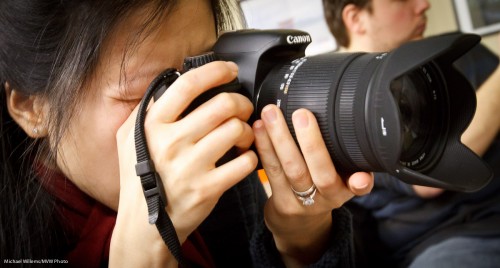
This photographer is doing what I do – she, like me, is left-eyed.

Did you know we are all left- or right eyed, and left- or right-eared, just like we are left- or right-handed?

For photographers this means we either have to close our left eye, if we use our right eye to look through the viewfinder, or we use our left eye in which case the right eye is behind the camera (and our nose is against the LCD screen).

It’s not a big deal, but it pays to realize what we are. Next time you pick up your camera and your phone, observe which eye (and ear) is dominant.


Tip of the day: Events

When shooting “camera-aware” pictures at events, here’s a tip:

Shoot every picture twice.

You should tell your subjects “we’ll do it twice”, and then do two shots.

Why?

  • People blink. But not twice.
  • You may get focus wrong in one shot – but not in both.
  • One or both subjects may relax after shot 1 – or stiffen.

Either way – there is a very good chance that one image will be markedly better than the other. And the better image is the only one you show.

That’s why you do this: it makes you a more successful photographer. Pros cannot fail!


Mano a mano!

I am often confronted by students who assume that automatic functions are easier to use than “manual”.

This is a misconception. You should only use auto functions after you have learned to do it manually! That way you know:

  • What the camera is doing (mystery is never good) and why.
  • What the alternatives are.
  • When the camera gets it wrong.
  • What you’re getting – manual is predictable.

So my advice:

  • Always choose your own focus spot.
  • Now try manual exposure – ISO, aperture and shutter speed – before you use aperture mode, shutter mode or program mode.
  • Once you have mastered these, try to use manual flash mode.
  • Manual focus (as opposed to focus spot selection) can be good in macro, video, and so on, so it’s worth practicing that too.

You will be amazed at how quickly you grasp the technical aspects of photography, once you start te be in charge of them!


Machine gun vs rifle

I watched Penn and Teller yesterday on TV. One item was on a machine gun versus a rifle – which is better when faced with five zombies?

Surprisingly perhaps,  the machine gun lost. 50 rounds killed only one zombie, while the rifle killed them all in 10 shots.

That is not surprising to photographers. “Spray and shoot” is often how new photographers start –  and it is as successful as the machine gun.

So try the following: Shoot less, Before you click:

  • Do you need this picture?
  • OK, then what is the background like?
  • And the (maybe off-centre) composition?
  • What is the subject meant to be?
  • How are you calling attention to that subject?
  • Have you simplified your picture? Really? Or can you do better?
  • Have you considered your viewpoint?
  • Have you considered what lens or zoom setting to use?
  • Have you focused accurately?
  • Is this indeed the right moment?

Only when you can say “yes” to all those, shoot. And be amazed at how much more rewarding your shoots become!


Battery Tip

Your batteries run out at:

  1. A convenient time
  2. An inconvenient time?

Of course, by definition ist is 2. So here’s three tips.

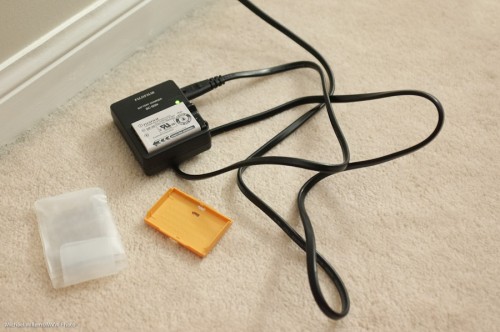
Camera batteries: always charge. Daily. Never leave home without fully charged batteries (main, and a backup). For your Litium Ion (LiIon) batteries, do not worry about discharging (though if you wish, you can fully discharge and recharge a few times a year).

Flash batteries: use rechargeable NiMH AA batteries. They refresh the flash more quickly between shots, and they are reusable. But they will lose charge, and occasionally need resetting. So: get a conditioning charger (Maha or Lacrosse – Google them). And they will run down by themselves, so before a shoot, top them up. Also – change batteries for every segment you shoot.

General: use equipment that has AA batteries (e.g. traditional pocketwizards) rather than funny (hard to find, expensive, small capacity) batteries. If funny batteries are inevitable, like in your light meter, then always carry a spare.