Cardinal Rules for studio light

So yesterday I taught my signature “Advanced Flash” workshop in Hamilton. And one of subjects was restricting and directing light.

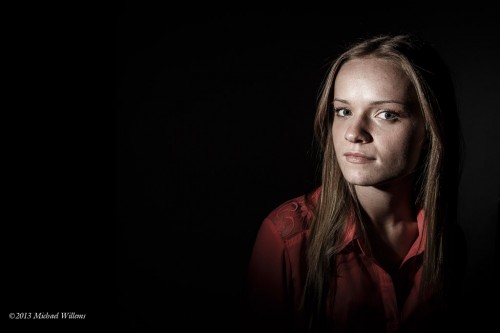
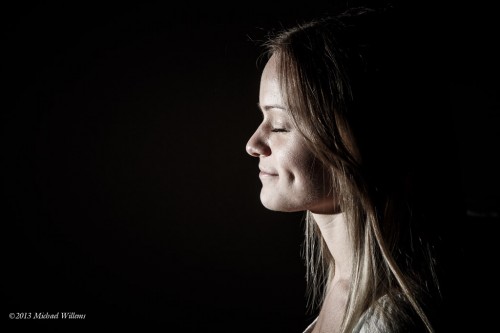
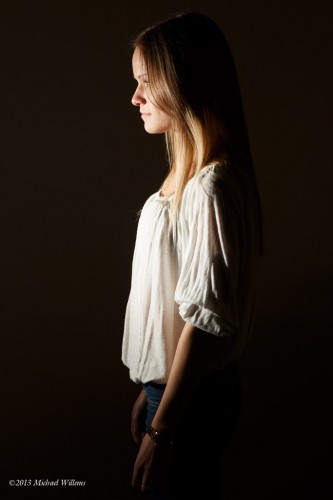
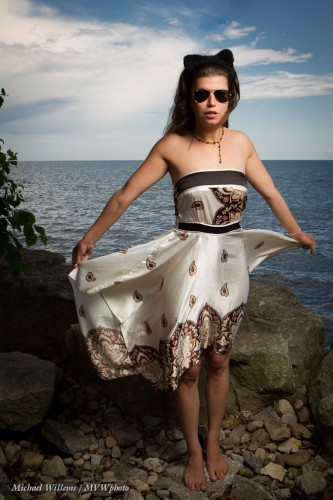
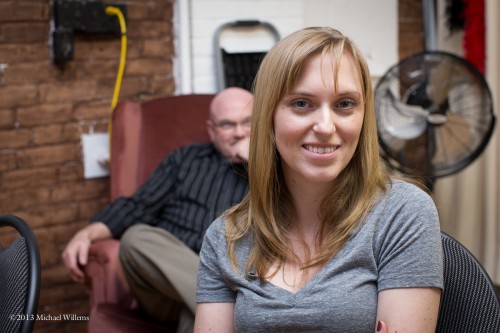
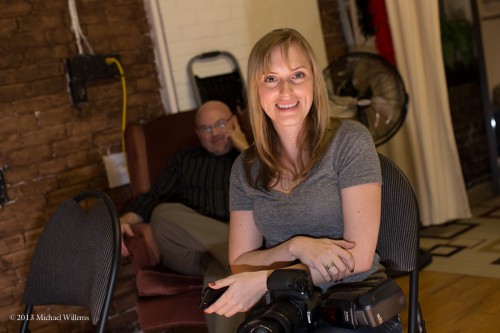
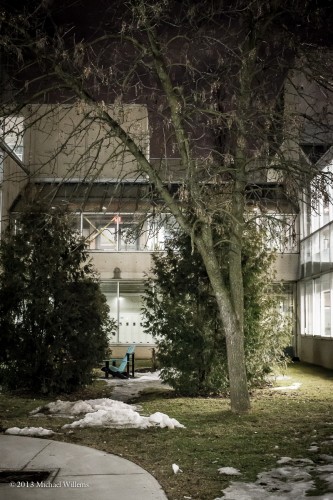
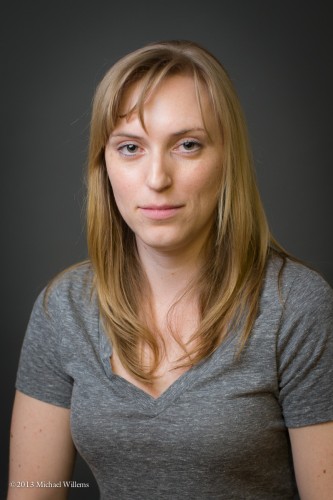
Look at these four images of Vanessa, our workshop model for the day, and consider me what you see happening here:
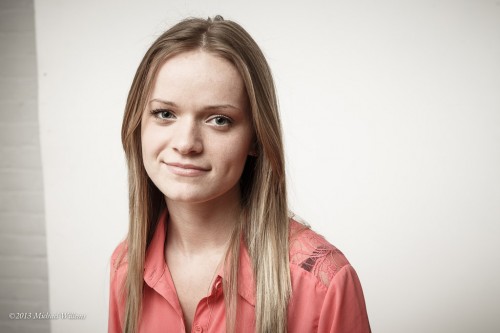
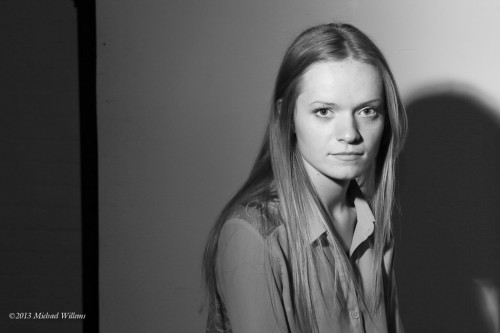
As you see, they are in increasing order of, as I like to call it, “specificity of the light”.

And can you see how they all show a different aspect of the model’s personality? And how they are all “storytelling pictures”?

Here’s the thing: all of these were taken with just one flash. Four very different types of light; one flash. And here were you, thinking “I can’t do what Michael does because I don’t have all the gadgets and gizmos he has, and I don’t have $30,000 to spare on equipment like he does”. Well – no longer true. You can keep it simple. Just keep in mind what I like to call my cardinal rules:

  1. Work out what the background should be like.
  2. Set your camera accordingly.
  3. Have the flash elsewhere than where your lens is.
  4. Always know what your flash reach is – “where is it shining”.
  5. And for effect, make it specific.

As for (1) and (2), I shoot at 1/125th second, f/8, 200 ISO. That gives me the dark ambient light I want.

As for (3), in the interest of speed, I used wireless TTL flash setup. But I could have used pocketwizards, of course, and I normally would have.

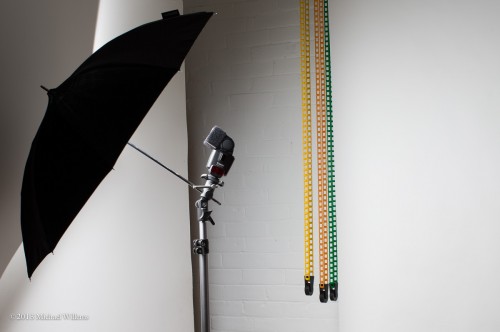
As for (4) and (5), except in the first image, which was bounced and hence not at all specific; and in the second image, where I used a Honl Photo 8″ softbox and which hence was only somewhat specific; I used a grid on the flash for the rest (my favourite flash accessory, a Honl Photo 1/4″ grid), in order to restrict where the light goes.

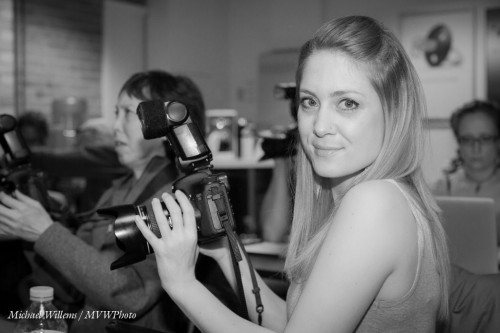
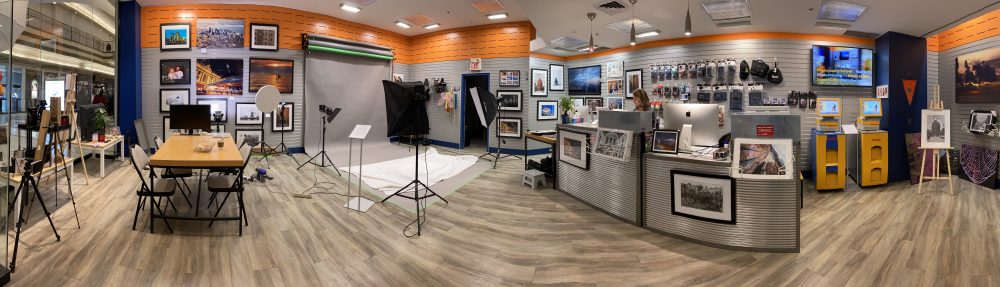
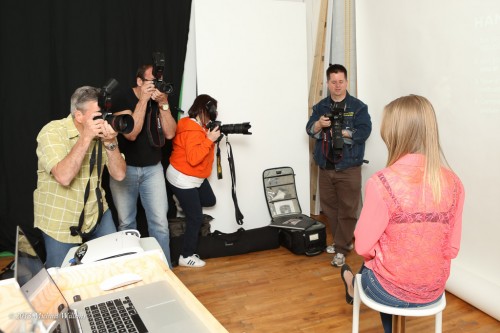
Here’s what the studio, and a few of the students, looked like:
Of course we can make it more complicated, and add the required “shampooey goodness(tm), but even that only neeeds a few flashes and a reflector:
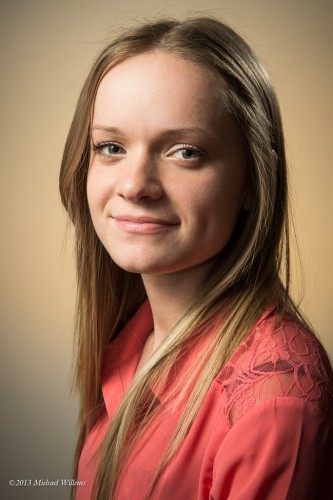
And then you get creative – two flashes, one with a grid, one with a blue gel. And then you can concentrate not just on your light, but on your positioning – as in this one, where my friend and great fashion photographer Baz Kanda did the positioning:
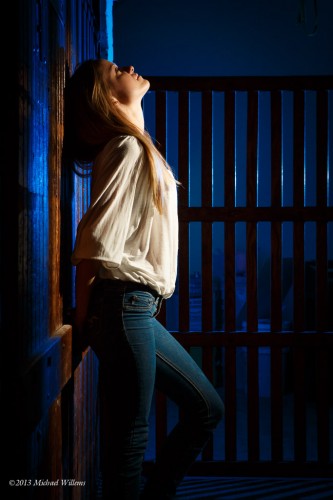
Even that is simple – just two small flashes with simple modifiers.

___

Learn the skills and become a great photographer with little equipment: it is very rewarding and you can do it. Many more courses coming up, so stay tuned on http://www.cameratraining.ca (click on “schedule”).
 

Light.

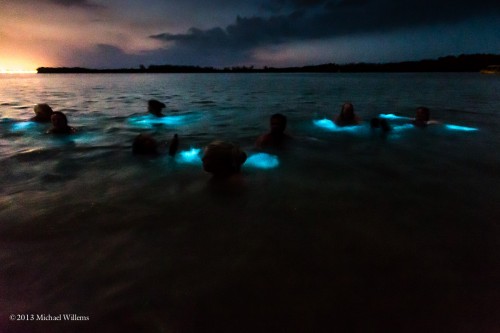
A phosphorescent dinoflagellate, you say?

Yes. A kind of microorganism that glows in the dark.  And it lives in salt water, but especially in Jamaica’s Luminous Lagoon. And it glows when agitated – like when there’s swimmers:

I was the only person to get any pictures. Why? Because it was dark. Very dark. Very, very dark.

So I had to shoot like this:

  • 16,000 ISO (!)
  • f/2.8 – f/4
  • 1/2 second shutter time, on a boat.
  • Manual focus – guessed because it was too dark to see even to focus manually.

Even then, I had to push the shot a little in post.

Longer shutter speeds and a tripod, you say? Not on a moving boat!

I could not see my focus scale, so I could not even look at the lens and manually set the sharpest point to, say, 3m. It was all guesswork – and guess what, it worked. Good gear (f/2.8, 16,000 ISO, yes, sixteen thousand) helped me a lot.


More fun

[EDITED 8 April]

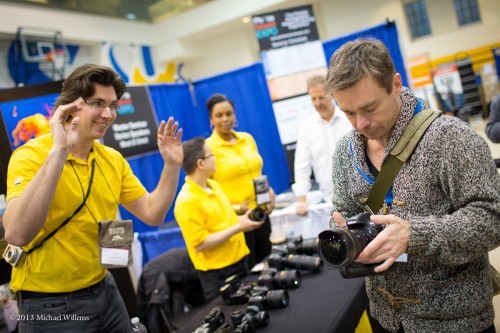
Today, I did a second one-hour flash course (a part two) at the Rick Bell-organized Niagara School of Imaging show at Toronto’s Maple Leaf Gardens – thanks to those of you who came out to see.

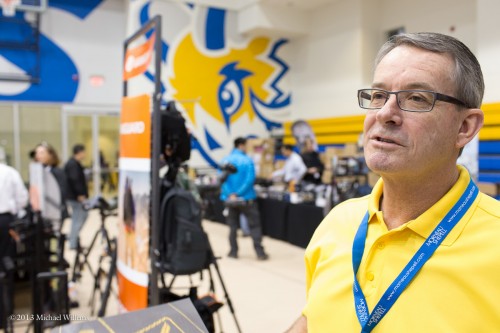
Here’s Rick:

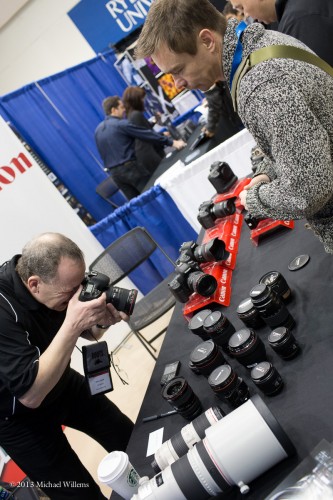
And of course today I had a little more time to talk to Canon, Nikon and the others who exhibited. A few observations, then!

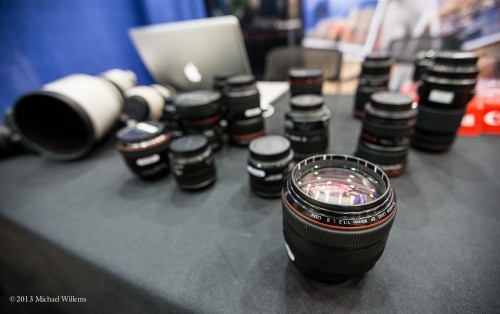
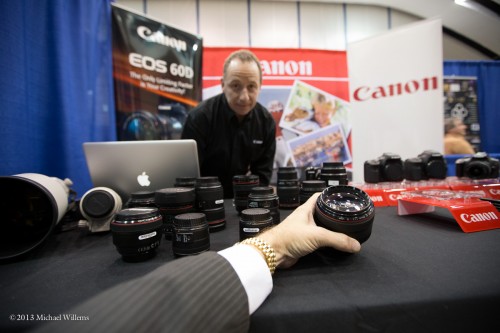
The 85mm f/1.2 Canon prime is the best lens I have ever used. It’s soooo sharp, and its focus ring moves soooo smoothly… a dream! Here it is:

(Ohh… that glass… and as for my image, don’t you love that 16mm look? My 16-35mm Canon is also sharp and quite consistent: I love that lens.)

When I pointed the great focus ring action out to the Canon person at the counter (not a junior staffer), and asked “why aren’t all your lenses like this?”, his reaction was: “you don’t like our equipment much, do you?”.

His reaction took me aback. Granted, it was perhaps partly caused by my having complained about the Canon service program (CPS) nowadays charging money for good pro service; and at the inconsistent focus I have with so many Canon lenses; and my musing about possibly switching to Nikon, but regardless, he continued to point out that he was a pro, a good one, and he had no problems, and that he has heard no other pros complain about Canon focus. It seemed to me that the implication was that I was at fault, that I did not know photography, i.e. that it was all my problem.

Now regardless of whether what I often experience is my problem or, as I strongly suspect, that of my lenses, his is a poor reaction to a customer complaint. Customers, when they engage with you to talk about your product or service, are doing you a very valuable service. It’s great to hear where customers, rightly or wrongly, perceive problems with your products. You don’t tell tem to go away, you ask for more depth, and either use the information to communicate more clearly, or to fix issues and improve your product.

[POSTSCRIPT: I can admit when I misjudged: Canon just called me and they are taking it seriously – the sales guy did escalate my issues, and a lady called and his making arrangements for investigation/repair and loaners. I shall keep you all in the loop!]

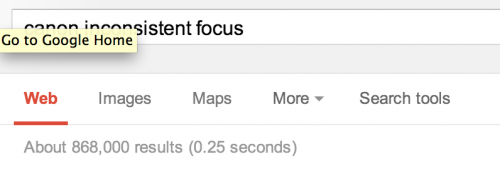
And in my case, I believe my concerns are valid. Search for “Canon Inconsistent Focus”:

Google shows 868,000 results. The same phrase with the word “Nikon” substituted yielded only 168,000 results.

[Again: since he did take it seriously and since the Canon lady did call, I imagine I misjudged and I finally got the attention I think I deserve as a great customer. Keeping you in the loop!]

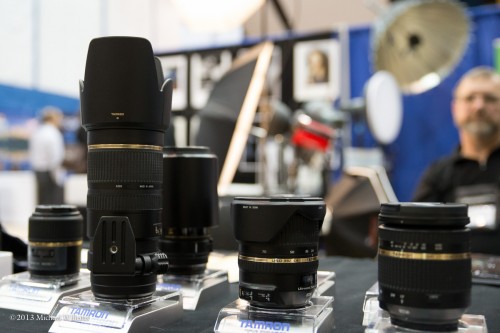
Anyway – off to Tamron next. I tried the Tamron 24-70 f/2.8 lens, and felt that it is almost as good as the Canon 24-70 f/2.8 mark II, and for $1,000 less. And it is stabilized! It is much better than at least my MkI version of the Canon lens. Anecdotal, but an easy to see and hands-on experience.

But the camera also showed Aperture “00” twice when I put this lens on my camera.  This is probably nothing to worry about – the “00” warning usually just means a bad contact – but it is still something to watch out for. I would not, for instance, buy one of these a week before my Jamaica wedding next week, just in case. But: recommended you check it out.

Enough gear talk for now. Back to my two new Bengal kittens. But first:

Beginners tip of the day: as you saw here the other day, remember that to do a flash picture outdoors, your shutter speed must stay below 1/250th second (1/200th on some cameras). First try the picture with the flash off. If the shutter speed is below or at that value, you can turn on the flash and shoot. Otherwise, don’t even try. Your camera will reduce the shutter speed to 1/200th-1/250th sec, and your picture will be overexposed. This will happen especially on sunny days when you want blurry backgrounds.


Fun day at the show

Today I talked at the Photo Network Expo show in Toronto (at the old Maple Leaf Gardens): “Conquering Flash”, a one hour crash flash course. Tomorrow, I am on again with the same subject at 3:30pm, so if you did not make it today, come tomorrow!

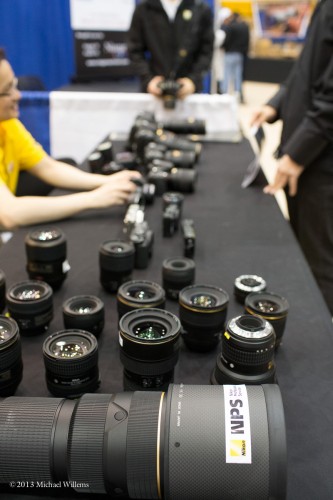
It was also a great opportunity for me to network and to play with gear, since gear is important. As you know I am considering adding, or switching to, a Nikon D4.

Service and support can be important too, and Nikon’s pro program is free for pros. The Nikon folks have been extremely helpful in my exploration of them and their equipment. Here’s Nikon’s Jim Eyre, who was instrumental in arranging to lend me the two D4 bodies and lenses and flash:

While the D4, like every camera, has a few drawbacks (the menu system is old; I cannot turn vertical shots a quarter turn so they fill the LCD display when reviewing “only on the camera”, etc), they are minor, and this camera is a true delight to work with. The “click” is just wonderful; it’s light; it holds very well – and ergonomics are important. It is very tunable, like all Nikon bodies; one feature I particularly like is that I can rename my own custom modes. I never use these modes on the Canon bodies, since I cannot rename them and hence, I forget what they are for.

The Nikon lenses have come a long way too: they are now, well, sweet. Progress is good, isn;t it?

Here’s Chris Ogonek, left, who like me used to teach at Henry’s School of Imaging, evidently in awe of his lenses, one of which, the super-sweet 14-24mm f/2.8, is being tried here by my tolivetolove.com colleague Kristof:

Canon, of course, has cool gear too. Here’s the 300mm f/2.8 IS in action:

And a few more:

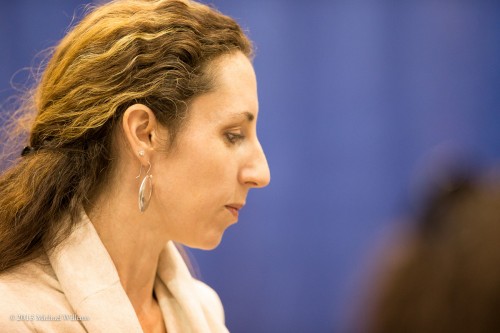
That’s 6400 ISO, f/2.8, with the 300mm f/2.8L IS II USM, and it’s like a studio shot – the lady’s hair, which I was aiming at, is great, with every strand sharp. (View at full size!)

The Fuji X100 is now the X100s: many improvements, but manual focus using superimposed squares (like a Leica) in particular is excellent. Damn, my X100 is outdated now. I liked the X100s as much as the superb Leicas, which were also on display.

My talk is about flash, of course. Including off-camera flash, like in this hand-held shot of myself I did in about ten seconds on stage:

More fun tomorrow: and for me, more networking and a report on what’s great.

For you, the same, and lots of speakers, including Storey Wilkins and David Williams; it is very much worth coming, even on a Sunday when perhaps you would rather sleep. Get up, come see the expo, an expo downtown for once, and learn from the great collection of NSI (Niagara School of Imaging) speakers!


Lenses matter

..a week before I go shoot a Jamaica wedding, here is a detail of a shot from my 24-70 f/2.8L lens (click, then view the full original size of this detail):

One of a series of many shots, all the same. And here is a shot from Kristof’s same lens (but the MkII), also one of a series, all the same:

Taken on the same 5D MkIII (and they show the same on my 1Dx). Good methodology (fast shutter, one central small (“spot”) focus point aimed consistently at a contrasty area, good light).

Now, can my lens be tuned, adjusted, calibrated, repaired? We shall see – time will not allow this I fear, so it may be a drive to the shop for me to buy a new lens.

This is the kind of thing pros do – that’s one reason you pay them.


Flash or fake flash?

You know that on many cameras, like the Canon 7D or the Nikon D90, you can use your camera’s pop-up flash to drive other flashes. Or you can use an on-camera “master/commander” flash to do the same:

A student asked me yesterday: “how do I turn the on-camera flash off, so it does not flash, and only the external flash fires?”

I told her how to set the on-camera flash to off. On Nikons, in the flash section of the pencil menu you set it to “-“; on Canons you select the option where only the external flash shows, so only it will fire.

“But it is still firing”, she mailed me back.

No. It is not. That is a misconception. Try this: turn off the external flash, then shoot. You see the flash, but the picture is all dark!

How come? What were you seeing?

You were just seeing the flash fire commands at any external flashes in the room, using “morse code”. I.e. you were seeing TTL preflash activity, not a “real” flash, fired when the shutter is open. This was just techie stuff, all before the mirror is raised and the shutter opens. After the shutter is open, nothing.

It helps to know these little techie facts, doesn’t it?

___

For more: http://photonetworkexpo.com/ : come see me talk this weekend in Toronto about Flash Photography, and even better: book online and use promo code Michael2013 to get 50% off a weekend pass. See you then!

The Outer Limits of Flash

When using flash, as you know, I very often use just one off-camera speedlight in an umbrella, like this:

But as you have read here before, there will often be limits to what you can do in practice. These limits and how we handle them are “what separates the men from the boys”. Usually, they are not coincidence: flash makers have made their flashes to be just the right power, for instance, to meet normal earth sunlight conditions. To help you, here are a few limits and solutions:

SHUTTER SPEED: You will run into limits w.r.t. shutter speed: when using flash, normally 1/200th to 1/250th sec will be the fastest shutter speed you can use. Solutions: be aware of this limit, and use low ISO/small aperture to control light.

POWER: Most of all, you will run into power limits. At 1/200th, in bright sunlight you will have to go to f/16-f/24 for a proper exposure, and this means the flash will have to be very powerful to equal or overpower the ambient light (we call this “nuking the sun”). Solutions: use no modifier but fire direct (a direct flash has much more power than a modified one!); or move the flash closer to the subject; or use multiple flashes.

LINE OF SIGHT: Outdoors, your off-camera flash must be able to see the “morse code” light pulses emitted from your on-camera flash. Make sure that the little round light sensor on the side of your flash (Nikon) or the red area on the front of your flash (Canon) can see your camera!

HEAT: Nikon flashes like the SB-800, SB-900, SB-910 and so on, and to a lesser extent Canon flashes, will overheat (and depending on model either break, or shut down, or slow down) when you use the flash repeatedly at full power or anything close to it. Solutions: fire the speedlights at lower power.

CONDITIONS: If the ceiling you are trying to bounce your flash off is 50 feet high, you will have to go to a very high ISO setting. Solutions: do use that high ISO, or use very fast prime lenses, or ask people to move to a better location.

FOCUS: In the dark, focusing your camera is very difficult. Solutions: use a flashlight, or a laser pointer; or focus manually.

TTL INCONSISTENCY: In fact, TTL systems like E-TTL or CLS work very consistently. Solutions, therefore: learn exactly how the TTL technology works; learn exposure and metering; adjust by using Flash Exposure Compensation; avoid reflections; use Flash Lock (FEL/FVL).

There are many more challenges, and the good news is that for each such challenge there is a set of solutions. Learn the tech, and then you will be able to concentrate on what really matters: composition, light, moment!

Enjoy Passover / Easter / the start of spring; and let me leave you with the Thursday News Roundup:

  • LEARN… Join me to learn studio shooting on April 10, and join me in many other courses: see www.cameratraining.ca/Schedule.html
  • WEDDINGS… Watch for news on The Wedding Café: Celebrity planner Jane Dayus-Hinch’s new initiative, which colleague Kristof and I are part of!
  • DESTINATIONS… I am off April 14-21 to shoot a wedding in Jamaica.
  • And finally GEAR: Nikon Canada is lending me a D4 and a few lenses and a flash for two weeks. I shall report on them in detail here.. excited!

If you have any time, then use this long weekend to learn and practice some new photography skills. I vote for “Flash”. Here’finally, a sample snap taken with one flash in an umbrella:

What is wrong here?

Look at this picture – a demo shot I made during a recent course, to show what not to do.

Can you see what is wrong here?

Yes, her eyes and face are all shadowy. Becuase I aimed my on-camera flash straight up. I see many people do this; it is seldom a great idea. Instead, of course, aim it behind you:

Note you need to have some kind of ceiling or wall behind you above that will reflect light. You may need to go to a higher ISO; in a large room, much higher, which is fine nowadays.

You can drive this “the umbrella is where you aim your flash” thing to extremes. Aim at the floor for eerie light – simply rotate your camera upside down, and you get:

Nice warm floor reflection!

Now, to see how fine modern cameras are with regard to ISO: a camera like my 1Dx goes to ridiculously high ISO values. 51,200 ISO with some noise reduction in Lightroom:

Yours will probably not be quite as good, but no problem if you want to go to a higher-than-usual ISO. Do it, and live with the grain – better than bad light or motion blur!

Rhonda

Here, from Friday’s workshop, is a photo of Rhonda:

Wonderful smile, truly! So that photo is good before we even start – how can you fail with a subject like that?

And yet, we have to get the focus and exposure right. Especially exposure is worth mentioning. hence this post.

Yesterday’s shots (scroll to yesterday to see them) had a pale-skinned subject in light clothing. Today, a darker-skinned person with dark clothing. So after the first person, do I need to, like, adjust anything?

If you are using manual flash settings (a typical studio shoot, with flash power set manually, perhaps using Pocketwizards): no. It’s set right, then it’s set right, never mind the subject.

If you are using TTL flash (automatic flash), then yes. You need to adjust flash exposure compensation – down. Down, somewhere between, say, -1 to -2 stops perhaps. Else the metering circuit will try to expose this shot just as light as the last one, and Rhonda will look light grey.

So remember: TTL (automatically metered) flash is convenient, but you have to know how it works and realize that depending on the subject, it potentially works differently each time you click.

Shampooey Goodness™

You have heard the term “hair light”? It’s the Shampooey Goodness™ look that makes hair look alive and wonderful. That is why we use it in portraits.

In yesterday’s flash course, I shot a few images of one of the wonderful students, especially to show you in today’s post. Here’s Becky lit with a single TTL flash (a 580EX shot through an umbrella) without the Shampooey Goodness™ secret ingredient added:

Pretty – but now let’s add a second flash, behind her, fitted with a Honl Photo Speed Snoot (a rolled up tube, that concentrates light). That gives us the desired Shampooey Goodness™, and now, in this scientifically objective and neutral comparison, we get:

See what I mean? That’s why we so often in portraits like to add a “hair light”.

Of course there’s something else missing from this image. Can you see what?

Yes – that background is a little dull. So we add a third flash, fitted with a blue-green gel:

Bingo. A great subject, soft light, Shampooey Goodness™, and a lit background. That’s how you do a portrait. Three TTL flashes with simple, small modifiers.

___

NEW: Learn this from me personally in Hamilton, Ontario on April 10 or May 14: www.cameratraining.ca/Studio-Ham.htmlsee the full schedule on www.cameratraining.ca/Schedule.html and sign up today.