TOTD

Tip of the day:

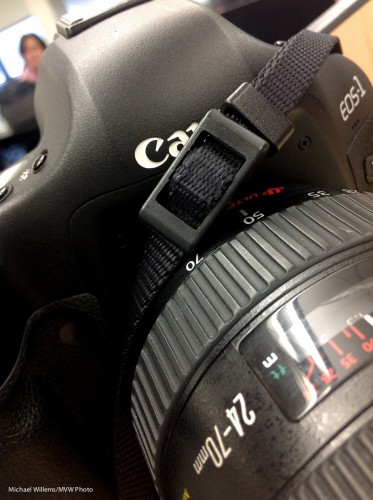
In spite of what I say about usually leaving your camera on all the time and just waking it up with a light touch on the shutter button… you should consider turning it off when:

  • taking off a lens
  • taking out a memory card
  • taking out the battery
  • putting the camera in a bag
  • putting it away for a long time (and if a really long time, remove and regularly recharge the battery).

Turning it off and on also forces a sensor clean on many cameras – an extra bonus.


Wide.. wider!

Wide angles, you have heard me say it before, rock.

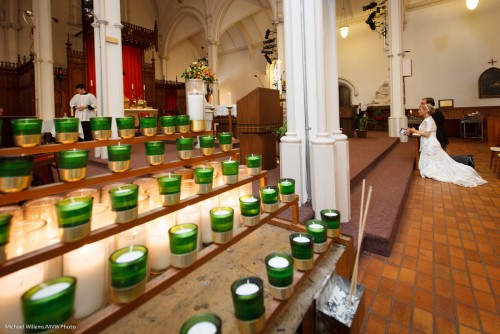
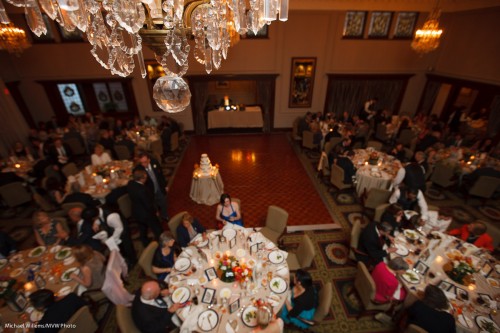
I mean 16mm focal length on a full frame camera, or 10mm on a crop camera. Take these sample shots from a wedding I shot yesterday:

All those, you will agree, are somewhat unconventional – my style. But you will also, I hope, agree that wide angles are fun – they introduce extreme perspective; depth; diagonals; and interest.

You will also, I hope, notice off-centre composition (the “rule of thirds”) and a good mix between flash light and ambient light; also a good mix between sharp and blurred elements in each image.

My advice: try to go wide for intetest: see what it does for you.


Focus: Help is Nigh

When you cannot focus, you cannot take a picture.

And to focus, you need

  1. A subject (lines/contrast)
  2. Enough distance (depending on your lens(
  3. Enough Light

There is often insufficient light. And that can make focusing very difficult.

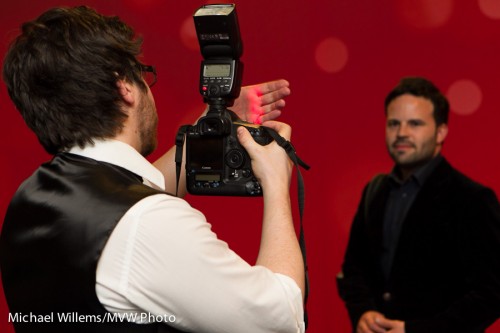
One thing that can help is your flash. Look at the photographer here, a colleague at a recent shoot:

As you can see on his hand, the flash is emitting some red lines. Those red lines are thre “focus assist” lines. The flash emits these when there is insufficient light. You can even use this function when flash firing is disabled: the flash can be useful in more ways than you thought!


Technical differences

Photographers are often confused by their camera’s behaviour, and this is not surprising since cameras are designed by engineers (I am an engineer, so I can criticize them).

Like how your allowed shutter speeds differ between brands.

When you select a certain exposure mode, the camera may restrict the shutter speed to keep it above a minumum. Here’s how Cannon and Nikon do that differently:
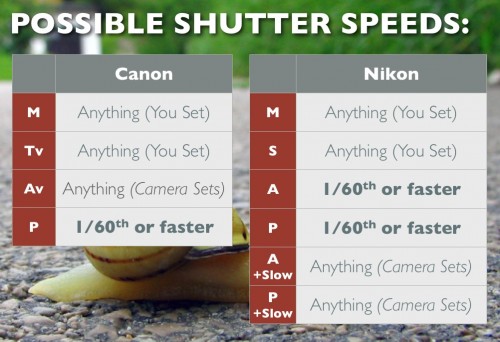
Canon has decided that in Av mode, any shutter speed will be allowed to make the background bright – even a second or more. Nikon has decided that in both program and aperture mode, there is a restriction to “above 1/60th second) (which you can alter on some cameras), unless you enable “slow flash” (which means “lift that restriction”).

These, remember, are just engineering differences. Nothing fundamental. But when you are shooting with a camera, you’d better know its behaviour.

And from the above, it is clear that flash pictures in dark environment should be taken in one mode: manual. Otherwise you will get dark backgrounds or blurred pictures.


Portrait reminder

You can use any lens for portrats: from super wide to super long.

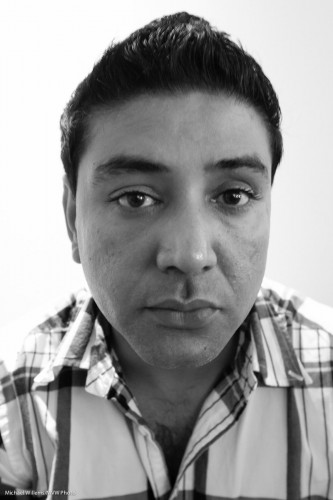
But when you are making a headshot, as opposed to an environmental porytrat, the face is large. And in that case you do not want to use a wide lens, like a 24mm lens, or this will happen:

The face is distorted; the nose is too large.

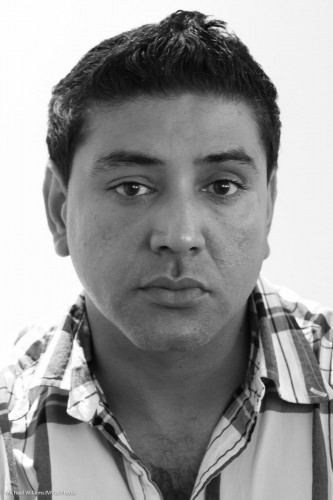
Instead, using a long lens, like a 70-200mm lens – or at least 50mm or more on a crop camera – is more flattering:

The wide-angle lens is good for environmental shots:

Rule of thumb: if the person/face is large in your pic, go long; if the person/face is small, you can go wide.


DOF and small sensors

You know how small-sensor compact cameras do not allow narrow depth of field (DOF)? That is why you have a DSLR! On a small camera, everything is in focus and you cannot blur backgrounds.

Yes… but!

The “but” is that small cameras also allow very close images to be taken. And as you know, proximity means shallow DOF.

So that is how I can take a picture like this one yesterday with my new iPad (and as sensors go, they don’t come much smaller):

Look at the top left corner: is that blurry, or what?

So when we say that a small sensor does not allow shallow DOF, we mean “from the same vantage point”. That much is true. But if you can get close, you can still get very shallow DOF.


What’s in YOUR bag?

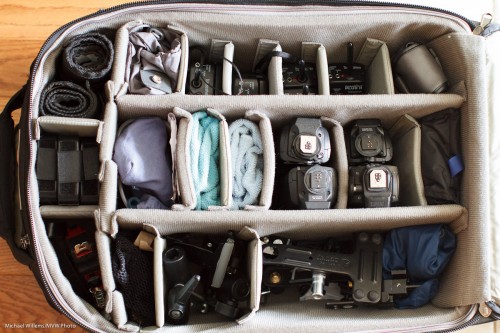
My flash/lighting bag as it is today:

It contains, from top left:

  • Two rolls of Honl Photo gels
  • Flashzebra Cables to connect Pocketwizards to speedlights
  • Six pocketwizards
  • Light meter (and spare battery)
  • Three Honl Photo grids (2×1/4″ and 1×1/8″)
  • Cables and a Fong thing
  • Speedlite feet and a microfibre cloth
  • Trays for Pocketwizards, and a microfibre cloth
  • Four speedlights
  • Rain pouch
  • Knife, tape, tape measure
  • Three Ball heads
  • Flash/umbrella attachments for light stands
  • Grips, cables, “thingies”.

In addition to this I carry another speedlight, more Honl modifiers including the large and small Traveller softbox, a tripod, a bag of light stands and umbrellas, and up to four large lights (Bowens) with a softbox.

Pretty large kit but then, I need to light some pretty unexpected situations, and with this kit I know I can.


Light.. action!

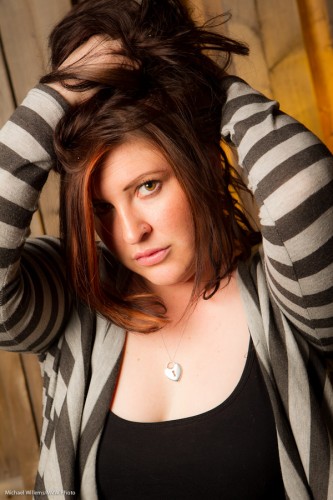
I shot a few shots of Kelly, the hair stylist for a shoot the other night.

Here she is:

Nice. So how did I light that?

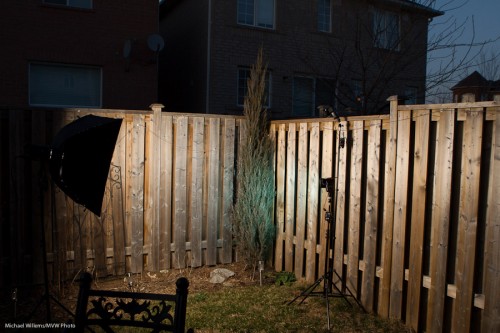
Here’s how.

I used my 1D Mk4 camera in manual mode, equipped with a Pocketwizard to drive the following flashes:

  • A 400 Ws Bowens light with a Bowens softbox. Powered by a battery (the Travel Kit); driven by a Pocketwizard.
  • A 430EX flash with a Honl Photo 1/4″ grid and a Honl Photo gel (green in the pullback shot above; egg yolk yellow in the real shot) to light up the background. This was also fired by a Pocketwizard, connected via a Flashzebra cable.

The other flash was a spare and I did not use it. I set y exposure for a dark background, then metered the flashes with a light meter. I used the speedlight to light up the background to provide hair separation, since I could not get it in the back aiming forward to light the hair, which I would otherwise have done.

A fairly simple setup for a nice shot, no?