Ways to get news

I just bought “Early Edition” on my iPad, and that prompts me to write a short post. Early Edition is an RSS News aggregator. In English, that means that you can read the news from all sorts of web sites that make news feeds available, all in one convenient newspaper-like format.

And that prompts me to tell you that is one of the three ways you can get news from this daily teaching blog:

  1. Read the blog, come back every day!
  2. Sign up for emails (click the “Email Subscription” link in the right column)
  3. Read the RSS feed on http://blog.michaelwillems.ca/feed/ using an RSS News reader.

Whichever you find more convenient.

I know your life is busy and while you are passionate about photography, simply remembering to check is a drag. That is why methods 2 and 3 make a lot of sense.

And if you choose method 3 and are lucky enough to own an iPad (you know you need one!), then add “Early Edition” for a really cool experience.

It's too bright outside. Quick! Hand me a flash!

We do not use flash “because it is too dark” – at least not just.  We very often use flash because it is too bright outside.

By using a bright flash, we can:

  1. Decrease the exposure of the background, thus making it less bright
  2. Then use the flash to increase the exposure of the foreground, to avoid darkening it as a result of step 1 (becasue this would otherwise happen).

Step 1 also

  • Increases the colour saturation.
  • Allows you to make your subject stand out against the background.

Step 2 also allows you:

  • To accent parts of your shot,
  • To “model” shapes,
  • To throw light where you want it.

At yesterday’s all day Country Creative Lighting Workshop in Mono, Joseph Marranca and I used technique to do exactly that. So you turn a simple snap into this, instead:

A female runner

Female runner on a country road

For this, we used technique. Technique that included (apart from a talented model):

  • The use of two speedlites, set to manual, fired by Pocketwizards
  • A Honl Photo Traveller 8 portable softbox on one
  • Manual camera exposure settings

Two simple off-camera speedlites can create a shot like that? Yes they can. 430 EX speedlites can overpower the sun? Yes they can. Try it!

Autofocus and how it works: the modes

A regular reader asks (and I take questions, you know that, right)?:

Can you possibly do a short blog entry on the focusing modes offered by Canon? You know the ONE SHOT – AI SERVO – AI FOCUS buttons?

Certainly!

These “focus modes” are not about where the camera focuses (the focus point selection is about that: select one point for accurate control). Instead, these modes are about how the camera focuses. There are two main modes and an in-between hybrid mode:

  1. One shot (Nikon calls this “AF-S”)
  2. AI Servo (Nikon calls this “AF-C”)
  3. AI Focus, where the camera tries to guess which of the above two you want.

“One Shot”/AF-S means: when you press the button, the selected focus point tries to achieve focus. Once it does, a few things happen, all at the same time:

  1. The camera beeps
  2. A green dot lights up steadily
  3. The focus locks, and until you remove your finger, it stays locked at the selected focus distance.

This One Shot/AF-S mode works well in most cases. But what if the subject you are shooting is moving rapidly towards you, or away from you? Then every picture will be blurred, because by the time you press, the object is no longer where you locked the focus.

So for those situations you have AI Servo/AF-C (AI Servo means “Artificial Intelligence Servo motor control”, while AF-C means “Autofocus -continuous”). The focus never locks, and the camera keeps buzzing away as the focus motor keeps turning and adjusting. Better, it even predicts where the object will be when the shutter opens (that is the “artificial intelligence” part). So you can try to use this mode when shooting “sports, birds, and kids”.  Not every shot will work out, but at least some will.

Finally, the hybrid mode (AI Focus) tries to guess which one of the two modes above you really want, and then switches to that. I am not a great fan, and expensive cameras like my 1-series models do not have this mode. I think you should probably decide whether you are shooting mainly stationary subjects (then choose One Shot), or moving objects (then select AI Servo).

Why set White Balance when you shoot RAW?

When you shoot RAW (as you probably should if your pictures are important t0 you) then your in-camera image processing settings are not important. Setting like colour space (AdobeRGB or sRGB), sharpening, noise reduction, colour saturation, saturation, white balance, and more.

They are not applied, just attached to the sensor information as “suggestions”. You can always set, or change, them later in Lightroom, Photoshop, or whatever you use.

So why set Light Balance in the camera anyway? It is time-consuming, and if those settings are not permanent, why bother?

First, if you shoot RAW, you should turn off all image settings that make the preview look very different from the RAW image. Set your camera to “normal” picture style and disable auto lighting optimization, lens correction, extra contrast, and so on. I have written about that before on this blog.

Then, white balance. Why you might want to set it:

  1. Your images will look more like the finished product. You will get a better idea of “what you are getting”
  2. You know whether to correct anything.
  3. They will also look better, so you will feel better about your skills
  4. Most software will take the White Balance setting at least as a suggestion, so you can start off in Lightroom, say, with colours already almost right.

    Against this: it takes time. So what I DO IS THIS:

    • Not worry about it
    • If shooting in a studio, and I have time, I set it to Flash
    • If shooting a sunset, or late day light, or snow on a sunny day, and I have time, I set to daylight
    • If shooting in Tungsten light, and I have time, I set to Tungsten
    • But when in a hurry and at all other times than those above, set it to auto.

    That’s simple, no?

    Filter or hood? Which one trumps?

    A reader emailed me this question:

    First of all, I really enjoyed your Travel and Photo Journalism presentation on Saturday, thank you for some great information. Also the Flash Presentation was very informative.
    I use a Canon XSI with a Sigma 18-200mm as a walk-about lens. The lens has a good lens hood, however I also have a circular polarizing UV filter on the lens and , with the lens hood on, I have difficulty adjusting the filter.  I typically don’t use a tripod so I run out of hands and fingers at the wrong time! Because of this complication I don’t use the Hood most of the time, any suggestions as to the benefits of the hood vs. the filter if I can only use one.

    Good question, and one that may be useful for others too.

    I still advise using both… I have a 70-200 and with the hood it’s quite tricky to adjust the polarizer: but I still do it quite often.

    So I would say:

    • Lens hood: always. For stray light as well as for damage protection.
    • Polarizer when you need it (when the skies are blue, etc, or you want to reduce reflections, or you need to cut light).
    • Both when you can, and especially when you are shooting against strong light

    I feel the reader’s pain… it’s one of those things where we wish it was different – but it isn’t… 🙂

    Favourite lenses: the 35mm prime

    The 35mm prime is my favourite “event” lens. On a full frame camera it makes images like this, right out of the camera (shot at a corporate event the other day):

    An image made with the 35mm f/1.4 lens on a full frame camera

    35mm f/1.4 lens on a full frame camera

    In other words, this is a great lens for portraits at events, of one or two people. The ideal length (on a crop camera you would want a 24 mm lens, which would give you the same angle).

    I was originally reluctant to use this. Surely a zoom lens is better. Yes?

    Actually, no. The prime lens, although it necessitates walking back and forth a bit, is great, because:

    • It is relatively light and small
    • It is very sharp
    • It is fast – f/1.4. Meaning it goes to a low “F” number, which means that you can go to that low F-number in low light; it also means that when you shoot at even a slightly higher F-number,like 2.0 or even 2.8, it is very sharp indeed.
    • It enforces the right discipline: many images are just right because I move the right way.

    We overestimate the need for zooms. When shooting an event that involves pictures like the one above, this prime lens gives me excellent, repeatable, consistent, and professional results. What more can you want?

    Oh, and one more note: a quick start guide for events:

    • Use an external flash.
    • Aim that flash behind you, as I have pointed out many time here.
    • Set your camera to manual mode: start at f/4, 1/30th, at 400 ISO.

    But you can’t shoot at low aperture numbers.

    Right?

    Wrong. The above picture was shot at f/1.6. I used that aperture and 400 ISO at 1/60th second, because I wanted optimal image quality, and yes, you can shoot at low “F” numbers with a wide angle lens without running into depth of field issues.

    So: go for it. And above all: have fun. Your pictures are guaranteed to be better than Uncle Fred’s.

    What should I buy next?

    As you know, I invite reader questions on this teaching blog, and I try to answer them on the blog.

    A member of last weekend’s audience at the Photo Show wrote me some very kind words about how he enjoyed my seminars. He then added:

    I am just entering the world of photography as a hobby and just have a quick question.  So far, my equipment consists of the Canon T1i with the kit lens.  I have also purchased an accessory kit for the camera that contained a bag, UV Haze filter, and a spare battery.  I was wondering what you would recommend as my next move.  I am interested in the 50mm 1.8 lens and plan on picking it up this week, but where should I go from there?  A polarizing filter?  An external flash? An additional lens?  Any input/advice you could provide would be greatly appreciated.

    Interesting question – and a good one. As beginners in photography, there seems to us to be an infinite array of “must have” goodies, and it is important to decide where to spend our dollars.

    So here’s my take on this. First of all, I think the choice is right:the Digital Rebel (any variety” XTI, XS, XSi, T1i, or T2i) is a great camera.

    Canon T2i Digital SLR

    Canon T2i Digital SLR

    Not that there are bad cameras:today’s cameras are all great. While the Pros virtually all use Canon or Nikon, the offerings by Sony, Olympus, and Pentax are also great. It’s whatever you like best – how does it feel, how do the menus look to you: any small SLR will do exactly what a large expensive one does, so it is whatever you like.

    So you have chosen a camera. And you have bought a spare battery (a must!) and hopefully also a few extra memory cards (I like 4GB cards: that size “fits on a DVD”).

    More important than the camera is a lens. By all means start with the kit lens, but add the 50mm f/1.8 lens as soon as you can. (On Nikon starter cameras you need to manually focus that lens; on some others, there is no cheap 50mm lens availanel. This is one reason I like Canon). On a small DSLR, the 50mm f.1.8 lens works like an 80mm lens (50 x 1.6; a small sensor appears to magnify the lens length), and 80mm is perfect for portraits. And the large aperture (f/1.8, a low “f-number”) enables you to dramatically blur backgrounds and achieve very selective focus (“narrow depth of field”). Use this lens to take available light portraits and everyone will love their professional quality.

    So what’s next? Here is my list.

    1. A flash. I would go for a 430EX II flash. You can read all about flash on this blog – and why you never aim it straight at the subject from on top of the camera (which is the worst possible place to mount a flash). Bounce the flash and you’re good with great light.
    2. A wide angle lens. A lens in the range of 10-20mm would be fabulous. Search this blog for “Wide Angle” to see why, and to see what these lenses can do.
    3. Then a long lens (say in the 70-200mm range), especially if you shoot things like sports, wildlife, or if you do a lot of studio portraits or other photos that need “zooming in”.

    Then, and in no particular order, I would think of adding utilities, such as:

    1. A sturdy tripod
    2. A good camera bag (or “photography bag”: my camera does not go in a bag!)
    3. Lens hoods for each lens
    4. A circular polarizer filter
    5. A Hoodman Hood Loupe
    6. Perhaps some flash modifiers, like Honl bounce cards.

    And from that point on, “it depends”. On what you like – and by then you will have a good idea.

    The list goes on, but the good news: in the past, we used to spend $20 every time we used our camera. Today, that is gone: no more film or developing, So take that same money and use it for stuff that lasts, instead. In the end, you still spend less, and you end up with great equipment.

    And keep in mind that lenses last forever: a good lens (with a low “F”-number”, i.e. a “fast lens”) will keep its value for decades. The same applies to flashes.

    And above all – take some training. Even with one camera and lens, once you know how it works, you can do miracles!
    Soon: review of the Honl Softbox

    I have been using the Honl Photo Traveler 8 softbox, and will post a review soon: in the next week, if I can.

    Here’s the softbox, packed in its optional traveling case:

    Honl Photo Traveler 8 softbox

    Honl Photo Traveler 8 softbox

    And here, unpacked, assembled, and attached to a speedlite:

    Honl Photo Traveler 8 softbox

    As always, the convenience and sturdiness is what sets these Honl products apart. We can all do things in a thousand ways, but:

    • When your customer (or worse, your customer’s personal assistant or PR person) is tapping their fingers and getting visibly impatient and you know you have an hour to go to even set up your shoot, every second counts.
    • When you have to personally carry everything you use, every gram counts.
    • When it has to fit into bags, every fraction of an inch counts.
    • When you shoot for a living and hence throw things about, every bit of sturdiness counts.
    • And when you are far from home, every bit of reliability counts.

    I think that is why I like these Honl products so much: it is obvious that Dave Honl lives in the same world as I do. And I suspect, the same world many of you live in. And no, Dave is not paying me for this; and yes, I plan to do more workshop together with him like the one I did in Phoenix in March: stay tuned.

    But first, a review, soon, of the softbox, and some tips for its use.

    Wide angles, and why?

    I like wide angle lenses, as this shot, taken the other night at an event I was shooting, shows:

    A wide angle shot

    A wide angle shot

    I used a bounced flash and set the camera to manual mode and opened up the aperture, slowed down the shutter, and increased ISO enough to allow the available light to d some work as well.

    And wide angle means:

    1. I can focus easily on “everything”
    2. I can use a slow shutter speed without blur
    3. I can get close to someone or something, zoom out, and thus introduce depth.

    And that is what I did there.

    What's in YOUR bag?

    What do I carry in my photo bag? I am often asked this question. I was asked it again a few times at the Henry’s Photography and Digital Imaging Show this past weekend, where by the way I spoke to, and with, thousands of people, and loved every minute.

    (By the way, if you visited the show and have questions, do feel free to email them to me and I shall answer them on the blog – and sign up for email).

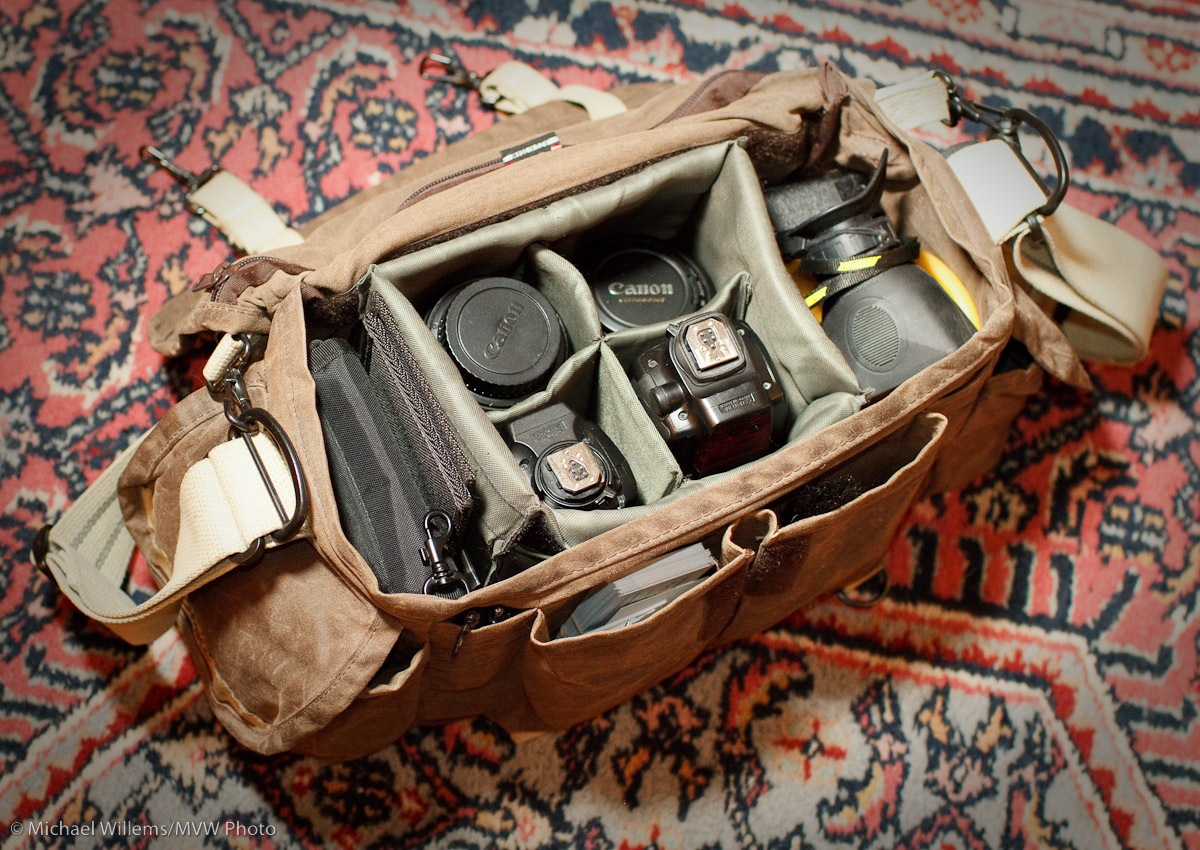
    So my bag looks like this:

    A photojournalist's camera bag and contents

    Camera bag and contents

    What does it not contain? A camera. This is on my shoulder, for fast convenient access. Always, even when I am travelling. I do not put the camera in a bag.

    What this Domke bag does contain is:

    • Two spare lenses, at least one of them a fast prime like the 35mm f/1.4 or the 50mm f/1.4
    • Lens hoods, one for each lens
    • A 580EX II flash
    • A 430EX II flash
    • Flash Modifiers: A Honl grid and a set of Honl bounce cards and a Honl gel set in a roll container, as well as a Gary Fong lightsphere
    • A Hoodman Hood Loupe
    • A container full of memory cards
    • A small grey card
    • Wallet
    • Note pad
    • Spare batteries for cameras and flashes
    • Business cards
    • A small brush
    • Pens
    • Pills (headache, throat)
    • Plastic bags
    • Shower caps, elastic bands, etc

    You can never be too prepared. Be like NASA (“do I really need each gram of this weight?”), but once you decide you need it: bring it!