Al's Not Home

Canon cameras have several ways of deciding where to focus (these have to do with the focus spots), and two ways of deciding how to focus.

You call the latter “focus modes”, and there are two: “One Shot” and “AI Servo”.

  • One Shot means that the focus locks (you hear a beep and as long as you keep your finger on the shutter, that distance remains locked.
  • “AI” is A I, as in “Artificial Intelligence”, not “Al” as in “Alan”; and a servo motor is a closely controllled motor with feedback loop. So that mode just means “continuous focus”.

One Shot is for static subjects. AI Servo is for moving subjects,like these:

I shot that yesterday, for the local newspaper. So since the young lady would not stand still, I had set my camera to AI Servo mode.

Another 7D review

Scott Bourne also reviewed the 7D: here [link]

So it is noisy but otherwise good. I agree, but the noise is not a big issue unless you shoot high ISO. And the Lightroom RC makes it a bit better.

My few-words review (see 7D tag for more):

Plus:

  • Great new focus system!
  • Great video ability (1080p, 24/25/30fps) and quality.
  • Ability to assign many custom buttons.
  • Nice to drive flashes from pup-up.
  • Better WB than prior Canons.
  • Great screen at the back.
  • Strong; withstands 3ft drop onto hard concrete.

Minus:

  • Noise (but by downsizing to fewer Mpixels you reduce this)
  • Deliberately dumbed-down menus for marketing purposes (eg no ISO range setting, no “save/retrieve basic settings”)
  • Still hangs up every now and then (needs battery removed, even off does not work)
  • Slow autofocus in video/live view modes

Noise should not be overestimated as an issue. See this earlier post for a sample at 3200 ISO:

http://blog.michaelwillems.ca/2009/10/29/3200-on-a-7d/

Note – the new RC of Lightroom, with 7D support, does not reducethe noice.

Overall, a very good addition to my 1D MkIII/1Ds MkIII family.

Event shoot

The other day I shot an event. So that meant dark light, high walls, hard to bounce.

“Crisp” means “bright pixels”, so you will sacrifice some crispness when it is dark.

Still – I never point my flash at subjects when it is the main light. So instead, I bounce. I use the wall or ceiling – but when that is too far (and at 800 ISO “too far” is quite far!), I use a Honl bounce card, or a Fong lightsphere, or I just bounce off my hand:

MVWS0730

Um yeah, the theme was “70’s”.

  • I was using a 1Ds MkIII and a 16-35mm f/2.8L lens.
  • I did not want too much noise so I stayed at 800 ISO.
  • I used 1/30th second, f/2.8
  • A wide angle lens means that even at f/2.8, I get nice depth of field.
  • And the slow exposure means I get some nice background light.
  • Flash pointed behind me to the right, and bouncing (I saw a wall not too far).

Everyone else got dark backgrounds; I get this. A fast lens (f/2.8) is quite essential.


A Better Battery Charger

When you use AA or AAA batteries, like those in your flash, use rechargeables. But they lose 10% of their charge on day 1 and 2% each subsequent day. Worse, your batteries are NiMH so they have a “memory effect”.

The solution:

  • Only use conditioning chargers, like the Lacrosse. They discharge your NiMH batteries before recharging. Worth every penny.
  • Use low-discharge batteries, like the Eneloop batteries. They keep their charge.

Problem solved!

I have three of these Lacrosse chargers.

New strobes

I have bought a few new strobes: 400 Ws Bowens “Gemini” strobes.

They come with two light stands and silver/white reflective/shoot through umbrellas, which is good. And these strobes work wonderfully.

These replace my older strobes, most of which died. That brand shall remain nameless while the maker has a chance to get back to me: I emailed twice and await a response. Fully 75% of the eight lights from that brand that I have owned died or started acting strange (like flashing by themselves, or refusing to flash at lower power settings). We’ll see if there is any response – only fair to give them that chance before I comment further.

Bowens, meanwhile, are good.

Stop!

Stop down if you want even brightness across your image.

Or, on the other hand, open your lens to the wides stop if you want vignetting – often, for instance in portraits, it is an advantage.

Here is my ceiling, shot with my Canon 7D, with the 35mm lens fully open at f/1.4:

IMG_2218

And the same shot at f/2.0, just one stop from fully open:

IMG_2219

Can you see how the first one is vignetted, meaning it is darker along the edges? Save both images and flip rapidly between them, if it is not obvious to you here. You’ll see the difference, I promise.

(Yes, and this is on a crop camera. Let’s debunk the myth that this only happens on full-frame cameras.)

So: want vignetting? Then open your aperture all the way. Or want even brightness? Stop down by one or two stops.

Try not to drop

Your camera plus lens ($2,000 each) on a hard concrete floor. The long strap pulled it down.

Lens dent:

IMG_2716

Top left, see? That hard steel rim is now dented.

The lens seems ok… but is it really still perfectly adjusted?

Of course I had the hood on. Always use hoods! The hood scratched and came off, but it did no doubt soften the blow. A bit.

Ouch

Mmm. I dropped my 7D onto a concrete floor today at the Royal Agricultural Winter Fair I was doing portraits at. It bounced and was dead for a minute until it restarted – kudos to the 7D.

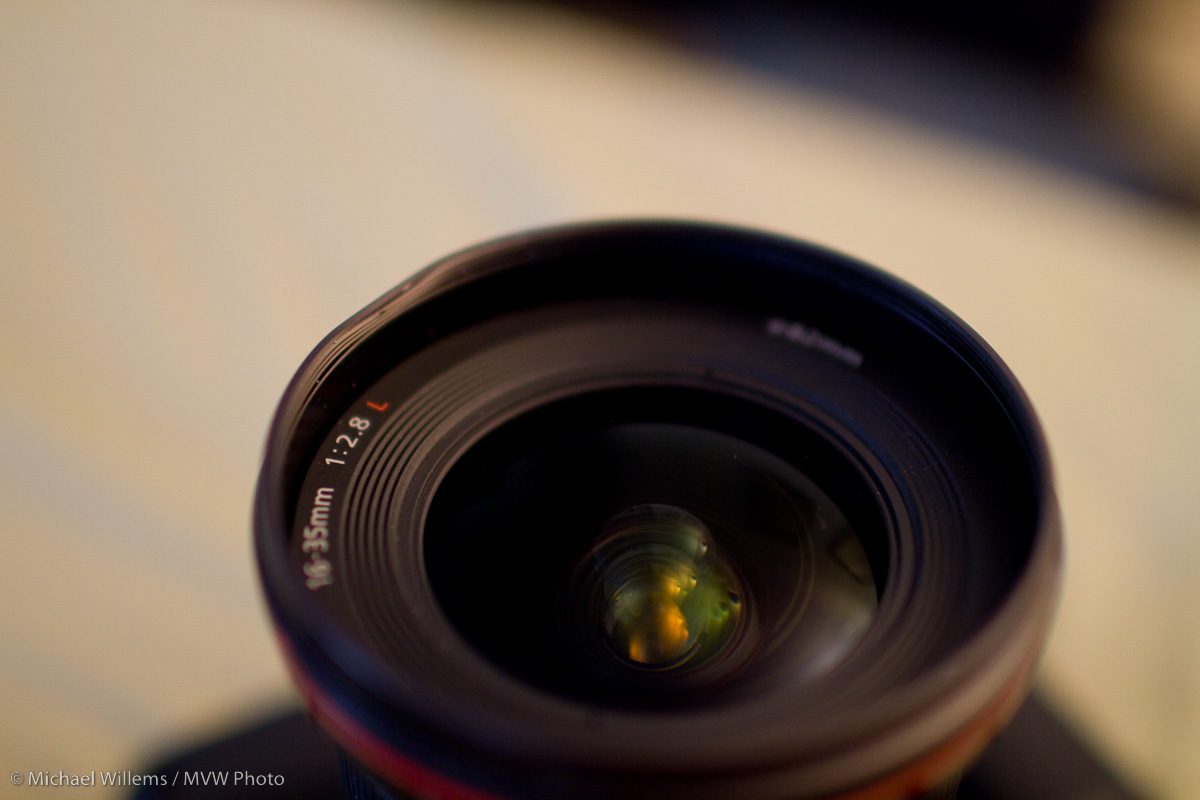
The 16-35 2.8L lens is dented. It all seems all right – but with a seriously banged about camera and a living that depends on it, this is basically $4,000 I can no longer trust. More than I make all month this month- this is definitely NOT my day. Yes, I can drive it all to Canon for a two-week CPS checkup. Problem is, first free day is in December. And I need the lens until that time, constantly.

Goes to show why we al have redundant equipment. Never rely on one piece of gear!

Question of the Day

Reader Len recently asked:

A while back you said “one major reason I bought a 7D: I can now, just like the Nikon users, drive my external flashes from the popup.” But your studio setup includes strobes (non Canon) plus two pocketwizards which are not cheap. Is this still your recommendation? Or would you now revise this to include Canon flashes driven by the popup flash and do away with the pocketwizards and strobes?

Good question. Yes, it is still my recommendation, but only to be flexible.

I have the speedlites (580exII, 3x 430EX) for reasons of portability, independence of power outlets, light weight, and TTL system flexibility. A speedlite (small flash) system like that is the first system I would recommend to anyone, and with the great range of Honl modifiers (snoots, grids, reflectors, gels etc) this gives me an incredible portable system. And it may be all you ever need. You can do studio work with this, for sure. And I often do.

But I still have my studio lights as well. Those are less essential: I could do it all with the small flashes. But the studio lights do give me benefits for typical studio use, such as:

  • More power.
  • No need to rely on batteries: they can stay on, ready to work always.
  • Consistency. You use studio strobes (big, mains-powered flashes) in manual (not TTL) mode, and once set up in any given layout, and once metered, the light will be consistent always. In a studio, TTL is not necessarily a benefit: manual has the advantage of being predictable, independent of the subject, and consistent.

Len adds:

BTW, FlashZebra sells cheap (but good quality) 30ft extender cords that allow you to place your flash some distance from the camera and yet retain full ETTL functionality. That works perfectly for me, with a 50D, 580EX and 430EX flash. What’s the advantage of using strobes and pocketwizards? Is it just more power and no cables? Or am I missing something fundamental?

Yes, Pocketwizards free me from having to use cables. So it’s just that preference – indeed cables are a possibility, but whether in a studio or outdoors, I prefer to have fewer cables rather than more for people to trip over.

So all that said, I almost always use speedlites and TTL outdoors and on location, and my studio strobes and manual in a studio.
Wide

Don’t forget the wide angles! Here’s a snap taken the other day, using my 16mm wide angle on a full-frame camera (so if you have a crop sensor camera such as a D60 or Digital Rebel, to get this you would have to use a 10mm lens):

MVWS9892

Can you see I like the diagonals to go  into the corners? That is my preference.

Photography becomes a lot of fun when you start to develop your own preferences.