Not too shallow

I hear people say sometimes that “you cannot shoot portraits at wide open apertures”.

So then how this available light portrait, shot on a full frame camera with a 50mm lens at f/1.2 (yes, f/1.2!)?

Well yes, it is shallow, but not too shallow.  Because I have enough distance.

Remember: depth of field (“DOF”) is a function of three things: aperture, distance, and lens focal length. The closer I get, the lower my f-number, and the more I zoom in, the more I get shallow depth of field.

So  portrait like this, with the person small enough like this, gives me plenty of DOF. Of course I would not want to do a full headshot at these large apertures, but in this type of portrait the shallow DOF is not too shallow, and the super blurry background makes things better.

So  -get yourself an affordable 24- 35- or 50mm lens!


Reader Question – exposure

“Use manual”, I say. Easier said that done eh? A new student asks me this:

Michael – indoor, dimly light (one table lamp), ISO 200, f/3.5, shutter 2.5″. Just when I have my shutter speed set to get meter at zero, I am still getting a warning that the conditions are not right. When I move the shutter up to 1/50, the warning disappears and then the meter moves to the end of the negative scale. Help!

Ah. OK. So when you set the meter to zero, which may give you an OK picture, the warning says “your shutter is too slow for a steady picture”.

Take the picture. What do you see? The exposure is in fact OK (“the brightness is OK”), but the pic is totally blurred. But the exposure is OK. So your method in fact worked!

But the way you did this (slower shutter, 2.5 seconds) is not ideal: the exposure is OK, but this extremely slow shutter speed gives you blur.

What are the four ways to get a brighter picture?

  1. Turn on more lights
  2. Slower shutter
  3. Wider aperture (“lower f-number”)
  4. Higher ISO

So you tried only number 2 and it worked but had a drawback. So instead of a slower shutter, try a lower f-num,ber.

Oh wait. Your lens does not allow a lower f-number.

Well then… apart from buying a better lens (with a lower F-number), what’s left? More lights or higher ISO. You may even need a combination!

Once you understand it, exposure is simple – very simple. But to get to that understanding you need to do exactly the kind of experimentation you are doing here!


Start manual

Tonight I am starting new courses, teaching constantly, and this reminds me to recommend the following to you:

Start using your camera in manual mode (“M”) and with auto ISO disabled. This way you set ISO, Aperture and Shutter Speed. Those are the only three variables that can affect exposure – use them yourself and understand the effects.

You see, if you use automatic modes, these “fight against you”. For instance, increasing ISO will not make your image brighter when your camera is set to an auto mode, since the camera will adjust aperture or shutter “the other way”. But it will not tell you this, leadinf to confusion.

So your exercise for today – and until you understand exposure properly: shoot in manual mode the entire day and adjust everything yourself. This is the only way you will understand photographic exposure.


Give the gift…

….of learning.

Wherever you do it, learn, and encourage others around you to learn also. In photography more than in any other endeavour, you have to keep learning. And I can help.

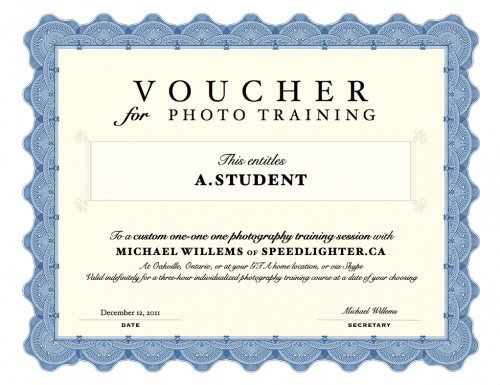
Here’s one way: buy a Seasonal Gift for a loved one. You can do this at the special December discounted price – 10% off the normal $95 hourly rate. Two or three hours, or a ten-pack or twenty-pack. Whatever you need.

You get a personalized certificate emailed to you, like this:

…which you then print and put under the tree, or whatever your gift-giving tradition may be. Done – and bonus: you avoid the mall.


The Eyes Have It

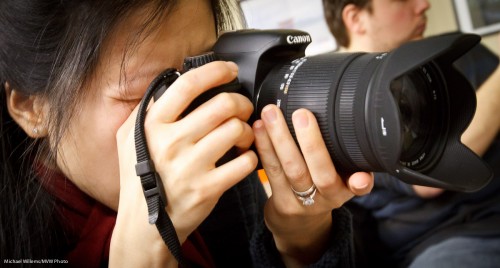
Look:

This photographer is doing what I do – she, like me, is left-eyed.

Did you know we are all left- or right eyed, and left- or right-eared, just like we are left- or right-handed?

For photographers this means we either have to close our left eye, if we use our right eye to look through the viewfinder, or we use our left eye in which case the right eye is behind the camera (and our nose is against the LCD screen).

It’s not a big deal, but it pays to realize what we are. Next time you pick up your camera and your phone, observe which eye (and ear) is dominant.


Beginner’s mistake

I don’t make those, right?

Of course I do – but then I fix them.

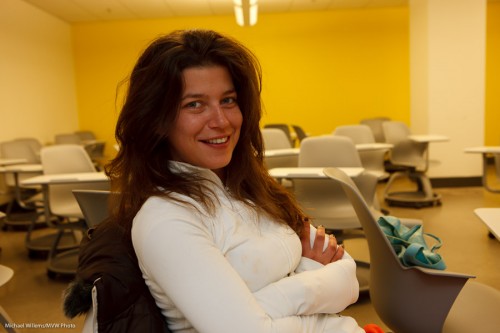
At a recent talk at Seneca College I shot my “assistant-for-the-evening” Kim in a test shot, using the usual settings (ISO 400, 1/40th sec, f/4; and the flash on TTL, aimed 45 degrees behind me):

Kim Gorenko assisting (Photo: Michael Willems)

Uh oh, too dark. What?

Oh. (Hits forehead)! White or yellow bright walls, a white top: TTL metering will of course get this wrong and will underexpose (just like ambient metering would).

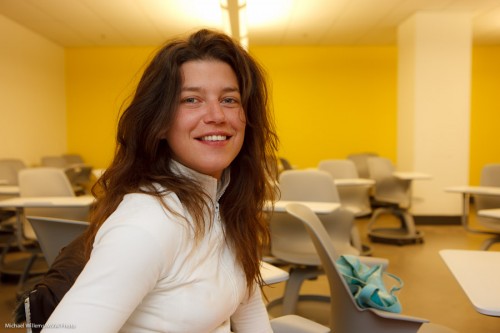
So let’s set FEC (flash exposure compensation) to +1 stop and let’s try that again:

Kim Gorenko assisting (Photo: Michael Willems)

That’s a lot better! (And then you can fine-tune from there). Notice how the ambient is the same (background), but the flashed part of the picture (her) is now brighter.

Often, when people say “TTL flash metering is unpredictable” they mean “I haven’t quite thought it through”, and this was such a case. Problem solved, and I should have done this even before the first test shot – but then, that is why you take test shots!


Interested in lighting? Consider some private coaching, where I explain all, you get to practice and take actual shots, and all will become clear. The December/January special is still on: 10% off during those months.

Michael’s Top Ten Dicta

Legally speaking, a Dictum is “a statement of opinion or belief considered authoritative though not binding, because of the authority of the person making it”. More generally, it is “a noteworthy statement: as (a) : a formal pronouncement of a principle, proposition, or opinion; (b) : an observation intended or regarded as authoritative.” Google it if you want.

So, assuming you know me and trust my judgement, you may well be interested in my Top Ten Dicta:

  1. Bright pixels are sharp pixels. The more you make your subject bright pixels, the more it will be sharp and crisp. Noise hides in the darkness, like cockroaches. Light your subject and it becomes sharp.
  2. Go wide and get close. Wide angles combined with proximity to something introduces depth and perspective into y our images.
  3. Indoors flash: point your flash up, 45 degrees behind you. This gives you the correct light angle for close-by portraits, like in events.
  4. Indoors flash: Use the “4-4-4″ rule” as your camera setting starting point: Camera on manual, 400 ISO, 1/40th sec, f/4. Then adjust for brighter or darker rooms, to give average ambient exposure of around -2 stop.
  5. Turn baby turn. Feel free to angle your shots whenever you like. Composition, simplifying, energy: whatever your reasons. It’s cool, it’s allowed.
  6. You, and the lens, make the picture. Cameras are cool – I buy a lot of them – but the picture is made by you – even an iPhone can produce cool shots – and more technically, by the lens. A good lens on a cheap body is great. A cheap lens on a good body, not so much.
  7. Go Prime If You Can. Prime lenses lose on convenience but win in every other way. I love my 35mm f/1.4 lens.
  8. Use off-centre composition and the rule of thirds in your compositions.
  9. Get close: fill the frame. This so often makes your images better, it is worth stressing as a Dictum.
  10. Simplify! Ask yourself: is everything in my image the subject or the supporting background? If not, get rid of it. A circle has 360 degrees.

That’s my wisdom in a nutshell. Do you know, understand, feel, and above all use all ten principles above?


Learn about these and much more in one of my training or private coaching sessions. There is 10% December Discount – this is a great time to consider buying a friend a session with me: buy a Gift Certificate for the holiday season!

How to learn?

Learning is key in photography – and that learning does not stop until you die, or retire entirely from making (not taking) photos.

So how do you best learn photography? I have Ten Tips that may help.

  1. Read some good photo books. They may not teach you much, but they will clarify, and teach you a few things, and above all – they inspire, and they lay the groundwork.
  2. Read your favourite blogs (like this one) – daily. Make a habit of it.
  3. Also follow podcasts and videos – there are many videos online you can learn from (I think I might start doing some, too!).
  4. Google is your friend – Google for interesting techniques and try to reproduce them.
  5. Always carry your camera.
  6. Assist a pro in a shoot. Even if you do this for little or no money, you will pick up many useful techniques and build confidence.
  7. Take scheduled courses. The homework element will force you to try techniques you would otherwise not have tried.
  8. Do individual coaching. This is very effective at quickly identifying and filling the gaps.
  9. As part of this, do a portfolio review. This is a very effective way – an essential way, I would say – of getting better quickly. “Critiquing” does not mean “criticizing”!
  10. Use your editing software (Aperture or Lightroom) to get better. This too is surprisingly effective. If you are always cropping or tilting or exposing more in post, you will start to so it in camera too.

It should be no surprise that I can help you in much of this – contact me to hear more. But however you do it – do it and improve.

The great news: in this digital age, competent photography can be learned by everyone. I do not believe in an innate ability that you simply have or lack – only in differences is how quickly people pick up good habits. But everyone picks them up in the end.


Blurry Backgrounds

If I want a sharp foreground subject with a blurred background – you have heard me say it many times, there are several ways.

The reason this subject is always confusing is that it is very complicated. “Sharp focus” and “depth of field” are subjects for mathematicians (check the Wikipedia entry, if you wish). Hyperfocal distance, lens geometry, approximations, cropping, aperture, magnification, f-numbers, image format size, sensor size – all these have an effect. The main factors that affect DOF are:

  • Sensor size
  • Proximity to subject
  • Zoom
  • Aperture number
  • The ratio of subject distance to focal length
  • Cropping

Several of these factors are complicated and need not be taken into account all the time – but several can help you in practice. Chief among them: it is not just aperture that affects depth of field – it is also the distance to the subject. As Wikipedia puts it:

For a given format size, at moderate subject distances, DOF is approximately determined by the subject magnification and the lens f-number.

In practice, this means that to get less depth of field (i.e. a blurrier background), you need to either:

  1. Select a lower f-number, or…
  2. You need to magnify more. And you can magnify more by zooming in, or by getting closer.

So to get an image like this, with the person behind the object blurred out, you do not necessarily need a fast lens or a full-frame camera:
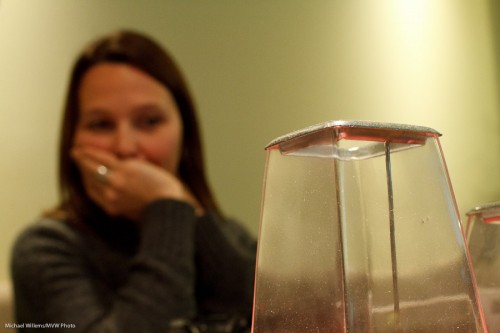
In fact that was taken with a Canon 7D with a 35mm lens (equivalent to a 50mm lens) set to f/5.6. This is an aperture that every lens can achieve. But I was close to the object!

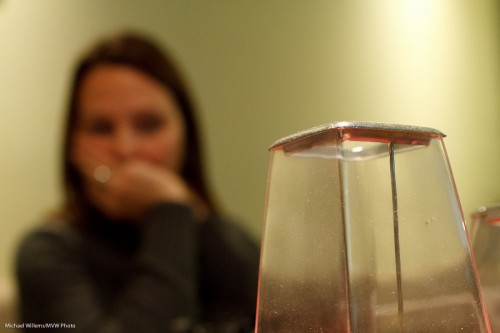
That said, of course a lower f-number in the same situation gives you more blur. Here’s f/2.8, which good zooms can achieve:
And here’s f/1.4, for which you need a prime lens:

So the lesson, I suppose, is that if you want blurred backgrounds but you cannot right now afford that full frame camera and the low f-number lenses that you should really invest in, at least get close.
 

Coaching Tip and special offer

I have a tip, a bit of self-promotion, and a suggestion for you. (You wil allow me a little promotion for once, I hope – if only because it can benefit you).

The tip: In addition to the schooling you take at commercial venues (like the School of Imaging or Sheridan College, both of which I teach at), consider doing some private or small-group coaching.

As it happens, December and January are great months for it, for four separate reasons:

  1. You have many events that need photos – family get-togethers, Hannukah, Christmas, you name it. You want to do well and impress everyone with what you can do now with your camera.
  2. You will have some time off, perhaps.
  3. You may even have new camera equipment… the world’s Santas do a lot of work in the dark months
  4. Coaches like me have time – December and January are months when much of the “normal” course work stops.

Small-group or provate coaching are especially great as a complement for class teaching:

  • You get the syllabus you need, not a set course. Your needs, your gaps, your equipment, your likes.
  • You get individual attention. Individual problem-solving.
  • You can do things you do not do in class – in-depth review of your images, to learn from them, for instance (this kind of “portfolio review” is incredibly useful in quickly making you a real photographer in the way you want).

So for the reasons above, to motivate you, I have a special on for December and January: a further 10% off the normal hourly price. As always you only pay me if delighted.
See more on this link and contact me (click on “contact” above) to learn more and to reserve your time right now – the months do fill up!