More crowds

So today I addressed at least several thousand people. These are the kinds of standing-room-only crowds I love:

IMG_1499

And I thrive in this, witness this picture taken by my friend, Oakville photographer Dani:

HenrysShow09_014-copy

Today’s subjects included Travel Photography, Introduction to your DSLR, Lightroom and RAW, and Composition. More tomorrow! And hopefully, more wonderful crowds like this:
IMG_1524

One more day – don’t miss it.

In walking the show, I was struck by two examples of customer service.

On the one hand, Gary Fong.  Yes, that Gary – the maker of the Lightsphere. He chatted with me, we exchanged business cards and he was genuinely interested in my suggestions and feedback. He even snapped my picture. Hats off to Gary.

On the other hand, Apple. At the Apple booth I mentioned that I had left Aperture, which crashed, for Lightroom. Because, as said, Aperture crashed. As soon as I said this, the Apple guy promptly turned away and.. well, sneered. An Apple fanboi also at the booth asked the Apple  employee “Crashed? What was he talking about?”. “Huh. Your guess is as good as mine”, shrugged Apple guy to Apple fan. “In fact it’s probably better”. Both turned away from me both laughed (no – sneered), and neither looked at me again.

This kind of appalling service is, I suppose, OK if you are Apple, but I cannot imagine it can do you much good in the long run. For a start, it leads to blog posts such as this one. Love Apple products, but the company… wow. Sneering at your customers for daring to say something that might imply that your Holy Product is not, like, perfect. Wow. I feel like I was… excommunicated.. what is it the Amish do when you are cast out from the tribe? These guys make Rogers look good!

Shake-free trick

You all know that when you take handheld pictures at low shutter speeds (like 1/15th second on a 35mm lens) you do not get sharp pictures like this:

IMG_0975-1000

Actually. you can. I took that picture hand-held – holding the camera with only one hand! – at those very settings. And no, the lens is not a “VR” (Nikon) or “IS” (Canon) stabilized type.

So how did I do this? Other than of course having a rock-stead hand?

Just kidding about the hand. Here’s the first five pictures I took:

IMG_0974

IMG_0975

IMG_0976

IMG_0977

IMG_0978

So how many sharp ones? One in five, and for me, that’s about what I get when I handhold the camera in one hand at half the lens length.

The point, of course, is that even with bad conditions like that, you’ll still get the odd accidentally sharp picture. If you need the picture to be sharp, shoot a lot. Click-click-click-click-click-click. It’s OK – sometimes you have to do it without a tripod even though you should be using one (and you know it!), and you’ll still get the odd sharp pictures even then.

(I’ll tell no-one if you don’t.)

Rock on

So today I was able to help 1,000 people with digital SLR knowledge, Travel Photography tips, and Lightroom and RAW  introduction.

IMG_1370

This is my favourite activity: to help people of varying backgrounds and with varying degrees of knowledge with their photography skills. It is such a thrill to make your life part of eternity by committing it to paper (well – to bits) that I feel privileged to help people do it. I mean that: how many of you have good pictures of your parents? with a little knowledge, you can!

IMG_1375

My mission: to make Canada the best country in the world in terms of photographic knowledge. And you know what: I think we really have a shot at it. Pun intended.

For those of you who have not been yet: Saturday and Sunday, in the International Centre next to Toronto Airport, and every vendor of photographic equipment, services, and anything else is there. And I am there every day speaking.

IMG_1442

If you know me and need a ticket, email. Else, it’s worth ten times the small price of admission. See you there!

IMG_1418

Oh – of course al these snaps were taken with the Canon 7D. In next to no light, I might add.

Focus on focus

I recently bought a Canon 7D camera.

The reason I bought another camera when I have two pro bodies already? Amongst many other reasons: The 7D focuses better, while my Canon 1Ds MkIII and 1D MkIII cameras do not focus consistently well when shooting “wide open”. When I use a “fast” lens, one with a large aperture/small “F-number”, set to, say, f/1.4 or f/2, focus is inconsistent.

And I shoot carefully. I use one focus point. The subject is contrasty and well lit. I am shooting at a shutter speed of ten times lens length (e.g. if using the 35mm lens, I am at least at 1/350th second). And yet – out of every five images shot like that, one or two are razor sharp, some are pretty good, and one will be blurry – focus blur, with the focus way out.

This appears to be well documented online. “Fake Chuck” writes about it regularly, like here.  Another post here also mentions Canon’s sloppy soft focus versus Nikon’s razor sharp focus:

All the Canon’s, all the way back to the Canon D30 deliver that famous soft focus look. Is it because Nikon (and now Sony) use a CCD sensor for focus and Canon uses a CMOS for focus?? If so, change it. if not, get rid of the trademark Canon soft focus once and for all. Nikon is so sharp it bites. Why?

One other issue is that my cameras tend to pre-focus when the lens is wide open. But less when it is not wide open.

Clearly, we need critically accurate focus if we are to shoot at f/1.4 (and that is why we spend thousands of dollars on f/1.4 lenses). And it can be done.

IMG_1087

I still shoot Canon, because I like the lens range and because I have over $25,000 invested in Canon equipment, such as my lenses:

lenses2

If, like me, you like to shoot wide open, I would recommend you do the following, apart from the obvious “shoot fast, use one focus point, look for non-equivocal focus areas”:

  • Use a tripod.
  • Use flash (or studio strobes).
  • Avoid being confused by the LCD display. On the 7D this shows sharp pictures. The low-level LCD on the 1D makes everything look blurry, especially when you zoom in all the way. Don’t be confused by this. It’s blurry when your PC or Mac shows  blur, not before.
  • Avoid wide open. At f/2.8 and above, it’s much better.
  • Take multiple photos of the same subject: one is bound to be sharp.
  • Live with some out-of-focus shots. As long as the rest are good.
  • Use the brightest possible light. Low light seems to make the camera focus less accurately, or a last differently.
  • Did I mention a tripod?

So, does the 7D do better? So far I am happier. It is not perfect: a few out of focus pictures so far when I am shooting wide open. But so far my impression is: “significantly better”. The new focus modes help, of course (spot focus in particular).

So.. stay tuned. And have fun, and do not worry too much about sharp focus.

Art costs

I found a great fashion photography blog [link here] with tutorial movies.

That linked movie explains why a magazine photo costs money. A shoot means many weeks of preparation and a day with a cast of thousands.

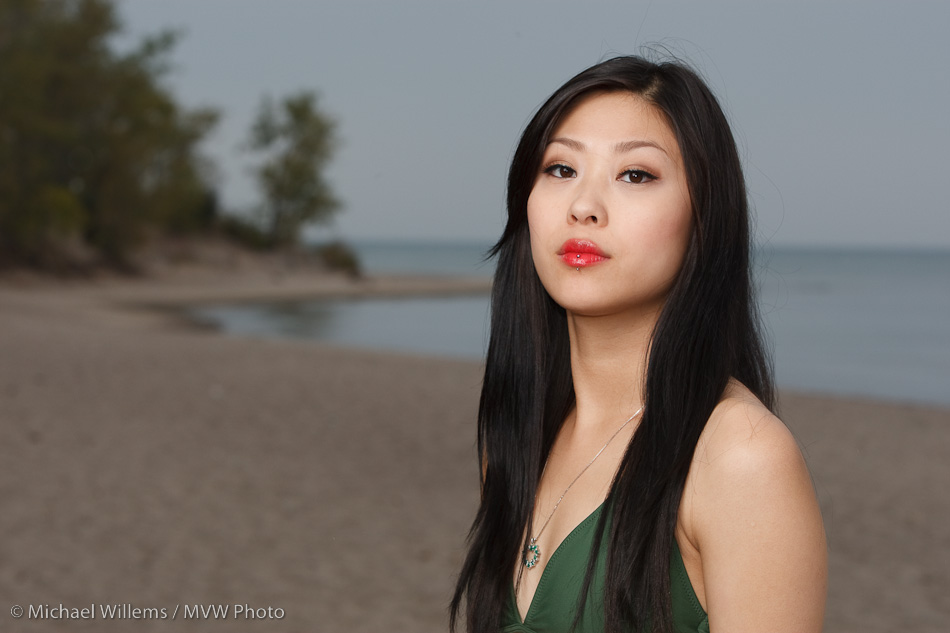
And I found myself thinking: I wish I could do that, on those budgets. I did a beach shoot recently:

MVW_2545

But it was me carrying all the gear, the cameras, and the lightstand with umbrella, and it was me setting up the fill light. It was me doing art direction, setup, and everything else. The models had to do their own wardrobe and make-up.  No-one came and handed me pillows to lie on, either. The budget for the day was under $100.

The moral of this story is, I suppose, twofold. First, there is a reason a professional shoot costs professional money. Second, at a pinch you can produce on a shoestring, too. It’s just different work.

But, most importantly to me: as a professional photographer I want to do more bigger shoots. What I could do with that kind of budget! Recession, be over already!

Crop sensors and depth of field

So a crop camera has wider depth of field?

Depends how you look at it. The way I look at it: “only because you will use it differently. If you use it to take the same picture, you’ll get the same depth of field”. But of course for that “same picture” you’ll need a different lens.

OK, this is complicated. So let me just show you by example.

Picture one: full frame 1Ds MkIII camera, 50mm lens at f/1.4.

MVWS0030-50mm-1.4

(You can click to see the large version).

Picture two: crop camera, a Canon 7D, with a 35mm lens also set to f/1.4. That 35mm lens on a crop camera is about the same as a 50mm lens on a full frame camera; i.e. enables me to be at the same point and yet get roughly the same picture. Now I see this:

IMG_1270-35mm-1.4-adjust+15

As you see, this gives you roughly the same depth of field. If there is any difference, it is minor. SO:

A 35mm lens on a crop camera gives you roughly the same picture as a 50mm lens on a full frame camera, and roughly the same depth of field.

A few notes, by the way:

  1. These results are consistent; not just “one randomly picked picture”.
  2. The DOF (depth of field, i.e. how much is sharp) is extremely narrow. Great care is needed when shooting at f/1.4!.
  3. I was aiming a single focus spot at the dot (near the 10) in all pictures (On the 7D, I was using the extra small focus spot).
  4. I have noticed that the Canon cameras (or is it the lenses?) focus too closely (they “front-focus”) when open at f/1.4. By f/2.8, this effect is either gone or too small to see clearly. In the last picture, I added an adjustment of +15.  This does not change the depth of field; it is just to make both pictures about the same.

Point 2 explains a few things to me, by the way. That’s part of the Canon-effect, more on which in the next few days; it’s why I have to adjust extra when wide open.

My friend "Mofia"

Mofia, pronounced as in “more Fire”, who is himself a talented photographer, in a few typical poses – his poses:

IMG_1161

IMG_1157

IMG_1168

All this in my basement studio. You can equip a studio very quickly and easily (I teach people how to do this). And guess what? That’s all shot using one strobe. One light, that’s right. And a reflector. Not four or five lights!

Speak now, or…

This coming Friday – Saturday – Sunday, I am one of the featured speakers at the Henry’s imaging show at Toronto’s International Centre (next to the airport in Mississauga).

At this show, during those three days I will be teaching short (45-minute) versions of workshops including “Getting to know your DSLR“, “Photographic Composition“, “Shooting RAW, developing in Lightroom“, “Creative use of your lens’s aperture“, and my own workshop, “Travel Photography and Photojournalism“.

For those of you who want to attend this show, I can recommend it wholeheartedly. And as for “Travel Photography and Photojournalism”, I teach this short version of my workshop at the following times:

  • Friday 11:45 AM
  • Friday 3:45 PM
  • Saturday 10:45 AM
  • Saturday 4:45 PM
  • Sunday 3:45 PM

I hope to see you there. This is a show not to be missed: Canon, Nikon and all the other greats are there, as are speakers like Gary Fong and vendors like Booth, Daymen and Pinnacle.

Haze? No problem.

Here is a simple but effective technique: if your background is hazy, blurry: put something sharp against it in the foreground. Like in this picture:

IMG_2060

You get benefits that include:

  • Better foreground subject definition
  • No-one minds that the background is hazy – it is a benefot, not a drawback, so everyone’s happy.
  • 3D into your picture.

It’s all good!