Shot of the day

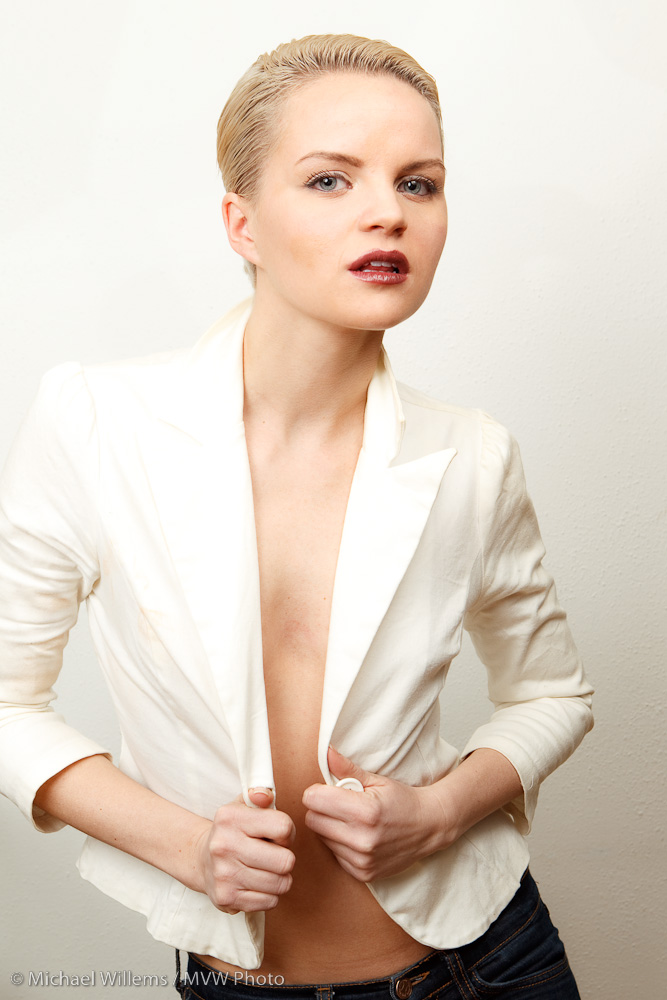
…of yesterday, that is:

I used my 1D MarkIV, and light was two direct speedlights with Pocketwizards on the left and right (full power), and one behind me for fill (also direct, but on half flash power).

How this is done is something I will explain more on the weekend lighting workshop I am holding, with Joseph Marranca, at my country retreat in early April. Details to follow!

Dark trick

A trick from the dark side.

When you have to shoot in low light, and I mean super-super low light (think f/1.4 at 1/15th sec at 3200 ISO), you can underexpose and pull up the image later.

This introduces nice (grain).

So then you… and here’s the trick…..Convert it to black and white.

Noise looks OK in black and white, and muddy colour disappears.

So sometimes b&w just means “it wasn’t good enough for colour”.

And then, sometimes an images just looks better in b&w.

Why you shoot through umbrellas

This is why.  A portrait with glasses, in which we shot into an umbrella. Looks fine, until you zoom all the way in, when you see this:

See the light?

Now of course the next shot is “tilt your head down” shot so the glasses no longer reflect – but the eyeball will still reflect a white circle with a black light inside it. Can you see it, in both eyes?

Shooting through the umbrella instead would have shown a nice white circle, instead.

Catch that light

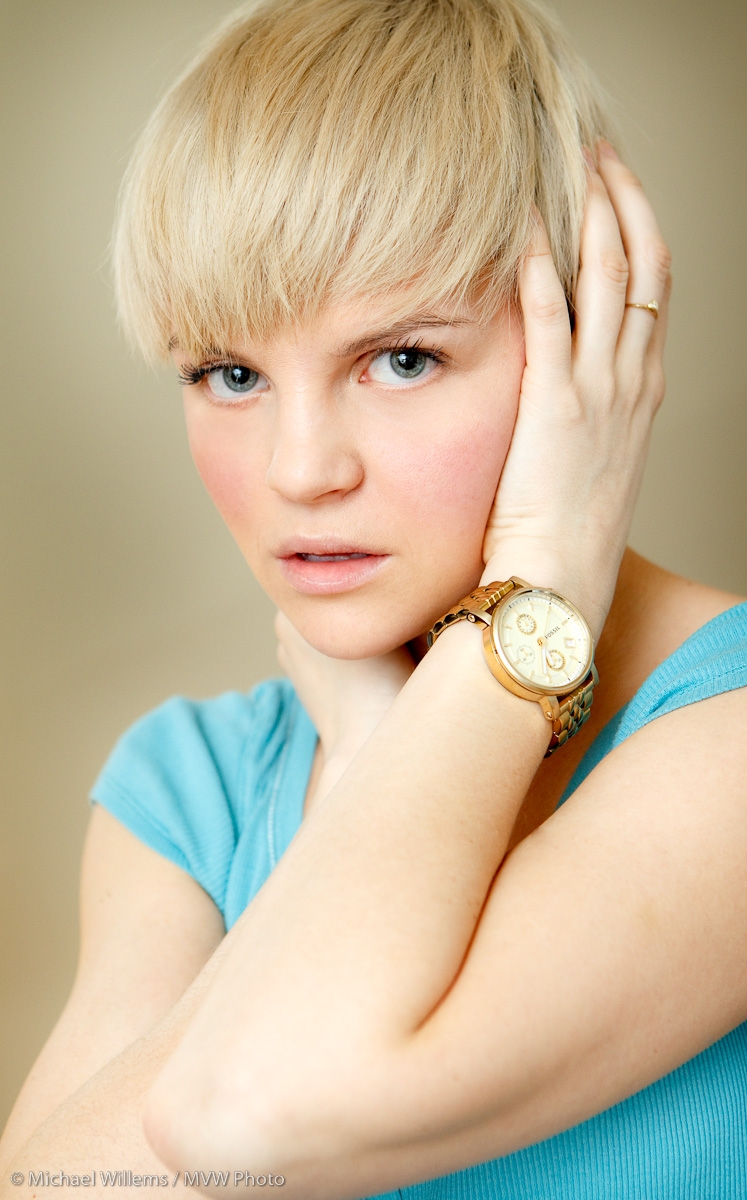
Every portrait, classical rules have it, needs a single “catchlight” in the eyes.  While I am not religious about this, I do tend to ensure that this is present. This very recent portrait shows the catchlights clearly. I used two umbrellas with speedlights, fired with E-TTL, and a light on the camera aimed backwards to add a bit more softening.

This is a high-key portarit: everything bright.

Flash and ambient exposure

What factors affect your flash exposure? There are four:

  1. Aperture
  2. ISO
  3. Flash power
  4. Distance from flash to subject

Two that do not affect flash exposure, or affect it to a lesser degree:

  1. Shutter speed
  2. Distance from subject to camera

What factors affect your “ambient” (available light) exposure?

  1. Aperture
  2. Shutter Speed
  3. ISO

Several that do not affect your ambient exposure, or affect it to a lesser degree:

  1. Flash power
  2. Distance from flash to subject

So you can see that by altering shutter speed, you only affect ambient exposure, while by altering flash power you only affect the flash exposure.

C? F? No, K.

K for Kelvin, that is.

If you find that your white balance setting still leaves your pictures yellow when taking pictures in tungsten light even when you set the white balance to Tungsten, try a Kelvin value if your camera supports that. I find, for instance, that in my bedroom 2700K is about right.

If your camera does not support that, use a Custom white balance setting after you shoot a white sheet of paper.  Your camera’s manual will help in this.

Of course if you shoot RAW [corrected]  this makes no difference, but I still recommend doing this: it reduces your post-production work, plus your back-of-the-camera previews look better.

The KISS principle

Means “Keep It Simple, Student”.

Meaning, you can often use simple equipment. Like when you are lighting and instead of using many flashes, you use just one. On the camera instead of off camera. Like in this recent fun ‘desat’ shot:

Using  simple speedlite bounce-light.

I explain this technique in my workshops, and use it often. Key is to:

  • Be in a small room with white walls (a light box)
  • Use Flash Compensation (usually of +1 to +2 stops)
  • Think “where should the light be coming from” – 45 degrees above from the subject’s head
  • Then draw a virtual dotted line from the head in that direction
  • And where that hits the ceiling or wall is where you aim your flash.

It really can be that simple.

New toy

Just received the new Honl Photo bounce card/speed snoot.

It is like the previous ones in that it is small, sturdy, and conveniently attaches to the Speed Strap.

What’s different?

This one has not a white but a gold reflector (equivalent to 1/4 CTO).

That means I can use it to:

  • Shoot with flash in Tungsten ambient light without making the background warm or the subject too blue; or
  • Warm up portraits with a nice warm glow.

Yet another thing to make my light-life easier.

I am going to be once again sharing my Flash expertise in Phoenix next month – 22 and 23 March – for pro and emerging pro users. You can be sure I am going to show how these small modifiers enable a whole new world of flash.

One light

You do not always need many lights. Sometimes, one light is enough:

f/8, 1/125th, 100 ISO

That is just one studio light, fired through a pocketwizard (but I could have used a cable) – and a reflector on the other side. This leads to this:

Yes, of course a background light, hairlight,and so on, would give me more control.

But we should all be aware that this amount of lighting is sometimes neither possible nor practical. And one light plus a reflector can give you nice light.