Improvise

I shot in a venue yesterday where the light was going to be speedlights off camera, using light stands and umbrellas.
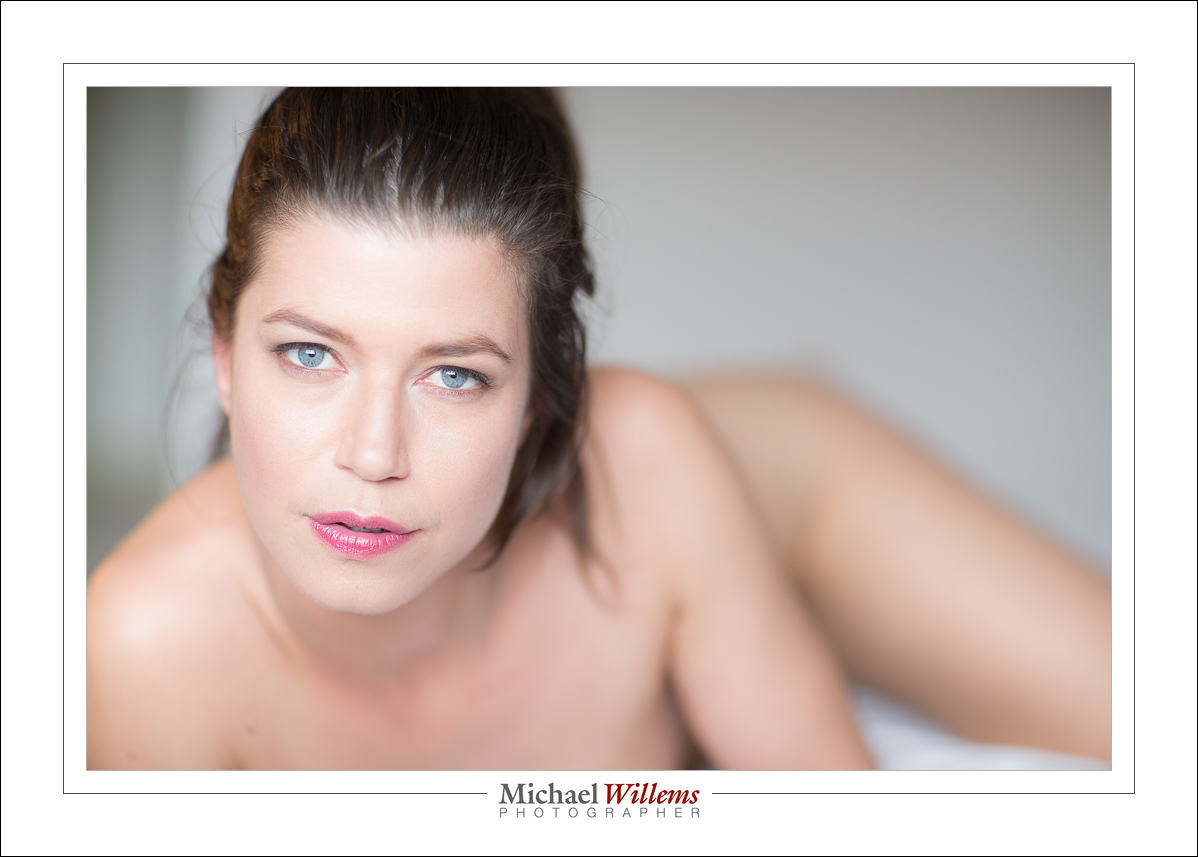
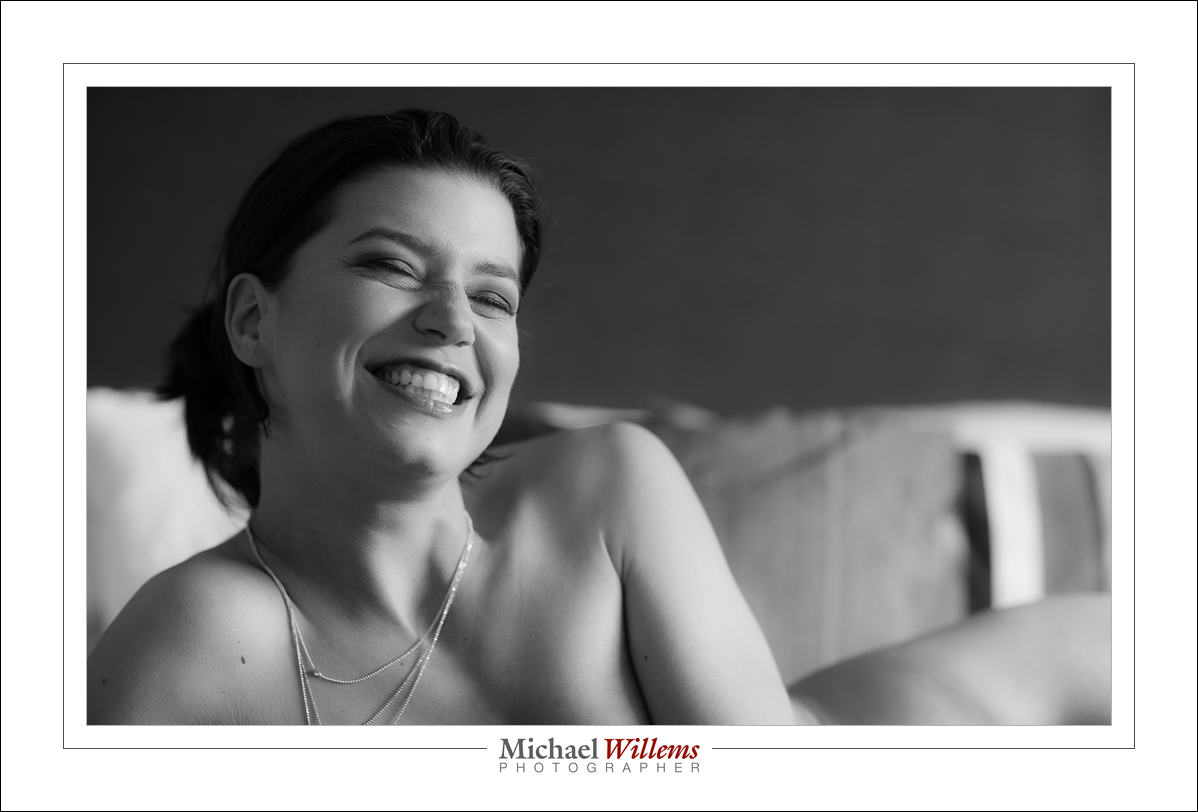
In the event, it was not possible to bring in lights, so I had to use one on camera flash. And here’s what I got:

I bounced my flash behind me. Up and behind me, but down enough to ensure that I hit a white wall, and that we get catch lights in the subjects’ eyes. And using TTL flash. And with flash compensation set to +1 to +2 stops.

And that gave me ok light!

Shoot.

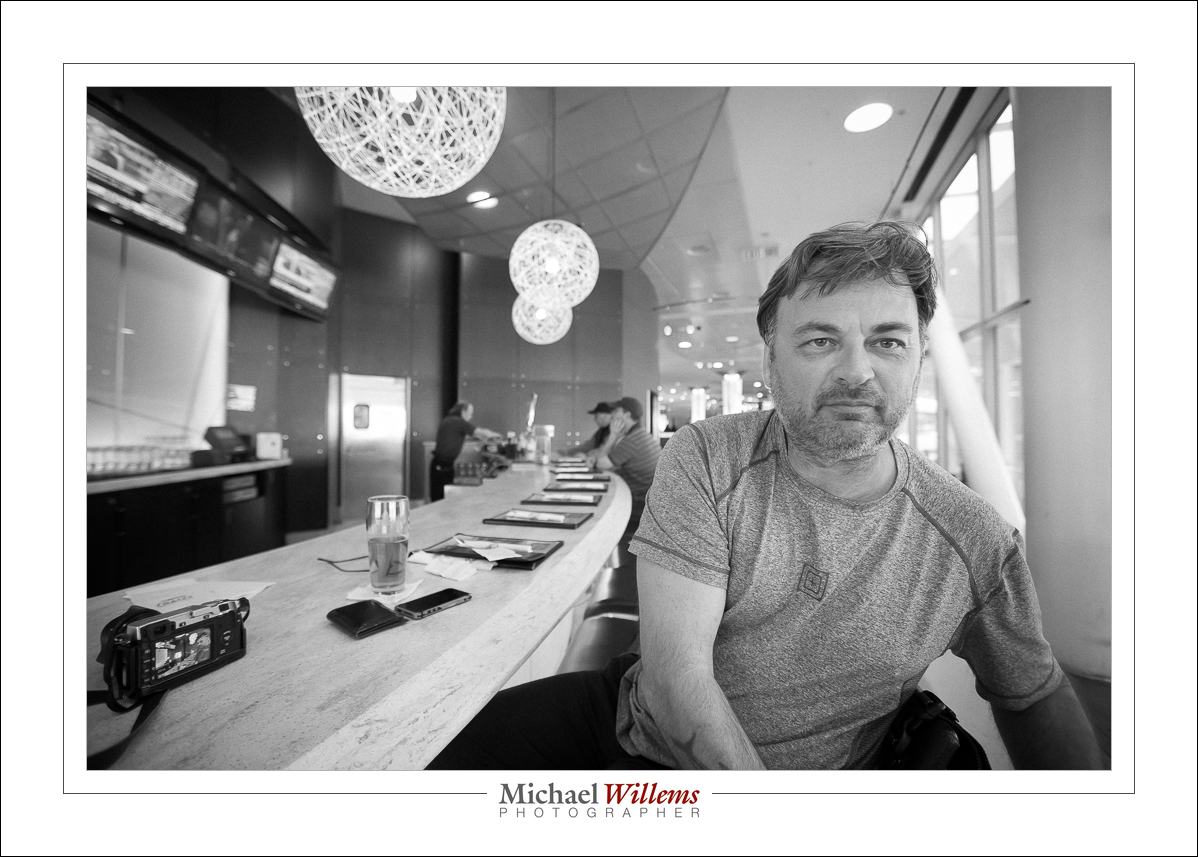
There I was, having a drink and some food yesterday with David Honl at Toronto airport.

David is known from his pictures of Middle East conflict areas, as well as from the excellent range of Honl Photo small flash modifiers, which I use extensively, and wholeheartedly recommend.

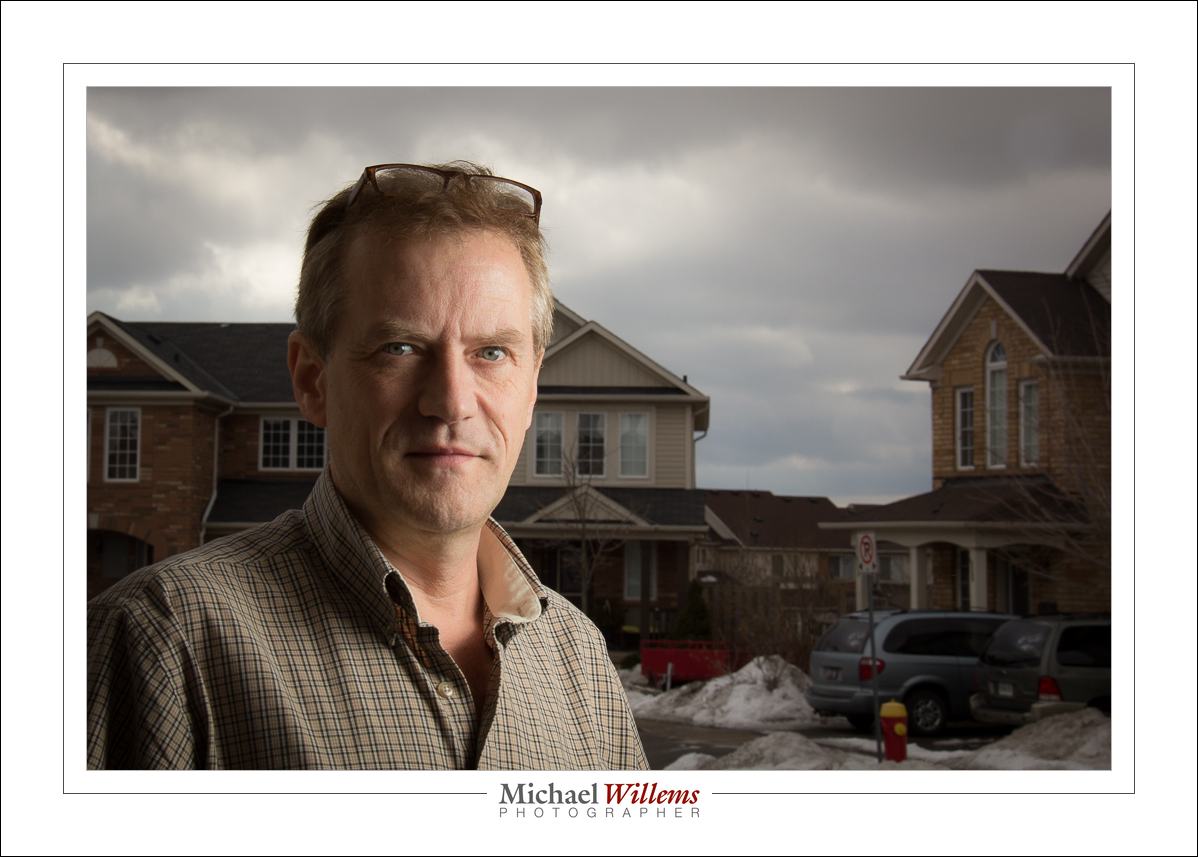
Yesterday, David was on his way from Istanbul to LA via Toronto. Here he is, as I shot him with a 16-35mm lens set to 16mm:

See how the leading lines draw you into the picture? And how black and white makes the picture about the subject, not about the colours in the background? And how I avoid putting the subject too close to the edge, where he would distort unacceptably?

Many photojournalistic images are made with a wide angle lens, and in B/W. I always carry a camera, I always carry a fast lens, and if it’s photojournalistic images, I often use a wide lens and B/W.

I suppose that if there is a moral to this post, it is this: always carry your camera!


Pic of the day

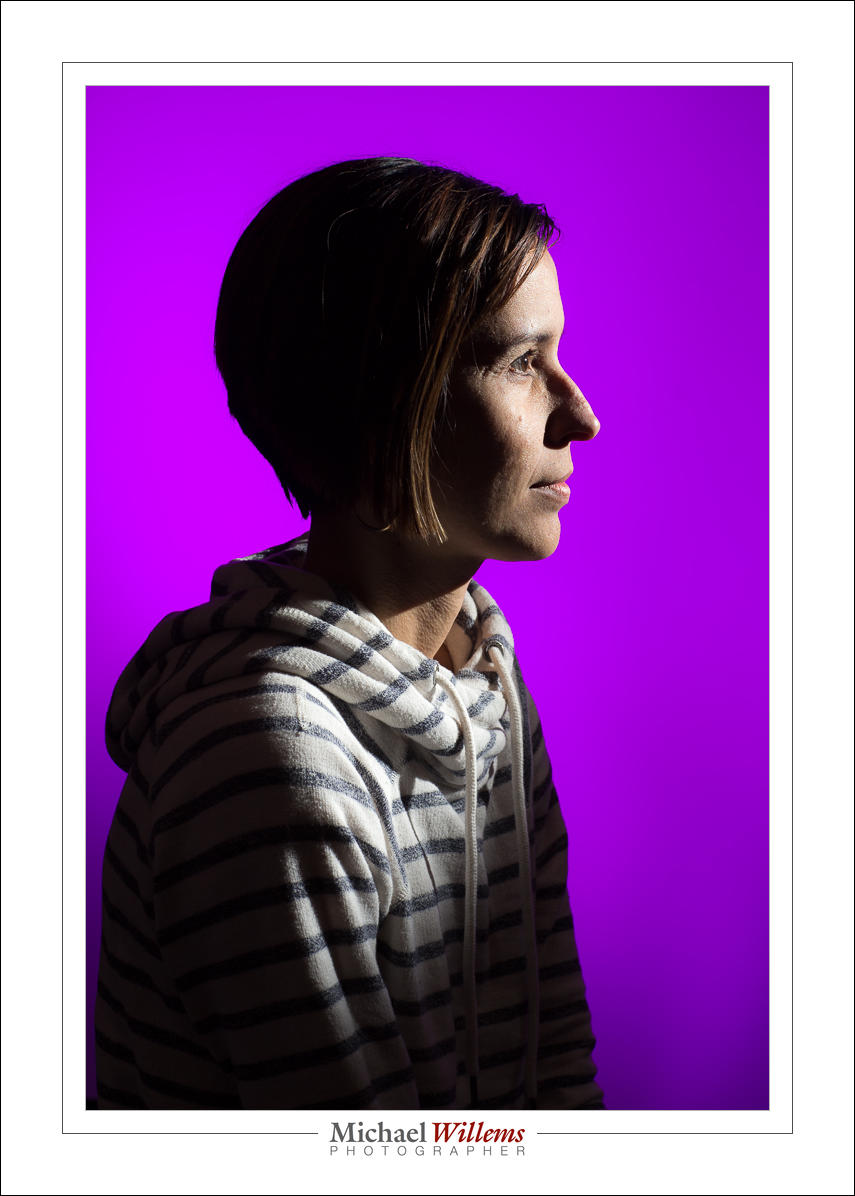
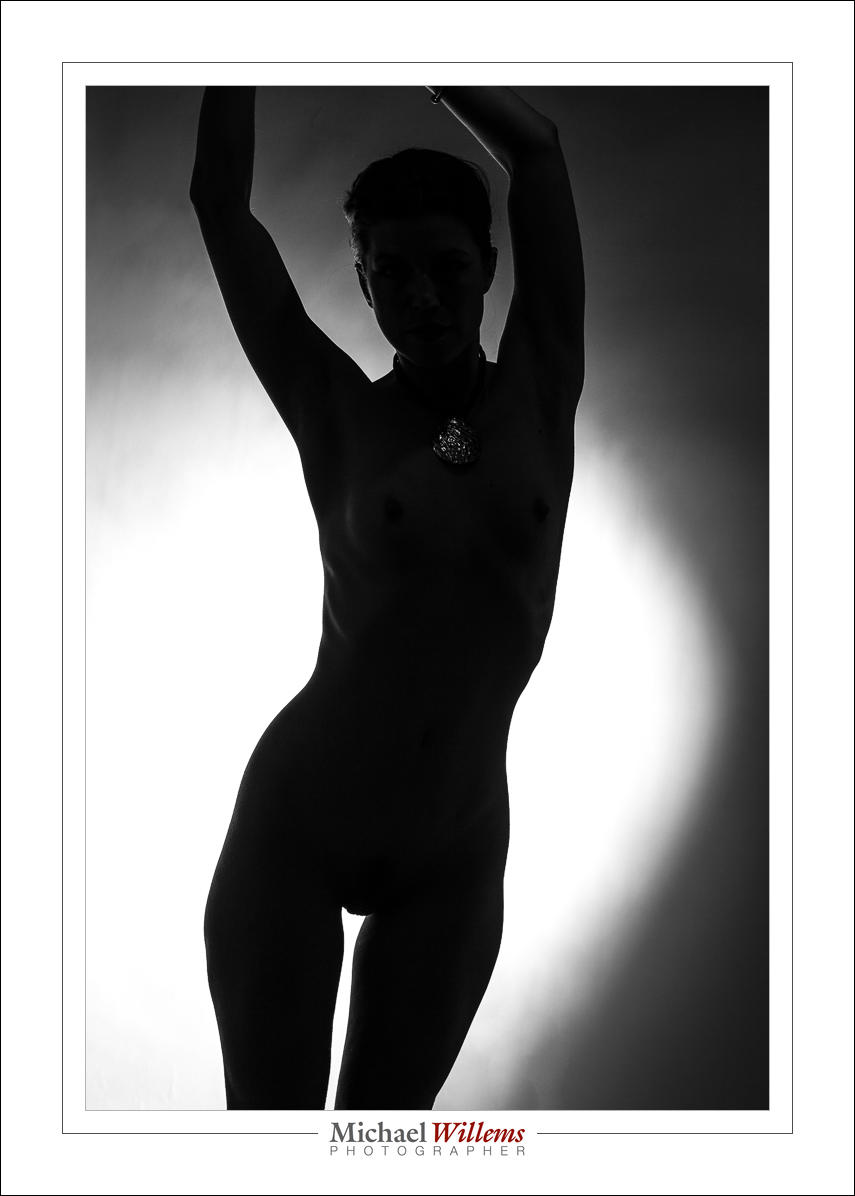
The pic of the day is a profile:

For this I used

  1. A camera set to “studio settings”: 100 ISO, 1/125th, f/8.
  2. A small flash aimed at the background, fitted with a Honlphoto grid and a Honlphoto purple gel.
  3. A flash aimed at the subject, also with a grid, from in front of her, slightly behind her from my perspective.
  4. Pocketwizards to fire the flashes.

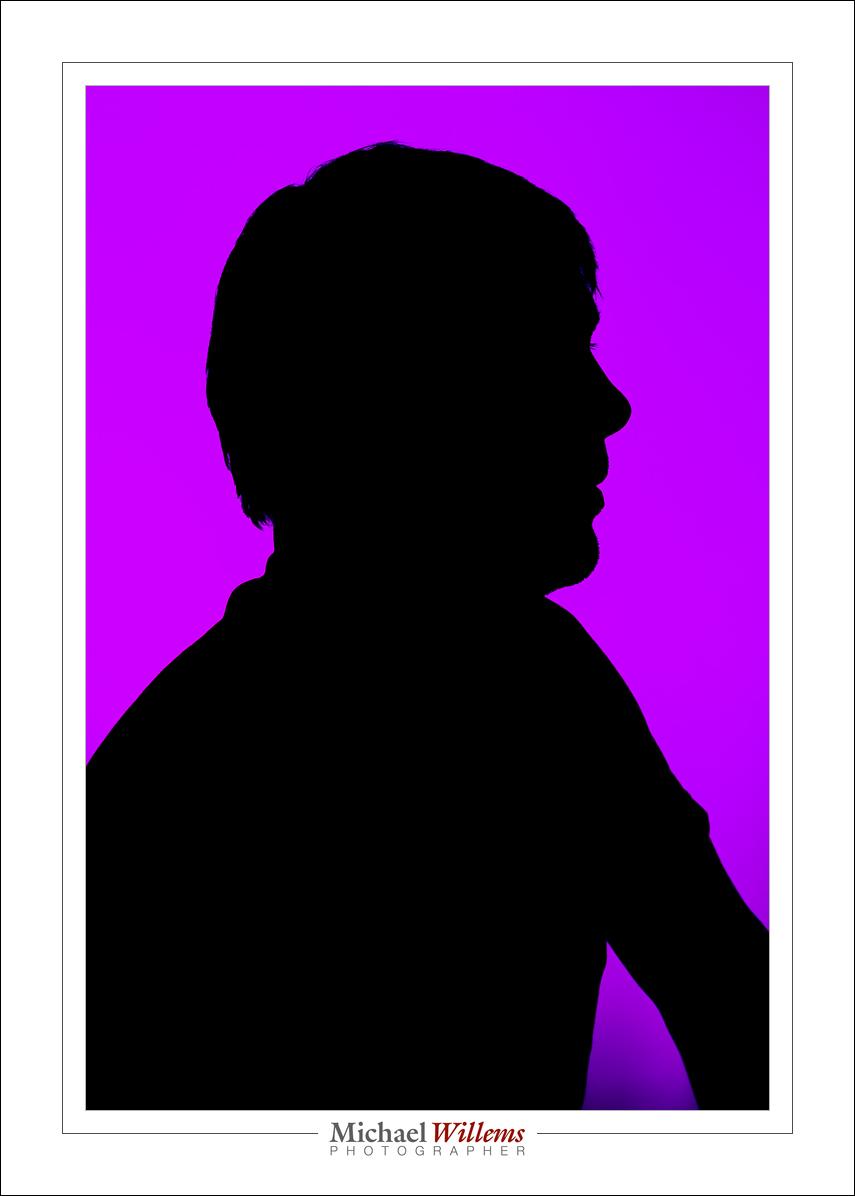
If I leave out the front-of-subject light, I get a pure silhouette:

And if I do the normal studio stuff (I add a hair light, key light, fill light), I get this:


Thanks to my three student volunteers from my Sheridan College class.


On A Mission

Yesterday morning I shot a mission. I shall tell you about it in a moment, but let’s start with the light.

Said light was not inspiring. Shade. Like this:

So the solution is easy: I grab an umbrella and flash. I use

  • An umbrella and light stand.
  • TTL flash, light operated. Using a 580EX on my camera and a 600EX in the umbrella
  • I set the ambient exposure to 1-2 stops below meter (the meter indicates 1-2 stops minus).
  • That gave me 1/250th, f/6.3, 800 ISO.
  • White balance is set to “Flash”.

I now get the light I want:

Now the mission.

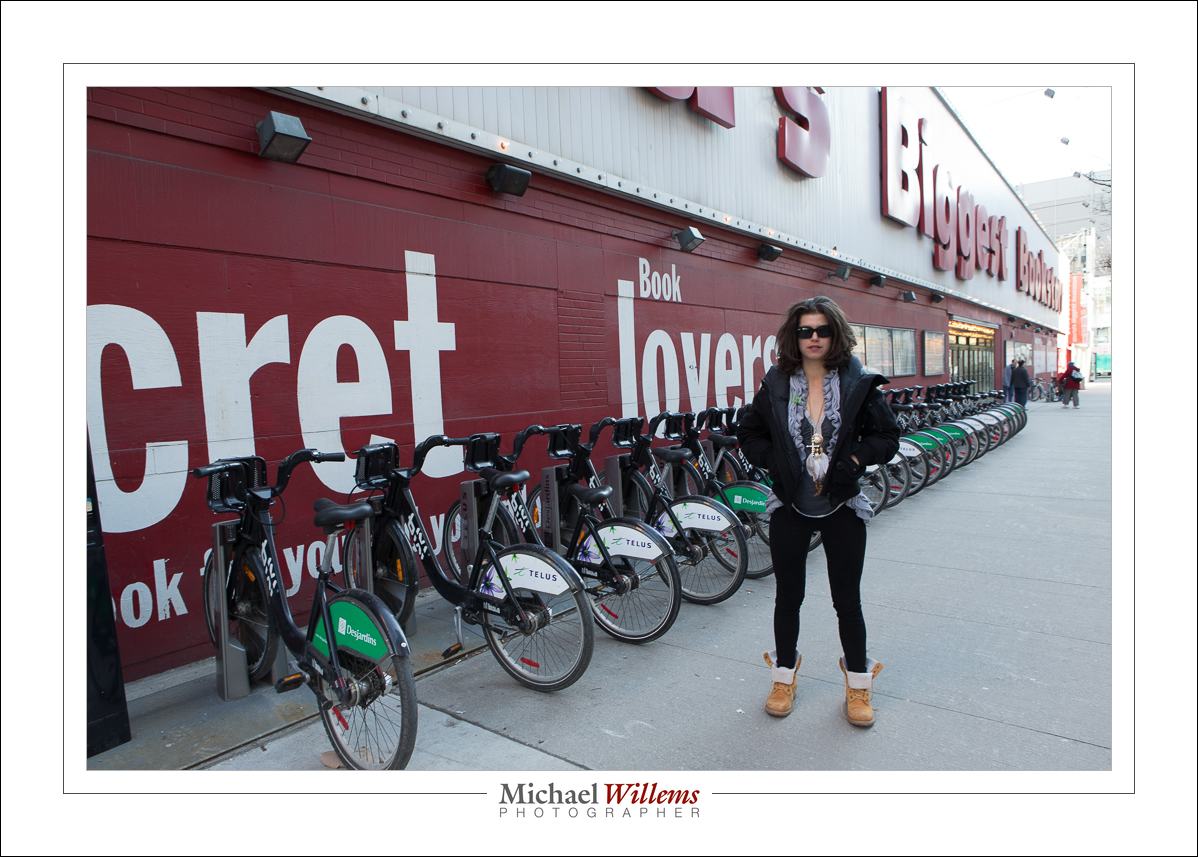
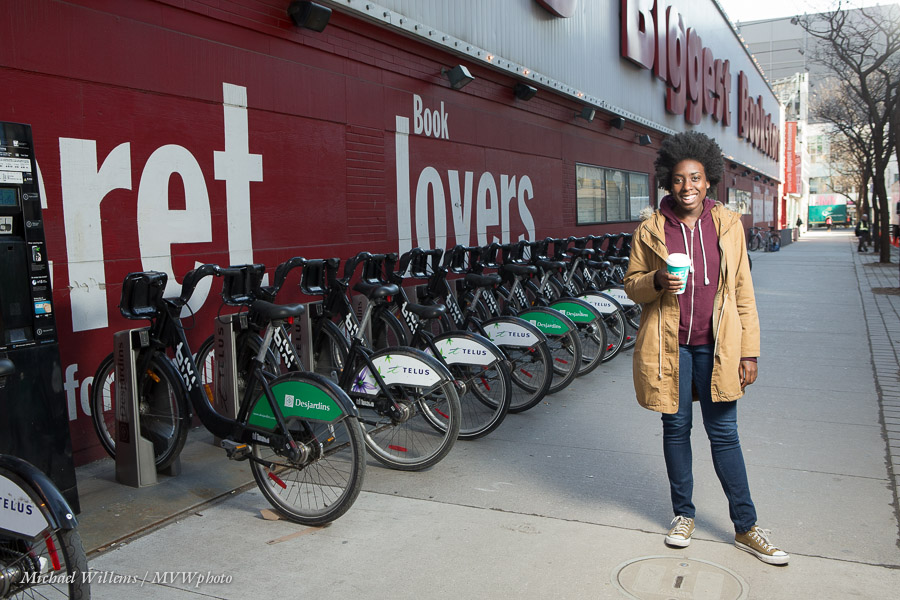
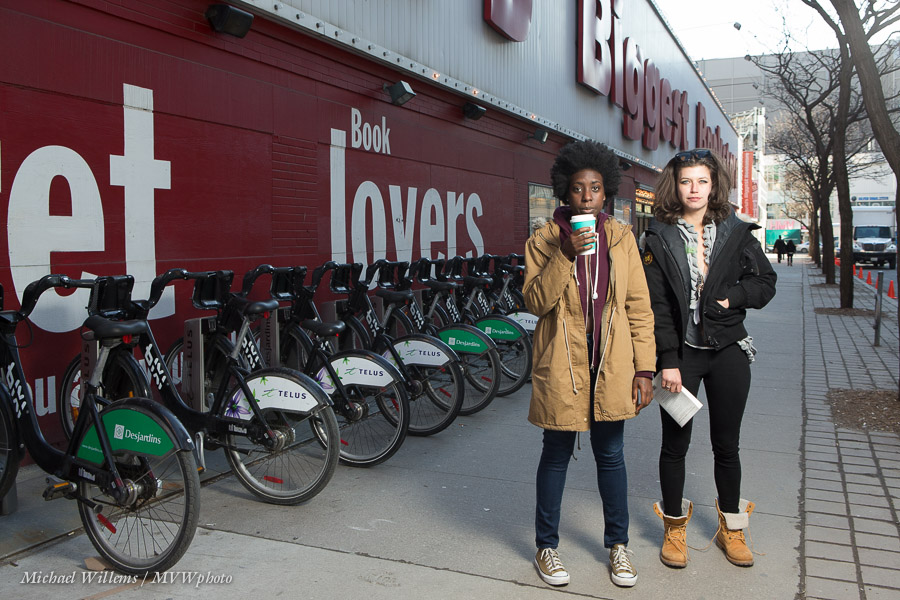
The young woman on the left is on a mission called the “Topless Tour De Canada“, and her objective is to point out that going topless is legally allowed in Canada, for women as much as for men.  Her tour starts in Toronto and will take her through the major Canadian cities, and she will be filmed and photographed in each of these cities—top free.

Here’s a Behind The Scenes shot:

See the light stand? And yes, umbrellas get blown over by wind, so hold them!

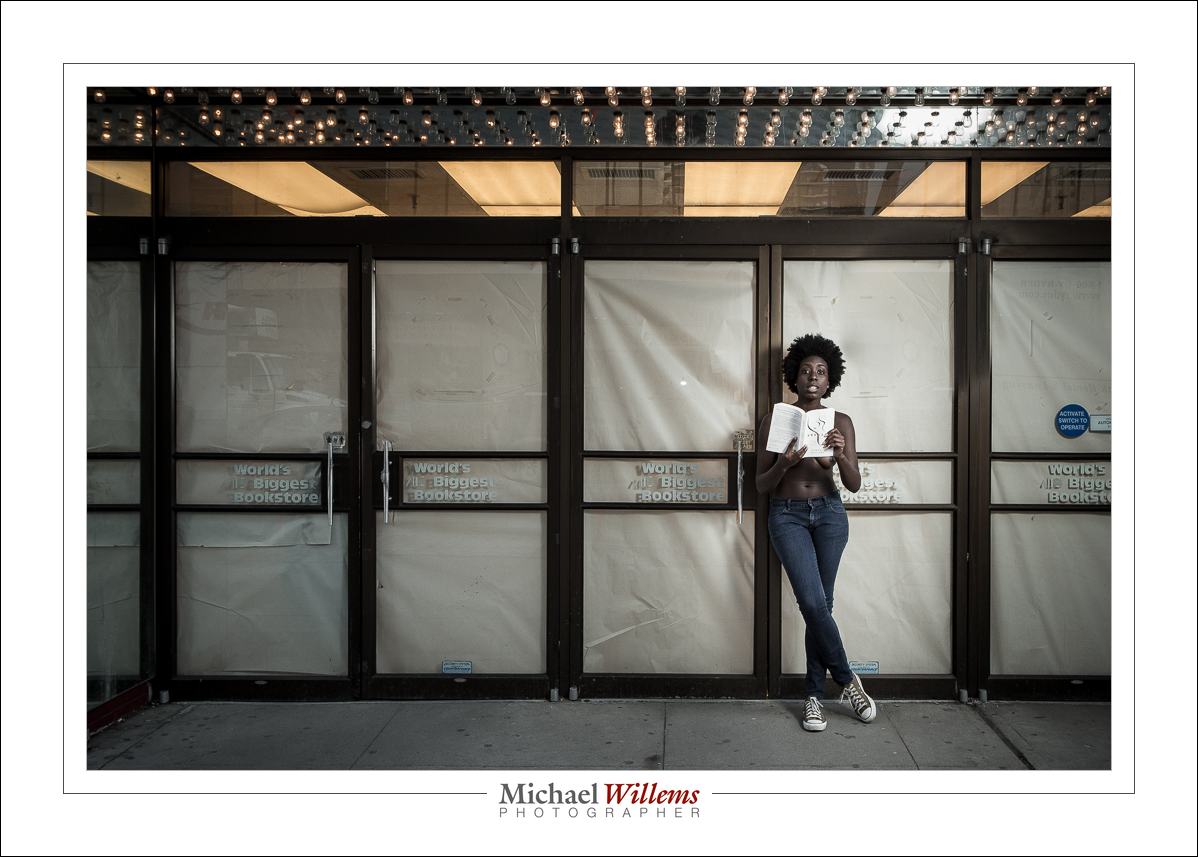
And here’s one of the finished shots, in front of The World’s Largest Bookstore in Toronto—a bookstore that, alas, has recently shut down.

There are lots more: see one here. And see another one here.

Bring it close.

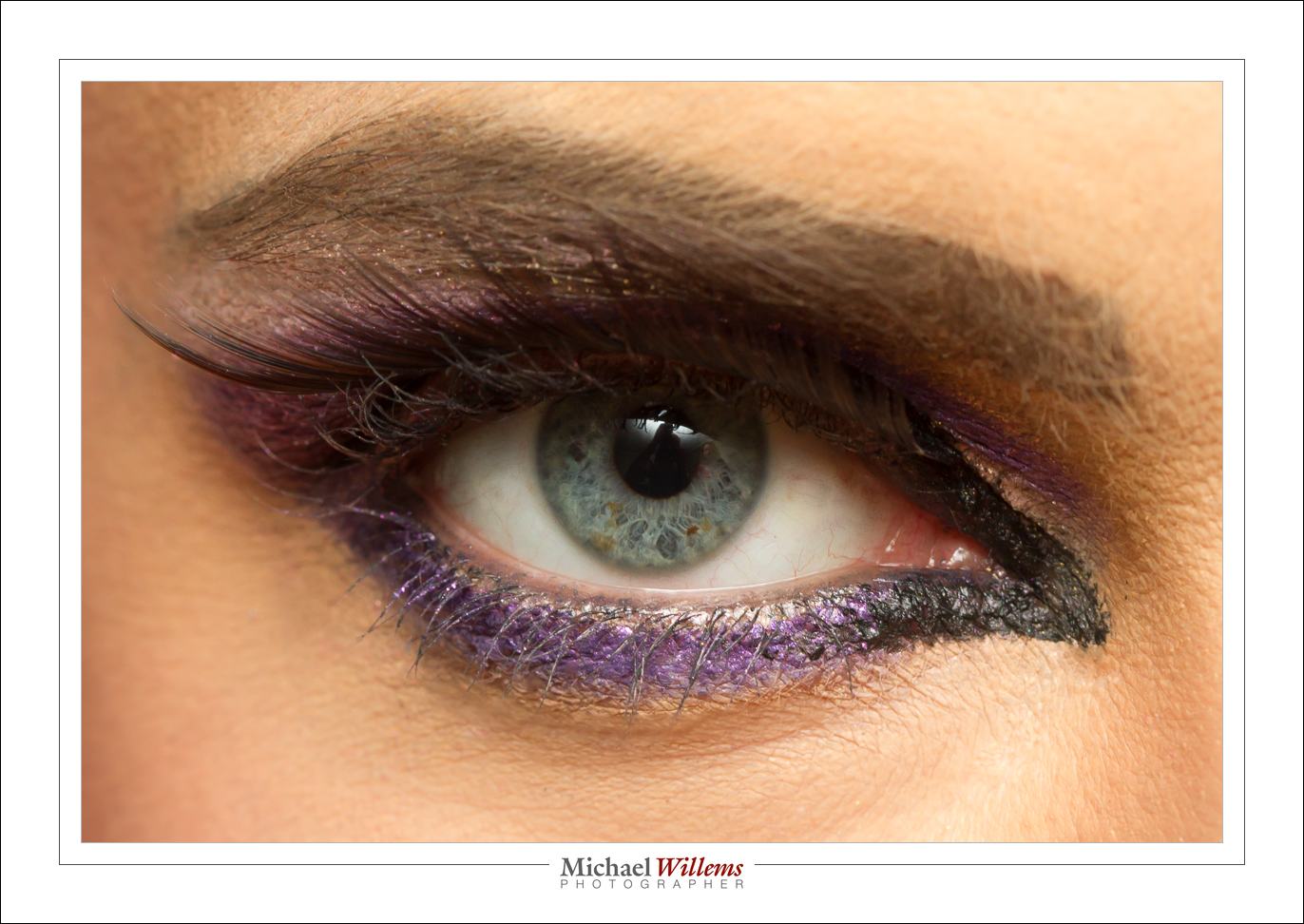
To shoot a true macro picture, you need a macro lens (Nikon calls this a “micro” lens). This is a lens that allows you to focus close-up. Like this from yesterday’s shoot, a shot for the make-up artists to detail their work:
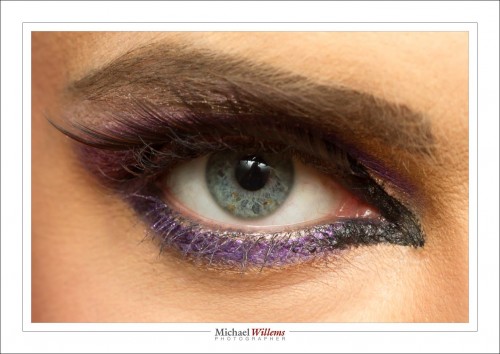
When you click and see it full size, you will see how ridiculously sharp this is: “DNA-level”, as I like to call it.

So why and when do I take a shot like that?

I do macro shots:

  • When I want to have some fun. Macro can be done in your kitchen all year round: when you make small objects large, they take on an entirely different life of their own.
  • When needed to document things—like the make-up job above.
  • When shooting small objects, like jewellery.
  • To get detail of an object, detail I cannot
  • When I think I may want to get close, even if I may not need to, I still like to use the macro lens so I have the option.

Shooting macro means you are close… and this in turn means that your depth of field is extremely restricted. You will probably need to shoot at f/8, f/11, f/16 or worse. You may even have to take multiple shots with varying focus distances and put them together electronically. A very close shot at f/2.8 has a depth of field (“where it is sharp”) of fractions of millimeters.

One mantra one often hears is that a tripod is necessary. Yes, it is recommended, and sometimes it is necessary, but with good shooting technique, you can often do without it too. Like in the shot above. 100mm lens on a Canon 7D camera; set to manual at f/11, 400 ISO, 1/125th sec.

Finally, the light. I used a bounced flash and I ensured that only the flash shows (by using “fast shutter, low ISO, high F-number”). Using only flash ensures that you see no motion blur: a flash happens in about 1/100th second (or even faster at lower power settings), so it’s like using a fast shutter speed.

 

Primes and why

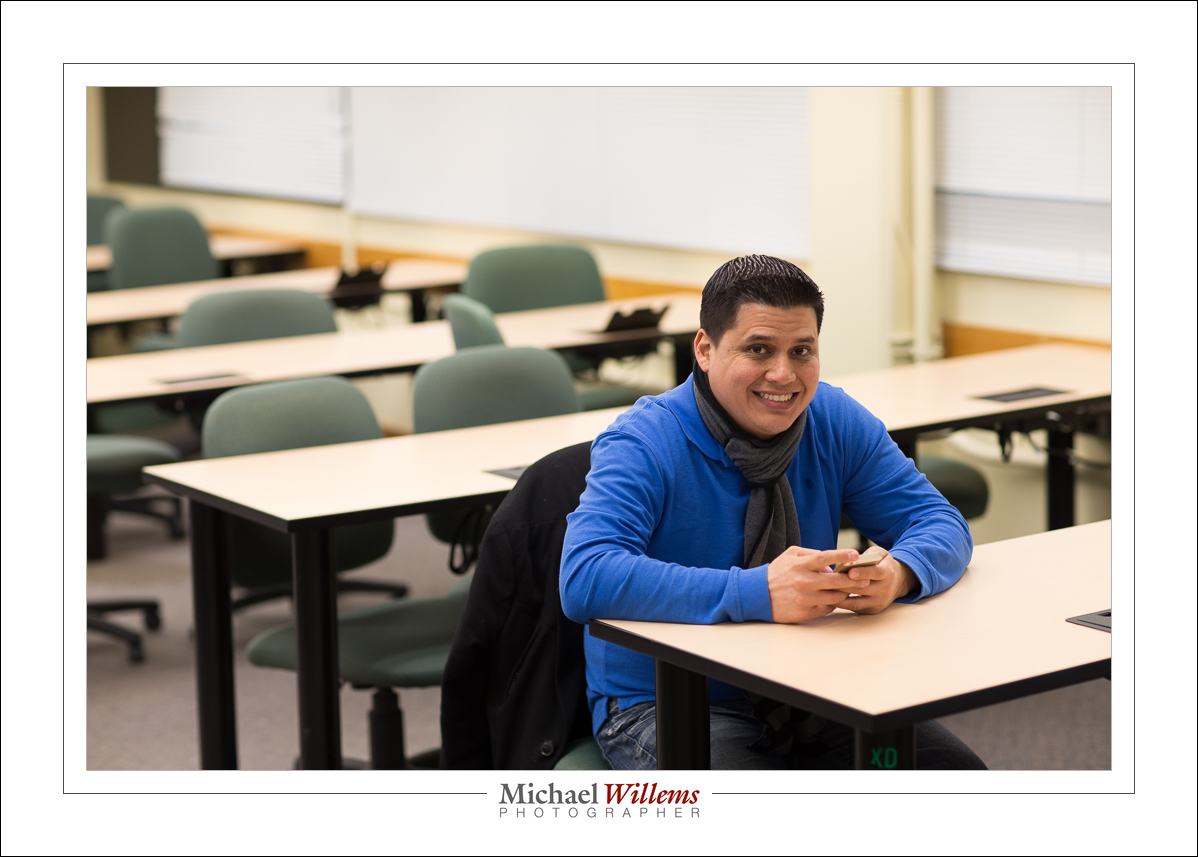
I love my 85mm f/1.2 lens, as readers know. My students know it, too. Here’s one of them, from Wednesday’s “The Small Photography Business” class:

The 85mm is a prime (i.e. fixed, “non zoom”) lens. And 85mm is a great focal length for fashion pictures, portraits, and so on. And extremely fast: f/1.2 is a great wide open aperture value. Of course that does not mean I always have to use it at f/1.2. When you stop a lens down, it gets better, and when I stop this lens down, it is very good indeed.

The reason I like to use a prime is multi-faceted.

  • I can shoot at faster shutter speeds or lower ISO values then with a cheaper lens. The pictures here were taken at 800 ISO, f/2.2, and 1/160th second in an evening classroom. Who needs a flash?
  • I get wonderful blurry backgrounds, so I can live with less than ideal backgrounds, as in the photo above, I just blur them out.
  • Primes are usually clearer and sharper than zooms, which are always to some extent a compromise.

But an oft-overlooked reason, and for me often the main reason, to use primes is that they give you a consistent shoot. You see, each time you zoom in or zoom out, a number of things change:

  1. Depth of field (how much is sharp in front of, and behind, where you focus).
  2. Minimum acceptable shutter speed if handholding the camera (think 1/f, where f is the focal length).
  3. Depth/perspective. Wide angle pictures look different from telephoto pictures. Long lenses compress perspective; wide lenses can exaggerate it.
  4. In a broader sense, the entire compositional look of your photos. A prime means you get to really understand the ins and outs of your shoot’s creative feel, rather than every picture being a new adventure. And it means that a shoot will have a certain feel, rather than being all over the place.

Here’s one last photo from last night, of another one of my talented students:

Your assignment, if you want one: do an entire shoot, or even shoot an entire week, with one prime lens. Be very careful with focus if you are shooting wide open: depth of field is extremely limited.

_________

About what you do not see

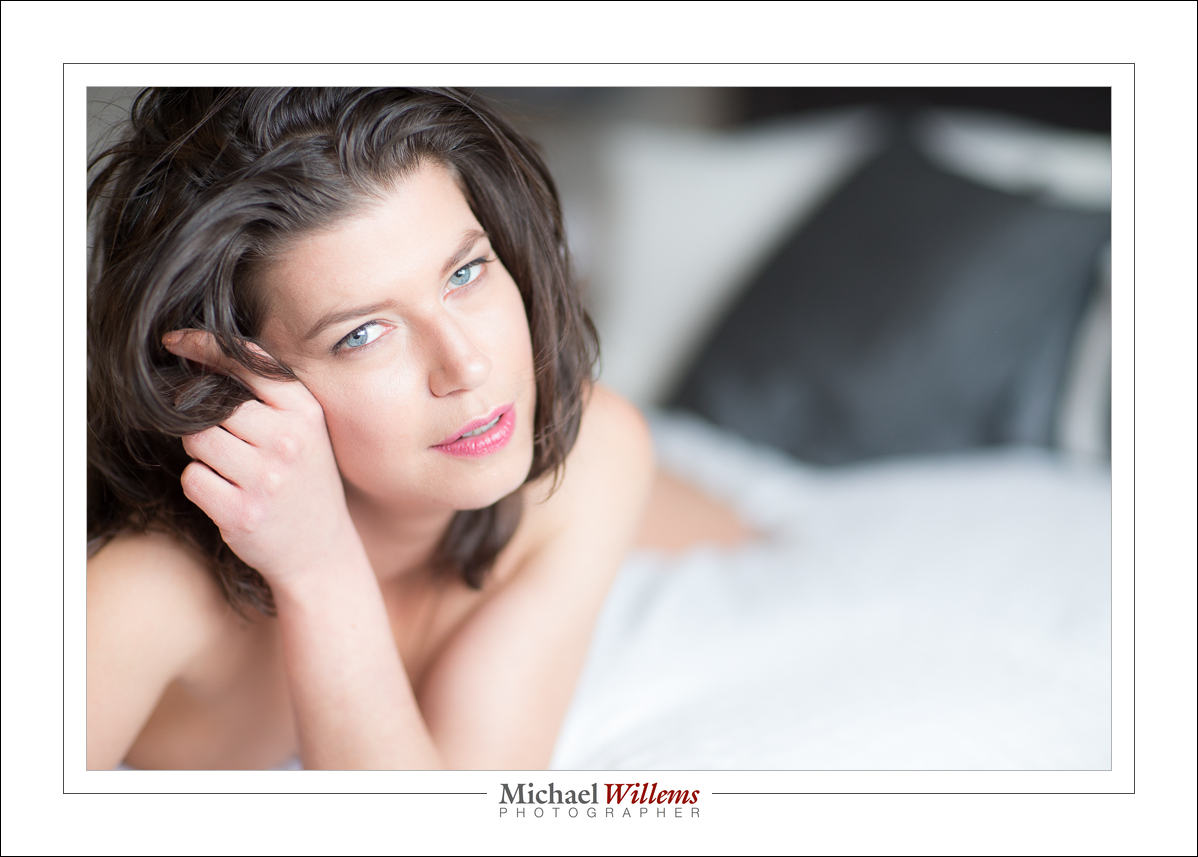
Sometimes, what you do not see in a picture is as important as what you do see.  Like in this picture:

There are four reasons I may want to blur the background: It would be distracting. And it is not really part of  the story. And implying is sometimes best. And I might not want it in the image for “facebook/SFW-reasons”.

So I shot this at 800 ISO, 1/160th second, f/1.8, using my 85mm f/1.2 lens.  Yes, f/1.8, and the gives me extremely shallow depth of field, and an extremely blurred background.

Wonderful, but it necessitates me using a very steady hand. After I focus (on the eyes) neither I nor the model must change our distance even by a few millimeters.

Here’s one more, for good measure:

Now, the lens. My 85mm lens on a full frame camera is equivalent roughly to a 50mm lens on your crop camera. And the 50mm f/1.8 lens incredibly affordable and great. So.. if you do not have one, get one. And if you do, use it!


Go Toward The Light

One thing beginners often forget is the light;l specifically, where is it coming from.

So tip: always ask yourself that in every picture. Where is the light coming from.

In the picture above, I asked my model to turn towards the light (which was window light on the north side of the room; i.e. soft reflected light). If I had not done that, the back of her head would be lit. In portraits, I think carefully about where the light should be coming from, and usually the answer is “from 45 degrees above, in front of the subject, perhaps left or right slightly”.

And you can do the same. As long as you ask the question!


Pro Aesthetic

Yesterday’s shot of the day was an “amateur” pro shot. Today, a “pro” pro shot. This one:

Lit how? With one off-camera flash (a Canon 430EX II speedlight) on the right, shooting through an umbrella. Using a 50mm lens.

The secret here is the “looks like it’s photoshopped in” look. Without actually using Photoshop or Lightroom. This is shot in camera. And you get this kind of “dramatic portrait” look by making the background darker.

How? The recipe for such a bright day, outdoors shot is simple.

  1. Set ISO to 100.
  2. Set shutter speed to 1/250th sec (the fastest sync speed; on some cameras it is 1/200th or even 1/180th)
  3. Now select the aperture that gives you a dark background, ca “minus 2” on the meter. This is generally between f/5.6 and f/18, depending on how bright it is. In the above shot, it was f/13.

That’s the background done. Now the flash:

  1. Set the camera to master/commander, and ensure the flash on the camera only issues commands (i.e. it is “off” when the actual picture happens).
  2. Set the remote flash to slave/remote
  3. Put it on a light stand and use a modifier like an umbrella if possible. 45 degrees up, on the side. (If possible: if you are shooting at f/18 the flash may not have enough power when you use a modifier, unless it is very close to the subject.)
  4. Test shot. If the flash part is to bright, use flash exposure compensation (FEC) to turn it down a stop. If it is too dark, try FEC as well, but the reason may be “insufficient available power”; in that case, bring the flash closer or dispense with the modifier.

And that’s the shot you get. Simple, very simple. now you go do it!

___

Learn all about this: Buy the Pro Flash Manual

More hands-on courses in Oakville imminent: see http://cameratraining.ca (http://cameratraining.ca/Schedule.html for the schedule). See the Kelby quote on the front page 🙂