Wedding lenses

For today’s wedding I used a 35mm lens, a 16-35, a 24-70, a 70-200 and a 100mm macro. At a later day (when I am not falling sleep after working 7am-midnight) I will go into more detail But for now:

Macro for close-up detail:

Wide for environmental shots;

And use telephoto for farther-away detail:

More on technique in the next few days!

Site of the day

I see that this site is today’s Site of the Day at http://www.1001noisycameras.com/ – that’s great! Welcome, 1001 Noisy Camera fans.

As you will see, on this blog I teach daily – a teaching post every single day. Enjoy, and search back through the past year – many useful tips here from a working photographer and teacher to everyone who is interested!

Few posts of mine come without a snap or two, so here are a couple from yesterday’s shoot – the Hon. Minister Harinder Takhar MPP, a truly charming man:

The Honourable Minister Harinder Takhar, MPP, photographed in June 2010 by Michael Willems

The Honourable Minister Harinder Takhar, MPP

I used three lenses: one long (70-200 on the 1D Mark IV) and two wide (24-70 and later 16-35 on the 1Ds Mark III).

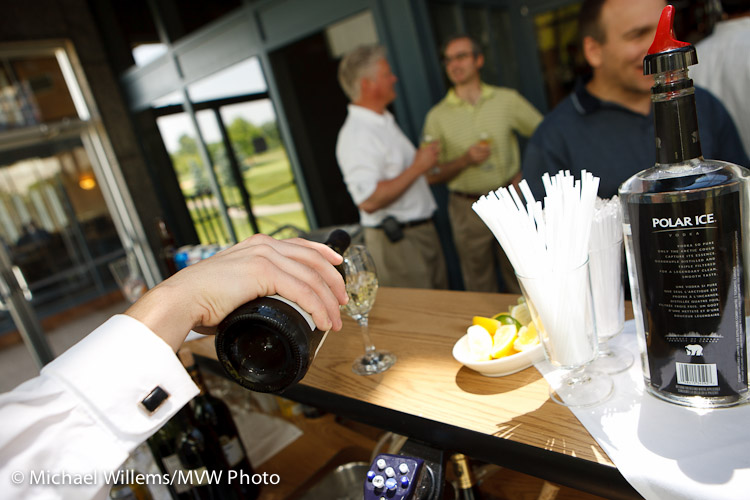
Wine being poured at a reception, photograph by Michael Willems

Wine being poured, photograph by Michael Willems

Manual and with a flash for fill.

Reception Buffet, photograph by Michael Willems

Reception Buffet

Cheers,

Michael

Le Chat, etc: Montréal ce soir

A quick walk through Montréal. 32-12800 ISO and Lightroom noise reduction.. Wow. Wow. And wow. Both Montreal and the low noise performance:

Montreal church, by Michael Willems

Montreal church, by Michael Willems

Montreal Wall, by Michael Willems

Montreal Wall, by Michael Willems

Montreal, by Michael Willems

Montreal

And my favourite:

Le Chat, photographed by Michael Willems

Le Chat (en Montréal)

All this shot handheld with a 1D Mark IV and a 16-35 f/2.8 lens. At ISOs up to 12,800, and with Lightroom 3 noise reduction applied.

Snapshot rules

Even when you take a simple snapshot, as a photographer you should think about how to do it. Almost subconsciously, I apply the same rules and the same thinking to a snapshot that I do to a photo I am paid for.

So I thought it might be worthwhile to discuss some of that thinking. In that context, here is a snapshot I took the other day of a friend:

Michael's friend Ninon, shot with a wide angle lens

Michael's friend Ninon, shot with a wide angle lens

In the second or two before I take that snap, what is some of my thinking, and what are some of the decisions I make?

  • Subject: What is this a photo of? (it is a happy snap, so “camera-aware” and a smile are just great). Check.
  • Light: Where is the light coming from? In this case it is from her front, indirect reflected light, i.e. nice flattering light. Check.
  • Lens choice: I want to use a wide angle lens here because this is a situational portrait, a city woman in her city. Wide angle lenses put a subject in context. I want a wide angle lens also because it creates those nice diagonals that converge on the subject, can you see them? Finally, I also want wide angle to show depth in the photo (a technique knows as “close-far”).
  • Depth of field: I want to draw attention to my subject by blurring the background, so I use Aperture mode (A/Av) with an aperture of f/2.8. Wide angle lenses are sharp all over, but by using a fast one (f/2.8) and by getting close I can still blur the background dramatically.
  • Composition: I am using the rule of thirds. “Uncle Fred” puts the subject in all his images smack bang in the middle: I use off-centre composition. In this case the centre of attention (her face) is one third from the right, one third from the top. And she is looking into the picture, not out of it.
  • Moment: you need to capture the right moment. I shot four times and by photo number four, her smile was best. Shoot a lot, even in a portrait. so you capture just the right moment. I also thought the right moment included the “suits” in the background. After all, King and Wellington, downtown Toronto, means suits out for (if not out to) lunch. So I was delighted to see them approach and took the four shots just as they passed behind her.

That is, in a nutshell, what I thought in the seconds leading up to this picture.

That is my thinking. Yours may have been different, and that is of course perfectly OK. There is not one good picture: there are 100 billion. The essence here is not what my conclusions were, but the fact that I was thinking at all, instead of just blindly snapping.

Light, moment and composition/subject, that is what makes up a picture. So think of those every time you take one, and your pictures will get better.

Berlin Wall

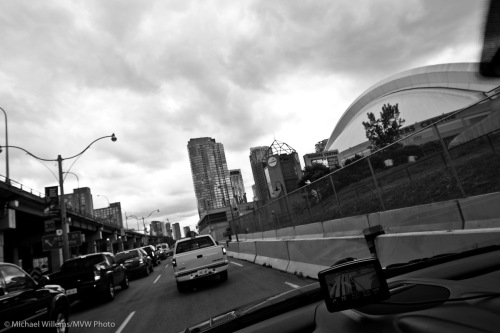
Toronto, for the next weeks, has a Berlin Wall, designed to keep any protesters and citizens (a.k.a. “threats”) away from the visiting G20 dignitaries, who must not see any of this.

I took a few snaps yesterday, from the car:

Toronto's G20 Security Fence, shot by Michael Willems

Toronto's G20 Security Fence

Toronto's G20 Security Fence, shot by Michael Willems

Toronto's G20 Security Fence

Toronto's G20 Security Fence, shot by Michael Willems

Toronto's G20 Security Fence

Army presence in the street, riot police, many extra Big Brother cameras, constant ID and security checks, roads closed when VIP convoys arrive, a large part of downtown that will be completely shut off for two days, cell phones that will be jammed when Mr Obama is around, and a $1bn bill for the taxpayer: very third world, and I thought that was probably worth a few dramatic black and white pictures.

Am I being ever so slightly manipulative, by using contrasty black and white?

Perhaps, and in news photography I would not of course use any contrast enhancement, or even go to mood-setting black and white. But in this type of documentary shots, on my blog, it is exactly what is called for. I believe the Berlin wall thing is hideous and that must be shown: outrage is suitable.

That said, you should be aware of the fact that just like a writer, a photojournalist can also tell the story he wants. A protest with only forty protesters? Shoot diagonally from above and it’ll look like hundreds. Black and white creates drama. When looking at news pictures, see them in this context, and ask “what was the journalist doing to put across his point of view?”
Capture the detail

When shooting anything, including events, always make sure you catch little details, not just the big overview pictures. Like this, from a recent corporate event shoot:

Snacks at an event: a food shot by Michael Willems

Snacks at an event: an impromptu food shot

Wide open aperture, bounced flash, camera to manual: grab shots like this and you add to the story.

Why use artificial light?

In yesterday’s post, I talked about making “hyper-real” images by using light coming from unexpected directions.

Today, another reason to use artificial light in photos: because the available light is too contrasty.

Here’s a picture of a model last Sunday in available light in the forest. Horrible contrast: pretty girl and great model, but not a picture I would use:

A model in natural light, photographed by Michael Willems

A model in natural light, in the forest

No, that just will not do.

Instead, let’s use a strobe in a softbox, and a gridded light as hairlight. Now we get:

A model in outdoors studio light, photographed by Michael Willems

A model in outdoors studio light

You can easily see how much nicer that is. The soft strobe light overpowers the sun, and removes the harshness and the contrasty nature of the available light. It also allows me to decrease the exposure of the background.

So next time you see a photographer lugging light stands and batteries and cables and such, you know why.