Using light today.

I shot Victoria Fenner today. But only, you will be glad to know, with a camera.

Let me talk you through that, shall I?

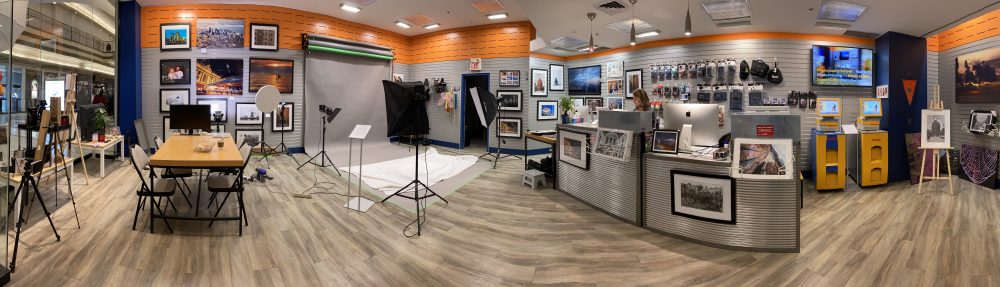
Victoria is an audio expert. She used to run the studio at McMaster University that we shot this in. We decided to shoot her doing her thing – and sound is her thing. So we shot in a studio first:

Camera: I shot her with a Canon 1D Mark IV. The camera was on manual at 100 ISO. I used a 24-70 lens set to around 24mm – meaning around 30 “real” mm.

Light: the camera was equipped with a 580 EXII flash to act as e-TTL “master” to drive three 430EX speedlites:

  1. The “A” flash through an umbrella on camera right, shining into Victoria’s face. An umbrella throws nice soft light, great for faces. (There is a certain irony in the fact that we use the word “umbrella” to name this thing that throws around this nice light. Umbra means shadow!)
  2. One “B” flash with a green Honl Photo gel in the background – I love adding a splash of colour, and green goes very well with purple.
  3. Another “B:” flash, fitted with a Honl Photo 1/4″ grid, as hair/accent light shining toward the camera. You can see it just outside the field of view.
  4. I set an A:B ratio of 4:1 to 8:1.

All this took about ten minutes to set up, and ten minutes to take down.

Then we shot some outdoors. For this, I used two flashes off camera: one into a Honl gold/silver bounce card; the other using a grid, as before. Yes, in bright sunlight you can fire these flashes using light-controlled TTL.

This was a bright day in April around noon. But it does not look like noon light, does it? I shot in Aperture mode, with -2 to -3stops exposure compensation. That darkened the background to give it colour saturation. The flashes took care of the foreground.

Balancing light

One subject photographers need to learn all about it balancing light. In particular, I mean balancing background light with foreground light.

If you take one of my workshops I’ll teach you all about “overpowering the sun”.

As an illustration of that, three years ago almost to the day I took a few snaps of my son in Army Cadet uniform. The sky was mid-day light blue, but I used three off-camera flashes, two of which were in umbrellas and one was direct, to overpower the sun and make the sky dark:

I used the 5D in manual exposure mode, set to -3 stops from ambient, and used TTL metered flash. Piece of cake. And yes, remote flash using light control does work in super bright sunlight, as long as you keep line of sight between the master and slave flashes.

Can you also see that for this portrait I used a very wide lens? Even though you are not supposed to do that for portraits? That is because it is a situational portrait. Where the environment is as important as the subject. Just keep your subject’s face away from the edges – centre, or near the centre, is good.

A portrait with three speedlites

Here’s a portrait I just shot.

I used the Canon 1D Mark IV with a 580 EX II flash on the camera, used only to drive three 430 EX II flashes using remote e-TTL. This is easier than ever: with the right knowledge and tools it takes mere seconds to arrange.

So here’s how I did it.

I used a 50mm prime lens (meaning 65mm effective focal length) with the camera on manual, 100 ISO, f/5.6 at 1/125th second.

The lights were:

  • One 430 speedlite, the key light, is on camera left one foot away from the subject and is mounted on a cheap light stand. It is equipped with a new Honl Traveller 8 softbox.
  • The second, the accent light, also on a light stand, is one foot behind the subject, is aimed forward at her, and has a Honl 1/4″ grid fitted.
  • The third flash, aimed at the wall, is mounted on its little plastic light stand and has a green Honl gel fitted to its speed strap in order to add a splash of colour to the background.
  • I set an 8:1 A:B ratio to stop the accent lights from becoming too bright (the key light was A). I also used – 1/3 stop Flash Exposure Compensation, since the initial frame showed the face a bit bright.

That setup was:

Simple and effective. And if I say so myself, I think the green gelled background accent was an inspired choice.

Today, with small flashes and modifiers, using TTL, you can do professional studio work in no time.

Fast Flash!

To exceed your camera’s maximum flash sync speed (which is something around 1/200th – 1/250th second), you need high speed flash (Auto FP flash, in Nikon terminology) where the flash pulses at ca. 40kHz instead of firing all at once.

You need an external flash for this, like an SB900 or a 580 EX.

  • When you need it: when you need to exceed your flash sync speed, e.g. when taking an outdoors picture of close object with blurry background. That means low F-number, which means even at 100 ISO you’ll need fast shutter speeds.
  • Advantage: in theory, you can you can go to any fast shutter speed and still use flash.
  • Drawback: you lose much power, so that Fast Flash is usually only suitable for close-by subjects.

The Shot: Shoot a close object or person with blurry background. To achieve this, set your camera to A/Av mode, and select a wide open aperture (f/2.8,say). (If your lens cannot go down to f/2.8 or it is a very dull day, you may need to go to 400 ISO).

You should now be exceeding your flash synch speed-if you set your flash to Fast Flash. Else you get an overexposed picture (your camera will refuse to go faster).

Note, your object has to be close, especially if you get to speeds of 1/1000th o rfaster. Else, your flash will not have enough power.

And now you can get this – the following image was lit by flash at 1/1600th second, at f.2.8!

The importance of being saturated

…as in colour. Today:

I took this picture yesterday and it shows a few things:

  • Lower the background’s brightness = increase its saturation
  • To add excitement, add a splash of colour!
  • In particular, add red to the green and blue you find in nature
  • Dramatic lighting = contrasty lighting

Five speedlites were used in the production of this picture. Four on the sides and one behind me. they were fired via pocketwizards.

In any shoot, the worst thing a photographer can encounter is bright light.

Why?

Here’s why. Think along.

  • The available (ambient) light will be fill light.
  • That, and the fact we want these saturated colours, means it will have to be darker (say, two stops darker) than the main, flash light.
  • That means the flash light has to overpower it (by, say, two stops).
  • That means the flash has to be two stops brighter than the sun.

That’s why we call this “nuking the sun”.

For which we needed five flashes, four on the sides and one behind the camera. Firing at full power, mostly.

(That much because ambient is controlled by ISO, aperture, and shutter speed. Shutter speed cannot go beyond 1/200th second (or whatever your synch speed is).  ISO is low already. So aperture is the only way to affect the background.  But Aperture also affects flash exposure so for each stop you close the aperture you need to double flash power.)

Studio Settings

A few words to get you started on studio portrait setups.

When you are shooting in a “studio” (i.e. controlled) setting, your camera settings might be, as I recently pointed:

  • Camera on Manual
  • 100 ISO
  • Auto ISO disabled
  • 1/125th sec
  • f/8
  • “Flash” white balance

Why as small as f/8?

Because lower aperture numbers than 5.6 can give you too selective a depth of field; and with most lenses, higher numbers than f/8 create diffraction, meaning slight blurriness. If you like sharp, stick to f/8 or perhaps f/5.6.

You also use f/8 or similar because studio lights are powerful. (Someone the other day searched for “how to shoot wide open with studio light” – often, the lights are so bright even on their lowest settings that the only way to do that  is to use a neutral density filter on your lens).

And lenses?

For portraits, I use 50-200mm. Smaller focal length (like 50-70 on a full frame camera) makes a woman’s body smaller (if I shoot at head height). Larger makes the nose smaller, but can make the body slightly bigger. I.e. larger gives you no distortion, but sometimes ever-so-slight distortion is exactly what you want. My favourites are:

  • 24-70 2.8L
  • 70-200 2.8L IS
  • 50mm f/1.4 (for use on the 7D, or for body shots on the 1D Mark IV or 1Ds Mark III)
  • 35mm f/1.4 (for environmental portraits)
  • 100 mm f/2.8 macro (yes, a macro lens is a great portrait lens)

But you can keep it simple! A Canon Digital Rebel or Nikon D90 with a 50mm f/1.8 lens, for instance, will allow you to take great razor-sharp studio portraits. It’s all about the light!

Shutter speed?

Quick rule of thumb:

  • Stay roughly at 1/lens length or faster to be sure your pictures are not shaky. Roughly! So for a 100mm lens, stay faster than 1/100th.And so on.
  • Hold your lens at the end.
  • Take 5 or more pictures – one will be sharp.

Quick, as rules of thumb are. But useful!

Flash from behind

Look at this picture, which a student took of me in a class the other day:

Michael Teaching

Can you see how she turned her flash behind her, so it aimed at the wall above her, which in turn lit me with soft, gentle light? Otherwise, if she had aimed it at me directly, we would have seen all the things that people hate in flash:

  • oily skin
  • flat face
  • dark background
  • overexposed subject
  • shadows under the chin

Instead, we get soft, natural looking light.  And it’s easy: turn the flash so that the light bounces behind you. With TTL, it’s easy: the camera does the math. You just push the button.

That wired effect

Here’s a picture I just took of my favourite patient model. I used some technique to get that dramatic “Wired” effect:

The way I made this picture:

Camera:

  • Camera: Canon 7D with 50mm f/1.4 lens
  • Set to Manual, 1/125th sec, f/8, 100 ISO

Flash:

  • Multi-flash TTL with one on-camera and two off-camera flashes.
  • One “A” Flash on the camera (580 EX) as fill flash and “commander”;
  • The main lighting was rim lighting: two 430 EX flashes either side of the model, slightly behind, set up as “B” flashes.
  • I was using a 1:8 A:B ratio.
  • The 430 flashes were each equipped with a Honl 1/4″ grid, to stop their light from hitting the entire room.
  • Flash compensation -1 stop to avoid overexposing the rims (this is common when your main flash lights only a small part of the picture).

Post:

  • And finally, I desaturated the colours in Lightroom: Presence +15, Vibrance -20 and Saturation -40. I also did a version where I desaturated only red and orange, and increased sharpness, which is the usual technique.

Try it yourself, or come to our two-day Light workshop 10+11 April to learn exactly how to do this.