One Day Special: Advanced Flash

Good news. The One-Day Only Special “Michael Willems’s Advanced Flash”, with special Guest Star David Honl (yes, the David Honl, the inventor and creator of that great range of small flash modifiers!), is now open for booking.

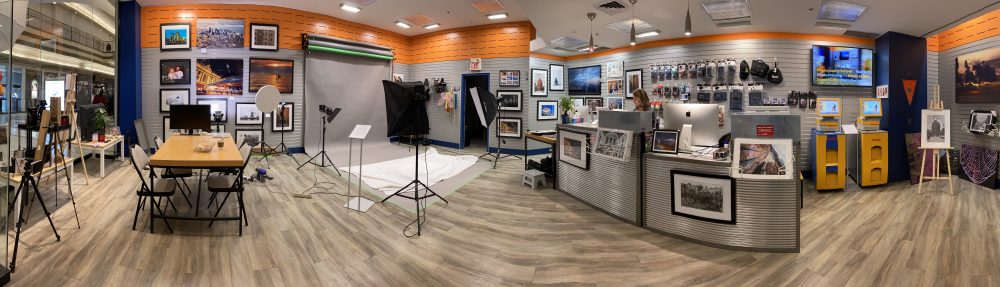
  • When? March 19. From 11AM until 2:30PM
  • Where? Downtown Toronto, Henry’s School of Imaging flagship location at Church and Queen Streets.
  • What? Check the syllabus at www.cameratraining.ca/Flash-Honl.html
  • How Much? $175

Registration is limited, so go to the Henry’s School of Imaging site today to reserve your space – click here:

www.schoolofimaging.ca/Courses/64044-Advanced-Flash.aspx

Registration is open now and space is limited, so I recommend you book soon if you are interested. In this four-hour workshop in downtown Toronto, you’ll learn a lot about advanced use of flash, and Dave will show you some signature shots made with simple, small flashes that you can also afford.

Not to be missed if you would like to be exert at using small flashes to create professional shots, even when the light is tough.

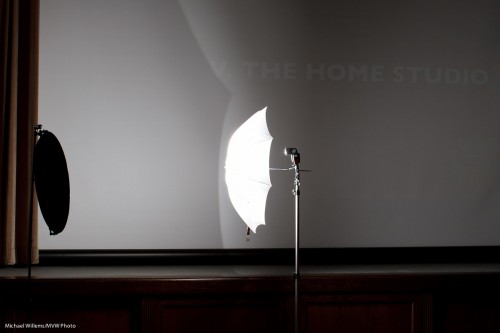
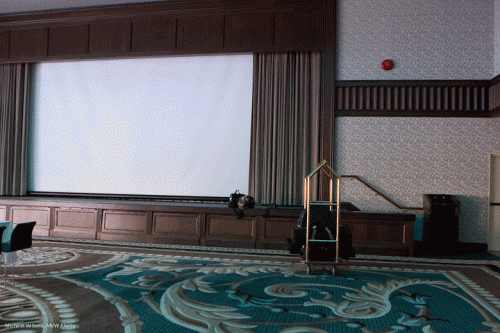
About that home studio

One more about the simple TTL home studio. I can give you some pointers to do your own.

Here’s how.

You need:

  1. A modern SLR camera.
  2. A lens – anything over 50mm will do. A 50mm f/1.8 might be a great choice: sharp and affordable (and if you need it, fast).
  3. If you have a Nikon, or a Canon 60D or 7D, just one flash (a 430EX/580EX for Canon or an SB600/SB900 for Nikon).
  4. If you have a different Canon camera, an additional 580EX to command the other flash.
  5. An umbrella (shoot through).
  6. A stand for the flash, with a mount for flash plus umbrella.
  7. A reflector (silver or gold or white, or a multi-purpose one).
  8. A stand for that reflector.

As an option, another flash with a small stand to light up backgrounds, but this is not a must have. You can just move the umbrella and subject closer to the wall if you want the wall to be lighter.

Now that you have the equipment:

  1. Set your flash to “slave” (Canon) or “remote” (Nikon) mode. Use the manual to find out how. On a modern Canon with a modern flash you can use the camera to set the flash.
  2. Set up your on-camera flash to be the “master” (“Commander”, on Nikon).
  3. Ensure that the on-camera flash is not going to fire (it will only  send commands to the remote flash, but it will not actually fire – else you get a shadow).
  4. Move the umbrella close to your subject. For a “standard” portrait, the best position is 45 degrees up, off to the side 45 degrees.
  5. Move the reflector close on the opposite side.
  6. Set your camera to manual exposure mode, f/8, 1/125th second, 100 ISO (or 200 on a Nikon).
  7. Take a test shot.
  8. Check the histogram. If you are shooting a dark subject against a dark wall, you may need negative (perhaps -1 stop) Flash Exposure Compensation; if you are shooting a light subject against a white wall, you may need positive (perhaps +1 stop) Flash Exposure Compensation.
  9. Make sure there is a catch light in the subject’s eyes. Ensure that any glasses do not reflect (move subject or umbrella if they do).

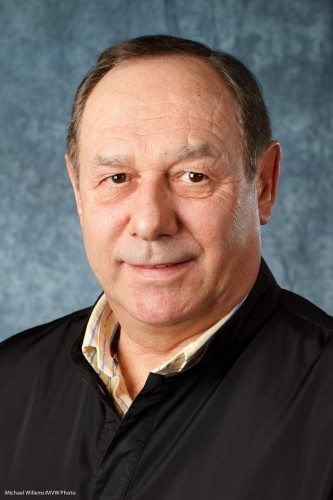
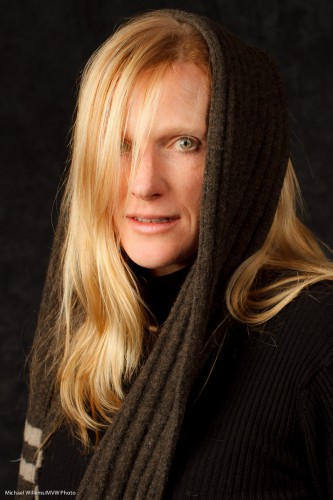
It is as simple as that. You will have studio quality shots, for very little investment. Shots like this (which I made with the exact setup above):

With a modern camera and flash and a little knowledge, it really can be that easy.

Granigif

That cryptic title means “Animated GIF at the Granite Club”. Which is where I was teaching portrait photography last night.

I cannot image a more fun way to spend an evening: some of the most committed, fun, outspoken, and friendly people I have had the pleasure of teaching.

So let’s start with how I set up. Click below to see it as an animated GIF. The time elapsed here was over an hour:

Studio Photography Lesson Setup, by Michael Willems

Studio Photography Lesson Setup, by Michael Willems

Last night was a lightning-fast lesson in portrait photography basics, from lights to pocketwizards to positioning techniques.

The interesting thing, I think, is that while for full control, the more “stuff” you have the better, you can often keep it remarkably simple.

A shot with “the standard four lights” might be this:

Portrait at The Granite (Photo Michael Willems)

Portrait at The Granite

That uses a key light (softbox), a fill light (umbrella), a hair light (Honl snoot), and a background light (Honl Grid).

But you can also keep it simpler. For a lady with light hair, I would not light up the background. We would also not really need the hair light. So now indeed it is simpler:

Robbin at The Granite (Photo: Michael Willems)

Robbin at The Granite

Beautiful, no?

But the real surprise is the simple setup on the left: you can just see it. A TTL flash through an umbrella. A reflector to provide fill light. And a background light to add a bit of brightness to the available background. Now all we are using, then, is two flashes and some affordable stands and a reflector.

That gives us:

Matt at The Granite (Photo: Michael Willems)

Matt at The Granite

You see: you can often keep a studio setup simple. Why use a light when a reflector will do just as well?

Studio photography is incredibly rewarding. If you think so too, I strongly recommend you take a course or private coaching and learn how to do it.

Another…

…delayed post. Things in my life are intervening, but here is a snap: a food shot. Inspired by the feeling that at 2am, I am hungry.

How do you shoot that?

  1. A soft light above the food (a flash in an umbrella).
  2. A back light from behind the food, to give it that extra sparkle (and to light up the steam).
  3. A simple composition.

Simple once you know, as always.

Another light example

Here is another lighting example for you.

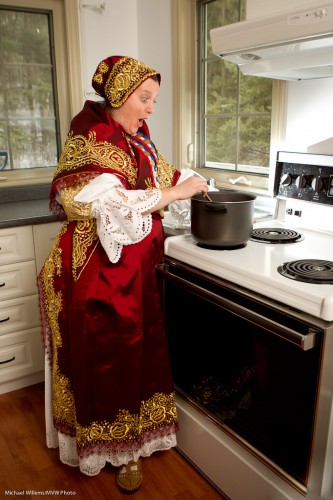
A very nice lady with an amazing traditional dress (which I am told took a year to make, which does not surprise me):

Croatian dress and mystery pot (Photo: Michael Willems)

Croatian dress and mystery pot

So how was that lit?

Here’s how.

  • First, I exposed properly for ambient light. That is why the background foliage looks good.
  • The camera, of course, is on manual.
  • Then, I added a main light on my right – a strobe in a softbox. This again gives us nice soft light. Fired by pocketwizards.
  • Then finally, I felt it needed more. So I used a speedlight in the sink, on manual, fired also by pocketwizards.

That’s how. Try some of the same if you have time!

A picture

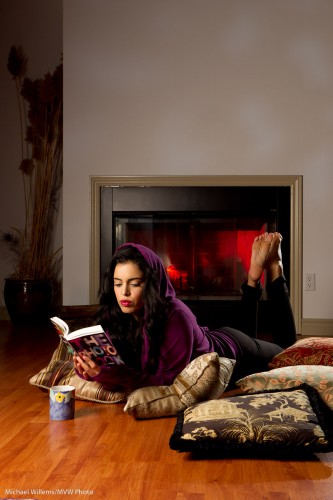
I would like you to look at this picture and see if you can tell how it was lit:

Tara Elizabeth (Photo: Michael Willems)

Tara Elizabeth (Photo: Michael Willems)

So I’ll give you a few. It is all artificial.

  • The main light is a strobe in a softbox on our left. This leads to nice soft light onto the model’s face.
  • Then, a flash with a grid, on our right, behind Tara. That gives us the oh-so important rim light.
  • Now look at the fireplace. Is that a fire? No – the wood would not light, so it is a speedlight fitted with a red Honl Photo gel. Those gels are incredibly useful!

The mottled light on the wall – that is more involved. Think cookie cutter (it too is artificial), and take one of my advanced lighting courses one day (see www.cameratraining.ca).

Also, keep March 19 open for a special Advanced Lighting course I am putting on in Toronto with David Honl (yes, the David Honl) as my special guest! The location and further details will be announced soon.

In the mean time: start thinking about how to light a scene with multiple lights.

Post soon

No time until tonight. But In the mean time, a note: Watch the June issue of Photolife magazine, Canada’s premier photography magazine, for an article about event shooting. Just saying…!

Also keep 19 March free for a special Toronto workshop with special guest David Honl!

Another reader question

A few days ago, reader David asked me this:

Just wanted to get your input on a upcoming event I will be shooting on Friday night. The events will be group shots (family and player) at a high school basketball game for their ‘Senior Night’. Since it will be in the gym with very high ceiling, bouncing off the ceiling does not seem to be a viable option. I was thinking about bouncing using a gobo card. Since the room will be filled with lovely (not) florescent light and wonderful (not x 2) swamp lights overhead, I could bounce the flash as a fill light to help get rid of the awesome green tones. The second option is to use an off camera 580EXII with a Honl Traveler 8 softbox (close to camera center maybe). The third option (since I believe in the power of 3) would be to use my Fong Reporter Whaletale with and on-camera flash. I am interested in “what would Michael do?” (As a a side note: I typically use a gray card to get a good white balance. I shoot everything in RAW, so flexibility in post-prod adjustment is not an issue.)

Good question, David.

For basketball I would say the following. First, here’s an example of a basketball pic I shot.
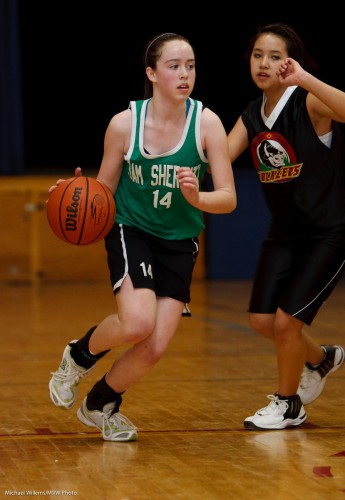
That was 1600 ISO, f/2.8, and 1/300th second.

And… oddly for the Speedlighter, I used flash, straight-on. As you correctly surmise, ceiling bounce or wall bounce can be difficult.

So this is one case where, if it is allowed (Ask the coaches! In high school basketball it will often be allowed) you can use straight-on flash to fill in the light. Of course this means recharge time between shots,  but if allowed, you may want to do it. Also watch out, you could get red-eye – easy correction of course, but still, you have to do it.

Alternately, you can bounce of a larger bounce card. That will mean less power and more recharge time, but it can be viable.

Of course you can also choose to live with the light that is available.

You other options are good to try, too. Off-camera is not likely to be much help though since at the distance you are shooting at, it’s close to the camera even if held a few feet away. The softbox, ditto, and you lose light.

Also, the long lens is great but do not forget the wide lens for close shots. And:

  • If you can, bring two cameras
  • Ask the coaches if you can use flash
  • Get close ups
  • Shoot under the rim, but be careful behind it – balls will hit!
  • Shoot vertical shots
  • Get the back of shirts to get the numbers
  • Shoot emotion: happy, sad, angry
  • Shoot action: close up
  • Shoot static for each player too

I hope that helps… and yes, I did answer this reader before that Friday!
A few travel snaps

I thought that perhaps today I would just share a few travel snaps.

Can you guess which city I took these in?

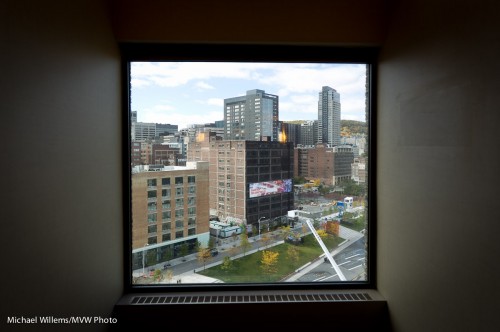
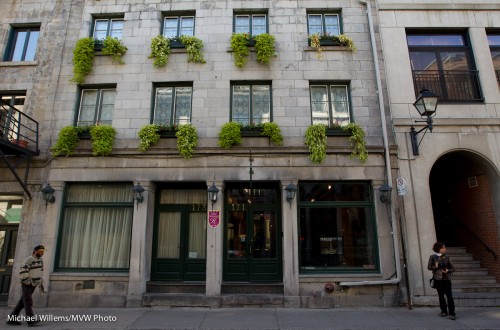
Using available framing:

Quartier Des Spectacles (Photo: Michael Willems)

Quartier Des Spectacles

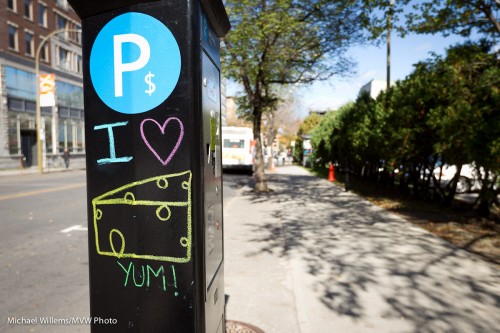
Emphasizing by using selective depth of field:

Yum!  (Photo: Michael Willems)

Yum!

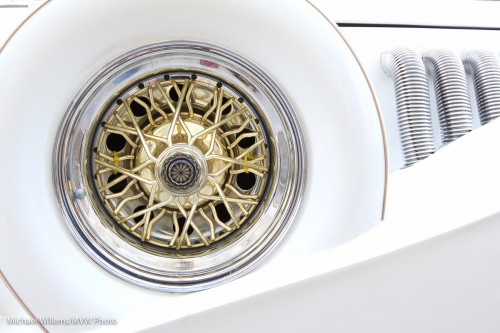
Using detail and simplifying by getting close:

Limo  (Photo: Michael Willems)

Limo

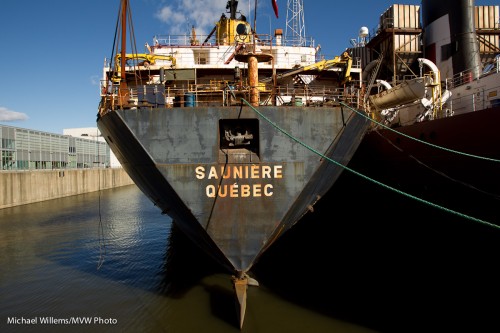
Using colour by exposing well:

Ship  (Photo: Michael Willems)

Ship

Showing people:

Snapping a snapper (Photo: Michael Willems)

Snapping a snapper

You have guessed which city this is, by now, perhaps ?

Ask not what speedlighter can do for you…

…okay, that is cheesy. But I just thought I would point out that I would like my message to go out widely, and that if you like this daily teaching blog, you can help:

  • Click on the “share” link under a post to share it on Facebook, etc.
  • Tell your friends.
  • Link to the blog or to posts you like.
  • Read comments; Comment yourself; and comment on other comments.

Shukran jazeelan! (That means “thank you very much” in Arabic).