Portrait lenses

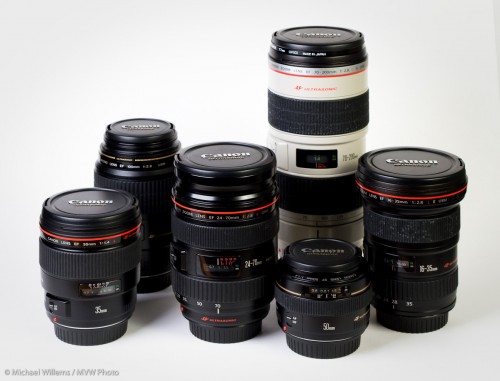
“What do you use for a portrait lens”, is a common question.
Michael's lenses

Michael's lenses

OK. So my favourites include:

  • 50mm f/1.4 for half-body shots (1Ds) and headshots (1D). Especially for avaialable open light portraits.
  • 70-200 f/2.8 for flattering headshots, in big studios.  A favourite… man, that lens is sharp.
  • 24-70 f/2.8 for fashion, etc: great for generic portrait shots.
  • 100 f/2.8 Macro for headshots: did you know, macro lenses are also great portraits lenses?
  • 16-35 f/2.8 for party shots. Wide allows me to inlcude dramatic views of room, food, etc.
  • 35mm f/1.4 for “dark party” shots, and environmental portraits.

Huh? All your lenses, Michael?

Yes. And I hope that helps show that there is not one answer to this question.

The “50-100mm” standard answer is an oversimplification. There is not “one portrait”, and nor is there “one portrait lens”.
Shout it out

Or rather, perhaps you should not.

I do not much like to use branded camera straps – like the Canon camera straps on my Canon cameras.

First of all, much as I love all my Canon equipment, without being paid for it I am not sure I should be an advertisement. Also, my fashion sense likes to think I do not have to match everything with Canon red. Black is easier.

More importantly, when I travel I like to avoid anything that draws attention to my gear. Every little bit of theft avoidance helps: tape over the name, a brandless lens cap (if you even use them), and these non-branded straps.

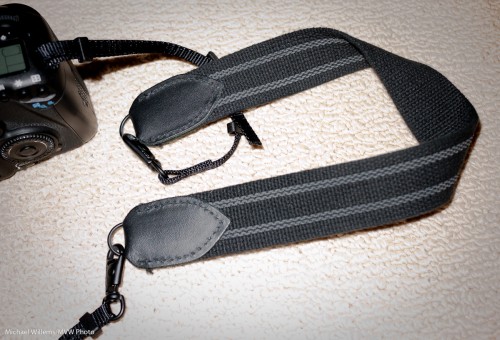
So I use these Domke straps on all my cameras:

Domke Camera Strap

Domke Camera Strap

These aftermarket straps have several other big benefits:

  • The rubber strip through the material ensures a good grip on my shoulder.
  • The strap is removable: two fasteners can be opened, and then the strap is gone. This is very handy when I want to switch to my Black Rapid strap, and need to remove the usual strap.

That is why I give my pick this:

Michael’s Quick Judgment: a big thumbs up.

A shoot

…from beginnning to end product is a lot of work. And seeing how others do it is very interesting. Tomorrow, I am attending an all-day session with Ivan Otis at Henry’s in Toronto. (Where I teach, as it happens… so I just happen to know there is may still be one or two available spaces: sign up before it starts at 10AM tomorrow and get to Queen and Church St, Henrys: link here).

Juxtapose!

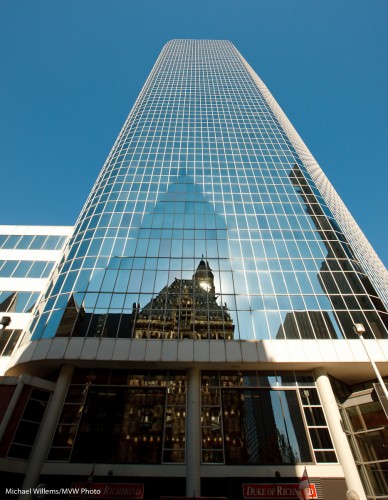
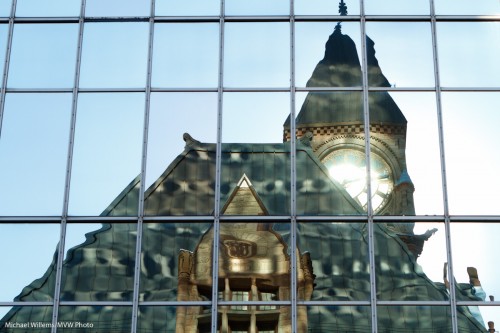
What I mean, in today’s tip, is this: your pictures look interesting if there is a juxtaposition in it – a contrast, an unusual difference between opposites.Big and small. Ugly and Beautiful. Organic and technical. red and green.

Or like in this picture, old and new:

Old and New

Old and New

When a juxtaposition is combined with another “interest”, such as “curves”, or here, “reflections”, so much the better.

And here one more, with blue and an intriguing shadow: intrigue (making the viewer work it out) is always good in pictures!

Old and New and Blue and Shadow

Old and New and Blue and Shadow

ISO rule of thumb

I am often asked about ISO. So here is a “rule of thumb” post on that subject.

Michael’s standard starting points:

  • Outdoors: 200 ISO
  • Indoors (even when using flash): 400 ISO
  • “Difficult Light” (eg museums, dark halls): 800 ISO

Michael’s exceptions:

  • Using a tripod: 100 ISO (as long as nothing moves)
  • Hockey, etc: 1600 ISO

In each case, go lower if you can, and go as high as you need to, when you need to.

Scale and grandeur

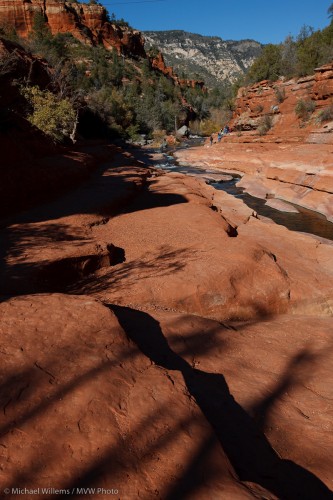
It is important to add both a sense of scale and a sense of grandeur to landscape photos.

You add grandeur by using a wide lens and getting close to something (even the ground). That shows the size.

And you add scale by helping the viewer. Adding people is a common technique, as I did in this image of Sedona, AZ, in December last year:

Sedona, AZ

Sedona, AZ

You need to see that image real size to really see it (click through, then select full size). And that brings me to today’s last tip: make it big. Large prints are sooo much better than 4×6 prints.

Size matters (2)

As I said earlier, in sensors, bigger sizes are better.  Let me expand on that a little.

A bigger sensor means five essential things:

  1. Lower “noise” (and hence, greater ability to shoot in low light).
  2. Greater ability to use selective focus (“blur the background”).
  3. Better use of the maximum resolving power of the lenses’ glass.
  4. On an SLR, a bigger, brighter viewfinder.
  5. Greater ability to use small apertures (high F-numbers”), which otherwise lead to distortion due to the bandwidth of light – so this is physics, and will not be overcome. This is why lenses have a “sharpness sweet spot” – say, at around f/8 on a full-frame camera with a typical lens.

And less fundamentally, but very importantly in practical terms, for those of you choosing between full-frame and crop sensor SLRs, a larger sensor also means that the same wide angle lenses are wider on the full-frame camera.

So what sensor sizes are there?

  • A typical point-and-shoot: 6 x 4 mm
  • Four Thirds (as used in Four Thirds and Micro Four Thirds cameras): 18 x 13.5 mm
  • APS-C, the sensor used on a typical crop SLR, like a Canon 60D or a Nikon D90: around 22 x 15 mm
  • APS-H, a Canon format, as in my 1D Mark IV:  28.7 x 19.1 mm
  • And “full frame”, as in a negative: 36 x 24mm

And every step smaller means less ability to close down the aperture and stay sharp, less ability to blur the background, and more noise.

The benefits of small sensors are the small size, weight and cost; the ability to use small and hence cheap lenses; the fact that they make lenses appear longer (which is good if you are a sports shooter, but bad if you are a wide-angle shooter); and the ability to get close, so point-and-shoots are usually very good macro cameras.

Flash power

A few notes on speedlites today.

How does a flash set its power level? Not by making itself brighter or darker, but by shining for longer or shorter. Using light in pictures is like using a spray can: the longer you spray, the more you get.

So how long is a flash? That depends. It is 1/1000th second on full power. 1/2000th second on half power, 1/4000th on quarter power, and so on. So if you want very short flashes, fire at low power.

How do I fire at low power? Just get closer to your subject or use higher ISO settings. Then set low power (if you use TTL, the camera will do that automatically for you).

But what if I use high-speed flash? Then rather than firing one flash, it fires many very short flashes, at a rate of around 40 kHz. This simulates continuous light, which you need when using fast shutter speeds (over, say, 1/200th sec), where the shutter does not open all the way at any time.

Product release: Those of you who shoot Nikon can go get SB-600s while they last, and then upgrade to the SB-700, a major improvement, if slightly less powerful than the SB-600. And hopefully it will not overheat too easily, like the SB-900 does.

Another event…

As you know, I, both at Henrys and by myself, and with colleague Joseph Marranca, teach beginners and advanced users all manner of photography topics.

And then… sometimes I see a course that complements my courses very nicely. One of those is the upcoming Henry’s Ivan Otis Pro Shoot event on 23 September. Ivan, a well-known and incredibly talented commercial photographer, spends a day with up to 20 people teaching them the mechanics of a full commercial campaign, including working with a full creative team. I happen to know that as I write this, there are a few spots left. Check it out!

Quick Note

Notes to Readers:

  • I see that some of you still come here via the old address, http://blog.michaelwillems.ca. Please note that the address is now http://www.speedlighter.ca
  • All old articles are here too: just search!
  • And you can search this blog by search word, by category, or by “tag”. See on the right. USE those resources: there is much useful information here.