Catchlights

Typically, a portrait needs to show catchlights in the eyes.

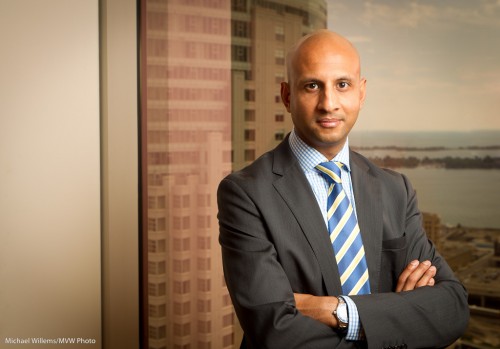
Those little sparkles of light. Like in this portrait of a recent client, Mo Vikrant, an amazing (and amazingly well educated) young financial advisor in Toronto:

Mo Vikrant, photo by Michael Willems

Mo Vikrant

Can you see how those dots of light add life, add sparkle, to this portrait?

Now, I am not as adamant as PPOC, the Professional Photographers of Canada, that every eye must have a catchlight (and only one), or it is a failed portrait. But I do think that typically, yes, they need to be there, and they need to be round.

So I used a speedlight shot through (not reflected off) a partially-unfurled umbrella for that portrait.I cold also have used the Honl Traveller 8 softbox – this too would have given me nice round catchlights.

Detail is important!

Dodo Lenses?

A student from the other day asks:

My son & I really enjoyed the course with you last night.  I do find myself a bit puzzled though about one particular matter when it comes to future investment.  I’m thinking about updating my 10D and then purchase another lens, yet you’re not the first person to praise their “Micro Four Thirds” camera – especially given the quality and additional lens options.  I’m wondering if this is going to be like the cherry-wood entertainment center I purchased years ago when wide screen tv’s were just on the way… but this entertainment center was not built for it.  Today, it’s still a beautiful piece of furniture, but it’s admittedly been sidelined since it’s unable to accommodate modern TV shapes.

What do you think? If this is the way of the future… perhaps my EF lenses may go the way of the dinosaur?

Good question: and yes, I d love the Panasonic Lumix I recently bought, and yes, it can produce work as good as the SLRs. So are we dumping those and going to Micro Four Thirds?

No – not at the expense of SLRs. SLR cameras will always be here. Why? Why lug about a heavy camera when a small camera can be as good? For reasons like these:

  • The availability of a much wider range of lenses.
  • The ability to shoot more quickly (ten frames a second on my 1D, 8 on the 7D).
  • Waterproofing
  • Focusing systems that do not rely on the sensor
  • The ability to use a viewfinder that shows “the real thing”
  • More buttons – yes, that is a good thing. Few menus needed. To change exposure, ISO, metering mode, white balance, and a host of other things, on my SLR I can press one button. On smaller cameras I often need to enter menu systems, which can be convoluted.
  • Micro Four Thirds is so special because it uses a biiig sensor: but it’s still not quite as big as a crop SLR’s sensor (and not nearly as big as a full size sensor). And sensor size matters greatly: lower noise, and more restricted depth-of-field possibilities.

Those reasons show why SLRs will be at the forefont of camera development for many more years.

Now, one thing you may want to do is use EF rather than EF-S lenses. More cameras are being released as full-sized snesors, and an EF lens can fit on any Canon camera, while an EF-S lens can only fit o the crop sensor camera.

EF lenses, then, provide great future proofing. You can go ahead and buy and not fear that five or ten years down the road, your lens will be worthless and (worse), useless..

Simplify…

I recently shot the picture below, during a Creative Urban Photography walk in Oakville.

Can you see how it is simple, how it is defined more by what it does not show than by what it shows? That is often the case: simple is good, and when the viewer has to piece things together that is a good thing.

Reader question

There is always pressure between “techie” questions and “art” questions. Many artistic photographer scoff at the idea of talking about technology.

But I don’t. I think that yes, sure, photography is art: but if you do not have the tools, and the knowledge of how to use them, i.e. if you do not know the craft, you will never get to the art you want to get to. And a blurry or underexposed picture is not going to be liked by anyone. So the tools and the technology are very, very important.

In that contact, let me answer a reader question I received today. Nicolas asks:

I am a photo enthusiast and take photos for my own pleasure when I travel, when I have some time to walk around or when I go to some events sports or others. So no pro, not necessity of any results to make a living, just for fun.

I have a 70-200 f4 IS telephoto lens from canon, a 18-55 not IS  and I used to have a 400d from canon.

But I broke the back screen of my camera when traveling because I just had it in a normal bag… I thought about having it repaired, but it costs too much compared to the price of a new camera.

I also thought for quite some time to get a bit better camera to improve AF, ISO and the way the camera handles since the 400d was a bit small.

But now my choices are very difficult. What camera should I go for and which lens to go with it ? I mostly take street photography or some inside photos with not that good light, and a few portraits. I really like fast lenses to create nice out of focus backgrounds. What would you recommend for my use ? I would like to stay with L lenses for future proofing and built quality.

  • 7d with 16-35 2.8 ? with 24-70 ? with 17-40 ?
  • 5d mk 2 with ?
  • 1d mk 4 ?

Anything else ?

My budget is not big at the moment, so if you would recommend the most expensive cameras that would mean wait more to save more, so no photos in the meanwhile…

Great questions.

First, of course it is not about the camera – much more about the lenses. When the picture is being taken, on two things are being used: the sensor, and the lens. The camera is just a box.

But there are several good reasons to replace your camera.

  • When it is broken.
  • When it is more than, say, 3-4 years old (by which time newer cameras have usably better, and dare I say it cooler, features).
  • When it is too small for you.
  • When you need the pro features, like the ability to write to two cards; faster shooting; extra customizability; or waterproofing.

It seems to me you hit at least several of these features. So you need a new camera.

OK, then, which one.

  • Since you travel and are an enthusiast, I would recommend against a big, heavy 1D-series camera. So, a Rebel, 50D/60D, 5D or 7D. All good.
  • I love the Rebels (like the T1i.T2i etc), but if you are ready for the next step up, a mid-range camera like a 50D or 7D seems a great choice.
  • If you need full-frame (i.e. you shoot wide angles all the time), a 5D might be indicated.

So if I were you, a 50D (which is cheaper now that the 60D has been announced) or 7D sounds great. The 7D is more modern (I have one), but also more expensive. I would only go to a 5D if the full-frame ability (even blurrier backgrounds, even lower noise, wider lenses) is important.

The 50D/60D and the 7D are both 1.6 crop cameras, so a 50mm lens works like an 80mm camera.

I agree with your choice of “L” (luxury) and “EF” (unlike EF-S, these fit on any Canon SLR) lenses, so that means things like:

  • Your current telephoto lens; great for wildlife, detail, headshots, etc
  • General walkabout/people lens: maybe a 17-40 f/2.8. The 16-35 is better but at twice the price. lenses are worth the money, but only if you have the money The f/4 is a great lens too.
  • Street: a 24mm prime (which works like a 35).
  • Portrait: 50 f/1.8 or even f/1.4 prime (which work like an 80).
  • Travel: anything in the 10-20 range, i.e. wide.

The great news is that the lenses keep their value (unlike the camera).

Personally, I would start with a wide range like the 17-40, and add a 50mm immediately for low light and portraits. Then I would add 10-20 or 24mm prime as soon as able.

Eat.

OK, do not eat quite yet.

I shoot events. All the time. It is what I love to do.

And these events are organized by corporations, or wealthy people, or governments, or charitable organizations. You name it. People like to get together. And all these people have paid a lot for the food – or sweated, making it.

And food is ephemeral: it’s there – then it’s not.

This is where photographers do a very useful job. One good photo, and that food exists forever. Like beauty, or youth.

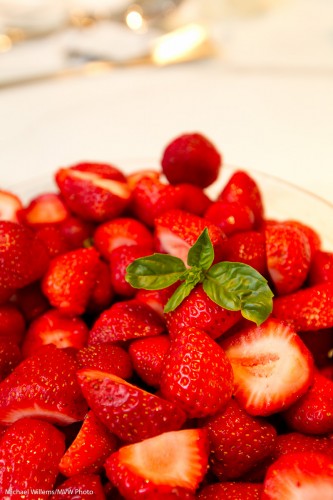
And like these delicious strawberries, which I shot at a very nice private event in Toronto on Labour Day:

Strawberries, by Michael Willems

Strawberries, by Michael Willems

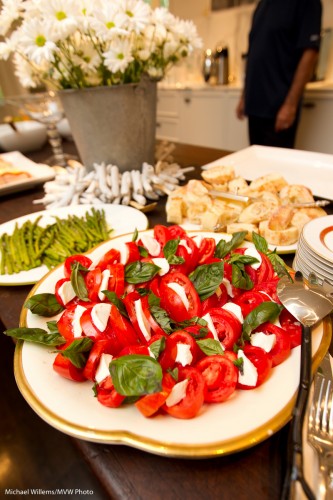
There. And this too:

Food Shot, by Michael Willems

Food Shot, by Michael Willems

The way to do this:

  • Set your camera to manual exposure mode.
  • Expose two stops below ambient (choose aperture and shutter so that the meter reads -2. This might be 400 ISO, f/4, 1/60th second).
  • Make sure your aperture is fairly open (that’s the “f/4”).
  • Bounce your flash off the ceiling/wall behind you.
  • Focus on the closest part.
  • Tilt as needed.

Your images will be loved by your client. The book can now include food shots as background or detail shots. The food is now good forever. The investment is secured for all eternity. And the story is a better one: not just grip-and-grin images, but also “background”.

Learning light

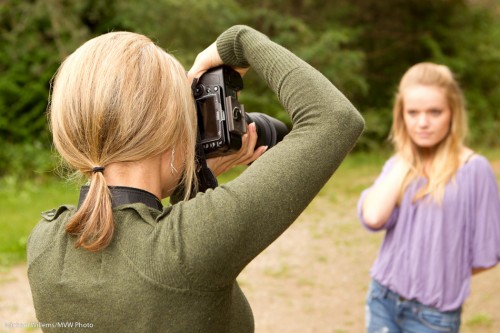
In an intensive half-day custom course, I taught my student Melony some glamour photography techniques a few days ago. From flash techniques to colour to modifiers to using a light meter to posing.

She brought her daughter as her subject, and both did excellent work.

Student shooting model

Student shooting model

(By the way, did I ever tell you to make the viewer work in interpreting an image? Yes I did. And the blurred out daughter in the background is an excellent way to do that. Don’t tell the whole story, let the viewer figure it out.)

But anyway. Student Melony also kindly photographed me:

Michael Willems, by Melony McB.

Michael Willems, by Melony McB.

That is a great portrait.

And I can say that because it is the photographer who makes the portrait, in this case, more than the subject.

So how did we do this? Why does it work?

This works because:

    1. The light is good. First, Melony exposed the background properly (i.e. she did not overexpose it: exposing less is good, so that the subject, not the background, becomes the “bright pixels”). Willems’s Dictum: “Bright Pixels are Sharp Pixels”. Also known as “blurriness hides in the shadows”.
    2. Then, I am lit by the sun from the right (aided by a speedlight, but as the sun came out just at the right moment, this was no longer necessary). That gives us the nice shadow.
    3. But then, in a twist, and that twist is what does it, I am lit by a strobe with a softbox on the (camera) left – that gives the “ultra-realistic” look. Light from the back -and yet I am bright in the front.
    4. This image also show good use of appropriate props – I am holding the camera, which for a photographer is part of the story.

      Pocketwizards and a battery-powered Bowens light, as well as a speedlight, were used here.

      And kudos to those of you who spotted the other essentials, around my neck: a Hood Loupe by Hoodman, and a flash meter.

      Light makes a photo. Creative light makes it better. And it is simple. Once you know it.

      This is the sort of stuff I teach at my workshops, and Joseph Marranca and I are doing several more in October: check the schedule on www.cameratraining.ca !

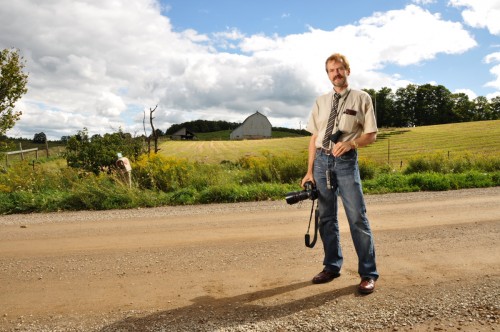
      And yes, I wear a tie almost every day.

      Blog notes

      Hi there audience!

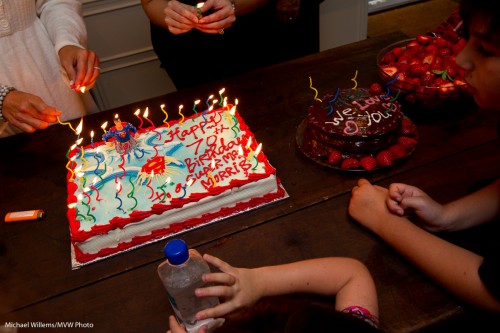
      I am just back from shooting a very enjoyable event – a birthday party. It is such fun to shoot these events.

      Cakes

      Cakes

      Four hours shooting, and two or three hours of post-production work. All great!

      More about events and how to shoot them – and what to shoot at them – in the next few days, but first, a note about why to shoot them.

      We only live a few years – “three score years and ten”, according to Leviticus. Thank G-d this is no longer the limit (the person whose birthday was being celebrated in the picture above will no doubt join me in being thankful), but even though it may be twenty years more now, there is a limit –  And then we’re gone. And we long for the days gone by.

      But when we have good photos, we remember. We mark those days, those places, those events, and those people down forever.  And in doing so, we own them forever.

      So please… have your significant events photographed. A few dollars is nothing compared to eternal memories.

      And that is why I like to help people learn photography. That is what this blog is all about: about learning the skills that will make you a really good photographer.

      This blog is, and will always remain, free. But in return, you can do something for me: spread the word. I see that I have several thousand visits a day, but I would like that to be several tens of thousands a day, or several hundreds of thousands. So please tell your friends and acquaintances; write about this blog; or link to it.

      And above all – read it, daily. I post every day and I hope you find it useful. Let’s make this community the best educated in the world. Photographically speaking of course.

      Now… I’d like to hang around – but I need to write tomorrow morning’s post!

      Blur is bad. Always. Or…?

      Or is it?

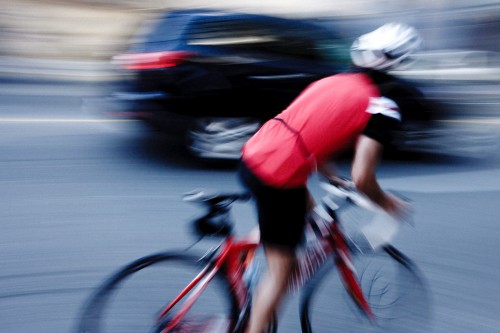
      Bike, photo by Michael Willems

      Bike, Toronto, Aug 2010

      Indeed not. That is why you have a shutter speed priority (Tv/S). Sometimes you want to show motion, and you do that by blurring things.

      I took the shot above while panning at 1/15th of a second (and f/22 at 100 ISO: it was a bright day in Toronto). It shows “in a hurry”, dynamic motion much better than a “frozen” picture of the same subject would do.

      Scale carefully

      How do people see your images? Do you ever wonder?

      So maybe you shoot at a gazillion megapixels. Or at 12 megapixels. Or even at a lower number: say 6. (That would be 3,000 pixels wide x 2,000 pixels high).

      Great when you want to print. But when you want to use your image at a lower resolution, like when emailing, or posting on the Web, then what do you do?

      After you create it (whcih you always do at the highest pixel setting), you then need to “scale down” the image to the right size, that is what. And you can do it, or you can let your email program or web site do it, which is even easier.

      Easier – but not better. When you scale down an image, you can do it in many way.

      Just now I uploaded a image to Facebook. A large-ish image. And it looked like this, after Facebook scaled it down to its required size of 720×480 pixels:
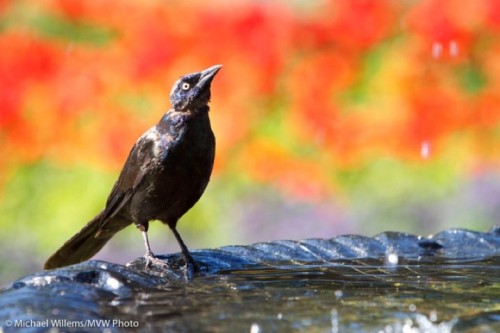
      Bird bathing, by Michael Willems

      Bird bathing (Aug 29 2010)

      (You can see it’s not great, but to really see this, you need to see it full size by clicking on it, since WordPress also reduces the size that you see there!)

      So then I did it myself in Lightroom before uploading, to exactly 720×480. Lightroom, when scaling, first applies a proper scaling algorithm, and then sharpens the image – which you need to do, since reducing the size blurs it slightly.

      The Lightroom-scaled version looks like this:
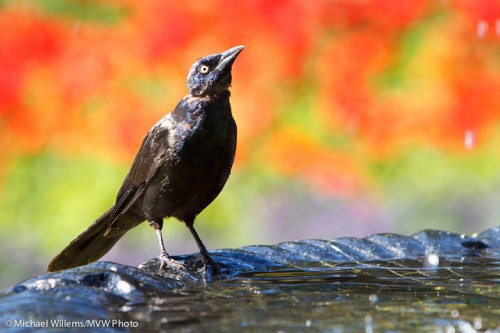
      Bird bathing, by Michael Willems (scaled well)

      Bird bathing (scaled well)

      (Again, you need to click and see at full size. In fact, better that you save both to your desktop an then flip between them there.)

      And you will see that the version I scaled is much better than the version Facebook roughly scaled down.

      So remember: pixels are everything. When producing output, find out how many pixels wide and high it should be, and produce it in that size in Lightroom (or Aperture, or Photoshop: whatever you edit in). And sharpen as the very last step.

      Some suggested pixel sizes:

      • Facebook: 720 x 480
      • Email: largest dimension 1200 pixels
      • iPad: 2304 x 1536
      • Small email-sized: 800 pixels widest dimension

      And remember, DPI does not matter if you specify the pixels. I set it to 300, but you will see that the file is identical whatever you set it to, as long as you can specify the actual pixels (which you do, in, say, Lightroom).
      Negative Space

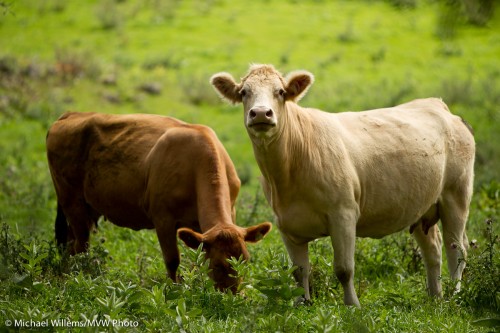
      Instead of making your subjects big, like so:

      Moo! Cows (Photo by Michael Willems)

      Moo!

      …you can also make them small, like so, and surround them with “nothing much”:

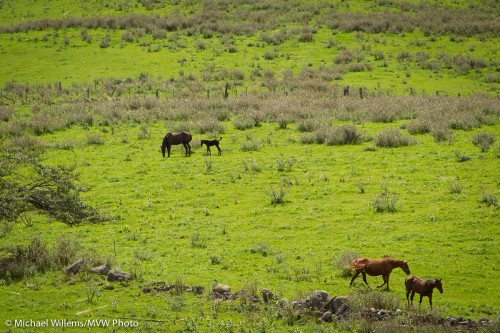
      Horses in Mono - Photo by Michael Willems

      Horses in Mono

      We call that using “negative space”.

      The use of Negative Space is a great way to show your subject not as huge, but as interconnected with, and inhabiting, a large area.

      The negative space needs to be just that: negative space, i.e. devoid of meaningful content. It does not have to empty: just empty of information.