Using light today.

I shot Victoria Fenner today. But only, you will be glad to know, with a camera.

Let me talk you through that, shall I?

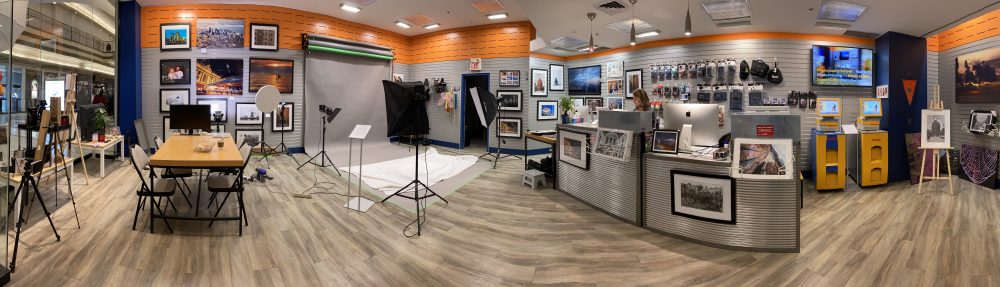
Victoria is an audio expert. She used to run the studio at McMaster University that we shot this in. We decided to shoot her doing her thing – and sound is her thing. So we shot in a studio first:

Camera: I shot her with a Canon 1D Mark IV. The camera was on manual at 100 ISO. I used a 24-70 lens set to around 24mm – meaning around 30 “real” mm.

Light: the camera was equipped with a 580 EXII flash to act as e-TTL “master” to drive three 430EX speedlites:

  1. The “A” flash through an umbrella on camera right, shining into Victoria’s face. An umbrella throws nice soft light, great for faces. (There is a certain irony in the fact that we use the word “umbrella” to name this thing that throws around this nice light. Umbra means shadow!)
  2. One “B” flash with a green Honl Photo gel in the background – I love adding a splash of colour, and green goes very well with purple.
  3. Another “B:” flash, fitted with a Honl Photo 1/4″ grid, as hair/accent light shining toward the camera. You can see it just outside the field of view.
  4. I set an A:B ratio of 4:1 to 8:1.

All this took about ten minutes to set up, and ten minutes to take down.

Then we shot some outdoors. For this, I used two flashes off camera: one into a Honl gold/silver bounce card; the other using a grid, as before. Yes, in bright sunlight you can fire these flashes using light-controlled TTL.

This was a bright day in April around noon. But it does not look like noon light, does it? I shot in Aperture mode, with -2 to -3stops exposure compensation. That darkened the background to give it colour saturation. The flashes took care of the foreground.

Pfffftttt…..

Canon Canada has just introduced a new CPS Program. CPS means “Canon Professional Services” – it is the program under which pros get faster service. Details of the new program are here: http://www.canon.ca/inetCA/categoryHome?msegid=5&catid=4345

From what I see, Canon has succeeded in changing the program as follows:

  1. Service level is lower than before. Yes, there are a few goodies, but mainly it’s less, from what I see.
  2. A previously free service is now -wait for it – $250 per year for the best service level.
  3. A form must be filled in (I just did); a page full of  legalise lays out the duties, punishments, etc. Geez, it’s like joining the army!
  4. This form-filling must be repeated annually, as must the paying.
  5. There is no email or contact address.

Perhaps I am misreading this. I mean – surely a company would not want to punish people fopr spending tens of thousands of dollars on their equipment by worsening service levels, introducing annual hassles (finding all the serial numbers took me an hour!)  and then charging for all that?

I have asked Canon what I am missing.. I shall tell you on the blog when I find out.

Focus where you want.

…where you want, I mean. Not where the camera wants. So as a tip for beginners and reminder for others, a few words about how to focus.

When you look through your viewfinder, you see focus areas, also known as focus points. Depending on your camera there are three, five, seven, nine, or even 11 of 45 of them.

When you press the shutter button half way, the camera indicates one or more of these by flashing them; then it beeps. As long as you hold your finger on the shutter button, these selected focus points stay active. Meaning that when you press down, that’s where the camera will focus.

How does it select which points to use?

It looks at all the focus points, and selects those that are on the closest subject. That’s how. So you’ll get this:

And therein lies the problem. What if you want not my hands in focus, but my face? Or what if you are shooting a relative in the forest and you keep getting that closest branch in focus rather than the relative?

That’s why you can disable this automatic selection of focus points.  And most people do most of the time. Ask a pro how many focus points he or she is using and the answer is almost always “one”.

Then you can:

  1. Select a suitable focus point
  2. Aim that one point at your subject
  3. Press half way down until your focus points locks and the camera beeps
  4. Hold your finger on the shutter, do not let go
  5. Recompose if necessary
  6. Press down and take the picture.

Q: In a portrait, what really needs to be sharp?

A: The subject’s closest eye. The rest is optional.

My student yesterday in a Henry’s Canon 7D class, taken with the 7D with 35mm f/1.4 lens using available light and, um, a TV:

Advanced users, did you know the following:

  • Focus selection is done in areas that are actually wider than the indicated focus spots.
  • The centre spot is the most sensitive.
  • The faster your lens (low F-number), the better it works.
  • Focus squares detect lines. The centre spot is sensitive to horizontal and vertical lines. Others can usually detect only horizontal or only vertical lines!

Well, now you do.

And if you are new to this, here is your assignment: reproduce this photo. Hand sharp in the very corner of your photo.

(Use aperture mode with a low “F-number”, or use program mode and get close).

My day

First, more episodes of season 7 of “24”… the inimitable Chloe… one episode to go 🙁

Then, teaching, and then to the gallery in Toronto’s historic Distillery District:

That was a wide angle lens: 16mm on a full frame camera. Aperture mode, exposure compensation minus two stops, and flash on. (Aren’t wide angles great?)

Then, in the gallery, a snapshot of a gallery visitor and potential student of flash:

That was done with:

  • The camera on “Manual”…
  • …with exposure set to around minus two stops.
  • A CTO-gelled 580 EXII flash aimed to my right.
  • …and white balance on “Tungsten”

Isn’t TTL wonderful?

Balancing light

One subject photographers need to learn all about it balancing light. In particular, I mean balancing background light with foreground light.

If you take one of my workshops I’ll teach you all about “overpowering the sun”.

As an illustration of that, three years ago almost to the day I took a few snaps of my son in Army Cadet uniform. The sky was mid-day light blue, but I used three off-camera flashes, two of which were in umbrellas and one was direct, to overpower the sun and make the sky dark:

I used the 5D in manual exposure mode, set to -3 stops from ambient, and used TTL metered flash. Piece of cake. And yes, remote flash using light control does work in super bright sunlight, as long as you keep line of sight between the master and slave flashes.

Can you also see that for this portrait I used a very wide lens? Even though you are not supposed to do that for portraits? That is because it is a situational portrait. Where the environment is as important as the subject. Just keep your subject’s face away from the edges – centre, or near the centre, is good.

New firmware for Canon 7D

There’s new firmware for the 7D, here: http://web.canon.jp/imaging/eosd/firm-e/eos7d/firmware.html

I’ll update mine this morning.

UPDATE: I just updated it. All well, but note, the upgrade reset my image number to 1, which I do not like. (NOTE: never use “do not import suspected duplicates” to ON in Lightroom, since LR appears to look just at the file number. This has cost me images!)

Son in car

My son, just now, in a car in broad daylight, in a shot that took only a couple of minutes to set up:

I used three speedlites on light stands; all three were fired using e-TTL light control from a fourth one on the camera.

One speedlite is on camera right, one on the left, and one in the middle using a new Honl softbox to light up his face.

Of course with a few more minutes I would have

  • Moved the softbox so it did not reflect,
  • Positioned the other better
  • Used more gels to add more colour
  • Cleaned the car more

… but with a teenager, even three minutes is a rare gift.

A portrait with three speedlites

Here’s a portrait I just shot.

I used the Canon 1D Mark IV with a 580 EX II flash on the camera, used only to drive three 430 EX II flashes using remote e-TTL. This is easier than ever: with the right knowledge and tools it takes mere seconds to arrange.

So here’s how I did it.

I used a 50mm prime lens (meaning 65mm effective focal length) with the camera on manual, 100 ISO, f/5.6 at 1/125th second.

The lights were:

  • One 430 speedlite, the key light, is on camera left one foot away from the subject and is mounted on a cheap light stand. It is equipped with a new Honl Traveller 8 softbox.
  • The second, the accent light, also on a light stand, is one foot behind the subject, is aimed forward at her, and has a Honl 1/4″ grid fitted.
  • The third flash, aimed at the wall, is mounted on its little plastic light stand and has a green Honl gel fitted to its speed strap in order to add a splash of colour to the background.
  • I set an 8:1 A:B ratio to stop the accent lights from becoming too bright (the key light was A). I also used – 1/3 stop Flash Exposure Compensation, since the initial frame showed the face a bit bright.

That setup was:

Simple and effective. And if I say so myself, I think the green gelled background accent was an inspired choice.

Today, with small flashes and modifiers, using TTL, you can do professional studio work in no time.

Setting up a sunny morning

That is, creating one with studio lights.

This is one of the things Joseph Marranca and I taught our students at the Advanced Lighting workshop we held in Mono, Ontario this past weekend.

Start with a normal day. Lit by available light, that looks like this when you expose for a proper background:

Not much foreground, of course. That is why we add studio lights. The trick is which ones, and how.

One goes outside, aimed at the model through a grid, and is equipped with a CTO (colour temperature orange) gel. That makes the day look like a sunny morning.

Then we add another studio light, indoors, on camera right, with an umbrella.

So now we have:

Which when done gives us one of those “Folgers moments”:

(On Sunday May 23rd, Joseph and I are doing another workshop in Mono, this time a one-day one, which builds on the light practiced in the previous workshop.)