Need an intern?

An off-topic post, for which you will forgive me!

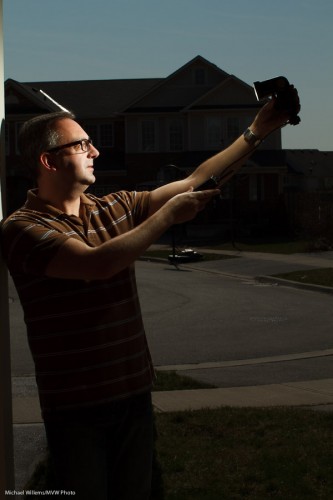
Many of my readers are in business, perhaps even as engineers. Hence my question: if anyone in the Oakville, Ontario area needs an intern for the summer, consider my son Jason. He is an Electrical Engineering student, in his final year at McGill university, and is home in Oakville for the summer. Resumé on request – he is experienced, having worked at various companies before. Let me know – email if you are interested in seeing his resumé: michael@mvwphoto.com
Combining light types

A repeat of an older post here – because it is very important.

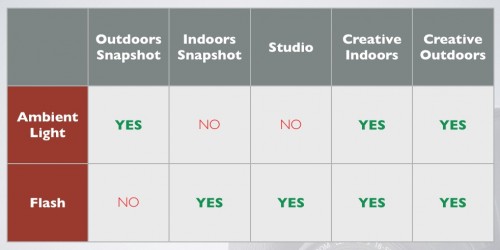
When you use flash, you can either combine it with existing light (as in a party) or not (as in a studio, or as in a snapshot).

To hep you understand this, here is a representation of when you do, and when you don’t, use flash; and when you do, and when you don’t, combine it with other light:

If you want to be a creative photographer, you should probably practice the three types on the right.


Flash 101 reminder

There are two ways to use flash. Always keep that in mind, because you decide which one it is for any given shot.

2. Flash as the only light source. You would do this in a studio setting.

If you want this, select an aperture-shutter-ISO combination that makes the available light go dark. Like 1/125th second, f/8, 200 ISO:

2: Flash mixed with available light. You would do this at a party.

If you want this, select an aperture-shutter-ISO combination that makes the available light show up too – maybe two stops below normal. Like 400 ISO, 1/40th sec, f/4 (the“Willems 444 rule”):

Simple, once you realize this: the flash is separate from the ambient light. In TTL mode, flash is metered separately.


HELP – in a good way

When I bought my pro printer, a Canon 9500, at Henry’s in Oakville, I bought the extra “HELP” (Henry’s Extended Life Plan) coverage.  And I was just reminded of how great that coverage is.

I broke the printer. My fault. But guess what? Rob Buchelt, the store’s manager, just called: Because I bought HELP coverage, my printer was quickly sent to Canon by the store, fixed, and returned to me, all free of charge. What’s more, I did not have to find the receipt: it was in the computer.

Advice: buy this coverage when buying photographic equipment. It has saved me more than once.

Disclaimer: I teach at Henry’s School of Imaging (as well as at Sheridan College). But I am not a Henrys employee and get no compensation of any kind from the stores – my advice is always independent.

Another tip or three.

Yesterday’s post: did you see those three images? Then let me add something about them. I shall debunk a few pretty common misconceptions.

  • Aperture must be low? They were all taken at f/5.6. So if anyone says “you can never get blurry backgrounds with an f/5.6 consumer lens” – wrong. Just get close.
  • ISO must be low? They were taken at … wait for it: 3200 ISO. So if anyone says “you can never get acceptable pictures at 1600 ISO or higher”-  not so, with a good camera.
  • There’s only one good setting? I was using an f/1.2 lens. So I could have gone to f/4 and 1600 ISO. Or f/2.8 and 800 ISO. Or f/2.0 and 400 ISO. Or f/1.4 and 200 ISO. Or f/1.2 and 160 ISO. Or instead of lowering ISO I could have gone to faster shutter speeds. But I chose not to for this demo. If I had,, I would have gotten very selective depth of field in the last image in particular.

So when you think something is a given – sometimes it is, but remember that “it ain’t necessarily so”.


Point of view

Changing your point of view often helps simplify your picture.

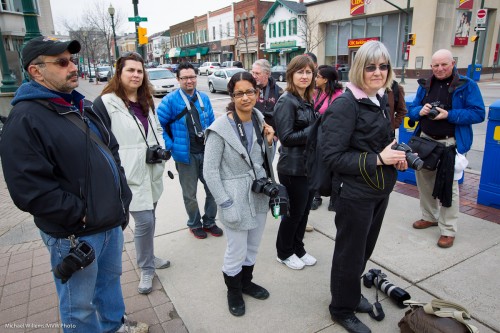
Here’s an example. A group shot a few hours ago of my Sheridan College students on a field trip in Oakville;

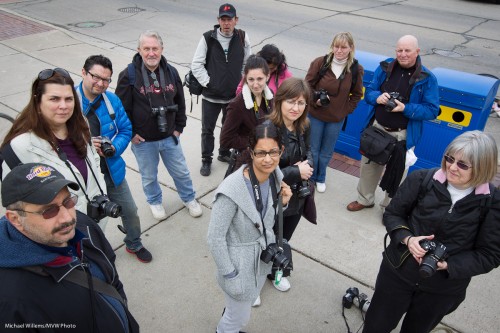
And here it is again, but now with me on an object to raise my level about three feet:

The shot is a demo – in a formal portrait, I would have had people look at me and so on – but you get the idea! The second picture has:

  • a semicircular appearance, as opposed to “flat”;
  • a much simpler background;
  • an unusual appearance due to the angle.

You should always ask yourself: could I take this picture from a different vantage point? Higher, lower, right, left, front, back: each of these can lend an image a different feel.


Outside direct flash technique

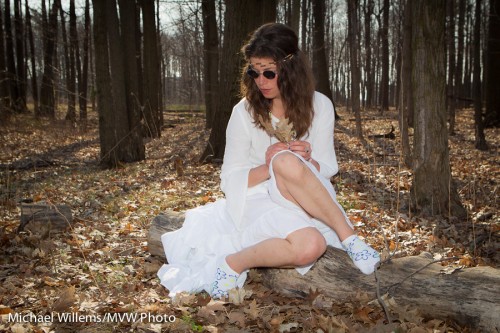
You can use a flash outside on the camera for some pretty cool shots, like this one I took yesterday of talented model Kim:

You do this as follows:

  1. Position the subject away from direct light (see the back light here? The sun is behind her).
  2. Expose to make the background a little darker (using either manual exposure, or an automatic or semi-automatic mode and minus (-) exposure compensation).
  3. Turn on your flash.
  4. Adjust your flash if and as necessary with Flash Exposure Compensation (FEC). In this example, a subject with a white dress needs “+” flash exposure compensation. If not sure: try!
  5. Because your flash is aimed directly at the subject, you need to allow for this. Ask the subject to aim their head slightly down, perhaps, so the light will come at the head from slightly “above”. Watch for shadows.

And this very simple technique makes for some pretty good “flash outside” shots when you have no off-camera flash or softboxes etc available.


Shot of the day

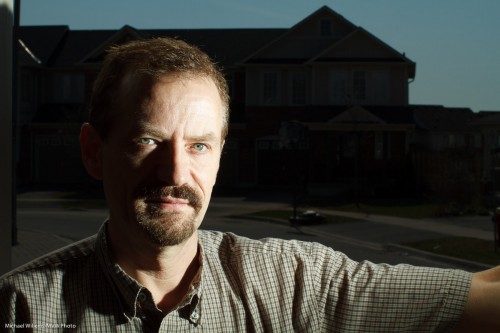
..taken by my student Nick, on a sunny day – super sunny in Ontario – at mid-day:

Here’s Nick, showing how it is done:

Exposure is set to create a dark background. 1/200th second (sync speed!) and f/11 at 100 ISO did the trick. And then the flash direct – but off-camera, fired by Pocketwizards, metered with a light meter.

And that’s how you take a dramatic portrait on a sunny day!