I'm a sharp freak.

Here I stand before you: I cannot deny it. I like sharp. Really sharp.

So when I go do some street shots, such as this portrait I shot outdoors after I shot a bookstore yesterday, I am delighted when the 7D, equipped with the 35mm f/1.4 lens, gives me this (and you should click and then view it at original size: don’t let your PC or Mac downsize it):

IMG_1628-3

(1/125th sec, f/4.5, 200 ISO)

That’s what a good camera and a good lens does. And shooting that street stuff yesterday, I was impressed with how sharp the focus is in most of my images – the focus system really is better tan that on my 1Ds3/1D3. Here’s another example:

IMG_1631

Nice car.

Why oh why..

…are studio flash pictures so much sharper than available light pictures? Like, always?

Whatever you do, available light may look great – but when you zoom in close, it is not perfect.

IMG_1303

Studio is much better. Look at this picture I just took with my Canon 7D at f/11, 1/125th sec, 100 ISO, using two studio strobes driven by a pair of Pocketwizards:

IMG_1566

Zoom in and it is spectacular. This is the original size (once you click), and utterly unaltered:

IMG_1566-2

Why is this so much better?

Let me tell you some differences. I count six:

  1. Aperture – Studio light means f/8. Available light means f/2.8. Lenses are typically sharper and clearer at f/5.6-f/8.
  2. ISO – Available light means higher ISO. Lower ISO, like in a studio, means sharper pictures.
  3. Shutter speed – Flash is around 1/1000th second. Available light pictures, even at 1/250th second, will not be as clear.
  4. Tripod – In a studio you are likely to be using a tripod. This is huge, in terms of focus and motion.
  5. Light direction – Studio flash is directional. Available light is diffuse. So surfaces look clearer.
  6. Exposure – In a studio, you are likely to expose to the right – the pixels will be bright pixels. Bright pixels are sharp pixels!

So it is not so much one factor. It is the combination of all of them. In a studio you have all of them your way; in available light, many, sometimes all, are not ideal. That is why studio flash is so much crisper.

Have I left anything out, anyone?

My 7D..

…just hung up again. Again, not long after live view. No response even to on-off switch: nothing happens and top LCD remains lit. And again, it needed the battery removed to start responding to anything. Worrying, and as a wedding shooter, this would stop me (a hang could theoretically very easily corrupt the disk).

Crop sensors and depth of field

So a crop camera has wider depth of field?

Depends how you look at it. The way I look at it: “only because you will use it differently. If you use it to take the same picture, you’ll get the same depth of field”. But of course for that “same picture” you’ll need a different lens.

OK, this is complicated. So let me just show you by example.

Picture one: full frame 1Ds MkIII camera, 50mm lens at f/1.4.

MVWS0030-50mm-1.4

(You can click to see the large version).

Picture two: crop camera, a Canon 7D, with a 35mm lens also set to f/1.4. That 35mm lens on a crop camera is about the same as a 50mm lens on a full frame camera; i.e. enables me to be at the same point and yet get roughly the same picture. Now I see this:

IMG_1270-35mm-1.4-adjust+15

As you see, this gives you roughly the same depth of field. If there is any difference, it is minor. SO:

A 35mm lens on a crop camera gives you roughly the same picture as a 50mm lens on a full frame camera, and roughly the same depth of field.

A few notes, by the way:

  1. These results are consistent; not just “one randomly picked picture”.
  2. The DOF (depth of field, i.e. how much is sharp) is extremely narrow. Great care is needed when shooting at f/1.4!.
  3. I was aiming a single focus spot at the dot (near the 10) in all pictures (On the 7D, I was using the extra small focus spot).
  4. I have noticed that the Canon cameras (or is it the lenses?) focus too closely (they “front-focus”) when open at f/1.4. By f/2.8, this effect is either gone or too small to see clearly. In the last picture, I added an adjustment of +15.  This does not change the depth of field; it is just to make both pictures about the same.

Point 2 explains a few things to me, by the way. That’s part of the Canon-effect, more on which in the next few days; it’s why I have to adjust extra when wide open.

One more 7D note

Namely, that the thing I miss most is a little one: the inability to save all your standard settings and recall them.

Yes I know, you have the “C1-C3” exposure modes on the dial. They do not do me any good. For a start they cannot be named, so if you set mode C1 for sports and mode C2 for babies and so on, you are likely to forget what you set. And you cannot see easily what you have set (“C1 is what – Aperture mode with spot metering? Or what?) And you cannot recall them easily (if you could move C1 back to Av mode, I’d be happy enough!).

No, what this camera needs is a mode where everything is reset to your standard settings to give you a good starting point. NOT Canon’s factory settings. Your settings – that would be the guy who paid $2,000 for the camera.

I am reminded of this by an event today where I shot with fill flash – and the person was blinking in every shot. Reason: I inadvertently had the popup set for wireless flash. That causes several flashes – hence a blink in young people. Groan. And to top it off, for some reason I was in JPG mode instead of RAW mode. Must’ve nudged something. Groan.Never happened before in any of my cameras – literally.

Canon just lost me a shoot, essentially. And to avoid this happening again, I will have to carry a checklist and before every shoot, check 53 sets of settings ( a total of hundreds of menu entries – literally) every time against that list. How dumb is that? This deliberate disabling of functions to make more money (“want a basic function like that? Pay $9,000 for a 1Ds”) is annoying.

As I have said before – Canon should make the expensive cameras better – not do their marketing by deliberately disabling the lower-end cameras. Nikon has many more of these settings – although their menus are not the easiest, they do not seem to engage in this type of “marketing by annoying”.

More 7D vs 1Ds MkIII comparison.

OK, so now let’s try a slightly more scientific test for the pixelpeepers among us here. Here’s my Canon 7D.

MVWS9935

For tonight’s second short test, I just used the Canon 24-70 f/2.8L zoom lens. Set to 24mm on the 7D, and to 38mm on the 1Ds MkIII, to give the same field of view.

I fired an umbrella-mounted studio strobe through pocketwizards, with the cameras set to:

  • manual
  • 1/125th second
  • f/8
  • 100 ISO.

Because of the varying zoom setting, which gives the same field of view, the two are still inevtably different – but being the same lens, and at f/8, this difference matters little. Essentially, this is a fair test.

We get, in both cases, a nice sharp image like this out of Canon DPP (that is all I used, and with no alterations at all):
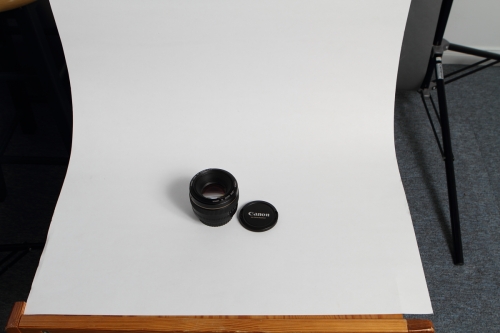
IMG_1148-full

Great picture on both cameras.

And that is where the story might stop. But because I am curious – how good is the 7D image compared to the 1Ds MkIII’s – I now crop to a 1200 x 800 pixel wide area in both cases. Here they are at full size (and you can click to see these crops unaltered, at their actual size):

7D:

IMG_1148

And 1Ds MkIII:

MVWS9916

When you click and compare both of these unaltered images, it shows how good the 7D is for a crop sensor body.

The white balance difference is hardly noticeable when properly exposed like this.

There is clearly a tiny bit more noise in the 7D image. But it is tiny, and the 7D has better blacks. The difference is so small that at this low ISO and with this good light, no real difference should be seen in practice. And with the 7D’s many other advantages, that is a great thing. This camera will remain at my side in shoots.
The mysteries of life…

Take your flash and put it on your camera:

IMG_1076

Aim at a subject while looking through the viewfinder. Take a picture.

Did you see the flash? Through the viewfinder? Yes you did.

How is this possible? When the picture is taken on an SLR, the mirror is raised. When the mirror is raised, the viewfinder is black. So it is impossible that you see the flash through the viewfinder. You cannot have seen what you just saw!

Those of you who do not know, click on.

Continue reading

7D progress

In the next week or so, I’ll do more of a review of the 7D. Still very happy with it: this camera is a major update to the GUI and is a lot of fun and focuses better than my 1Ds3 and 1D3. Video is fun too, although I am not sure I can spare another 5 Terabytes and 12 hours a day doing video post. Plus, taking video is nice but even a short video will be many gigabytes. So it’s back to driving around: no Internet can handle that yet.

I do wish they had not crippled the camera by design, by the way. Auto ISO, for instance, is a great feature. But why set automatically between 100 and 3200 ISO? Why not let me limit it, say to 800 or 1600 ISO? No doubt they intend that to be available only on the 1Ds Mk4. It would cost nothing to add it. Are we being manipulated for marketing purposes?