More technique:

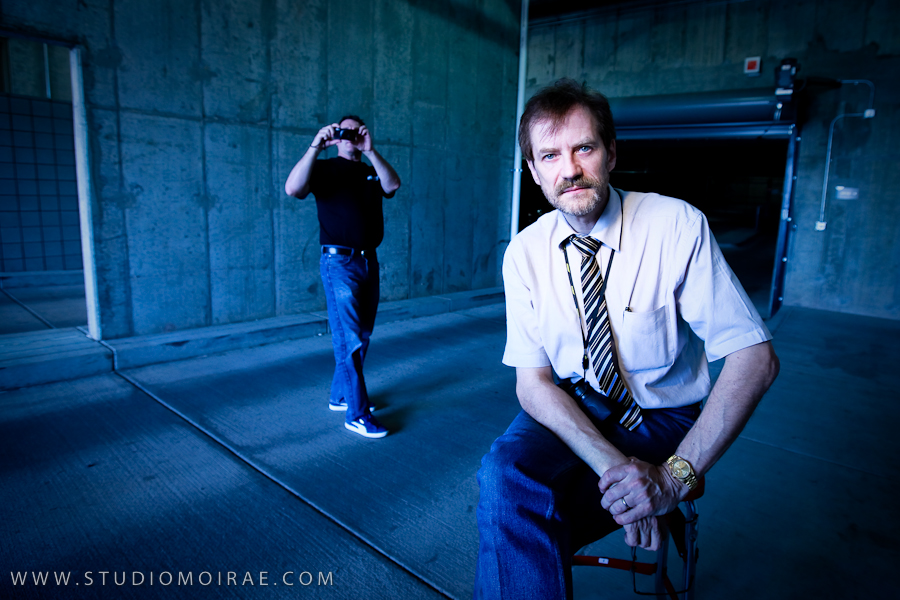
Here’s me, shot by Christy Smith of Studio Moirae:

Yeah, I model too.

But wait. That cool blue urban look. Was it actually like that?

No. The actual scene was like this. Here’s Christy and David Honl taking a test shot:

So wait. How come it’s all blue?

That’s because Christy and Dave set their camera’s white balance to “Tungsten”. That will turn daylight blue.

But then I would be blue too!

Except they are lighting me with a flash with a CTO (“Colour Temperature Orange”, i.e. Tungsten-coloured) Honl gel and with a Honl Grid to make the light go mainly to my head and shoulders. The flash was aimed straight at me and set to manual, and it was fired with pocketwizards.

That’s the kind of cool technique Dave and I taught the participants who came to the workshops Monday and Tuesday in Phoenix, Arizona. If you have the chance, come to a future one: they’re fun and you will lean sooo much.

Off to Phoenix

Again, off to Phoenix today. I timed it well: 70s in Phoenix, and freezing here.

I am looking forward to the workshop in which I will be joined by David Honl, who is flying in from LA with an assistant. Participants can look forward to some really cool flash training!

Packing is a challenge. My “Classified” bag is full of gear, but I am not bringing some items I really would have liked: the 70-200 lens and the 100mm macro. I am bringing:

  • 1D Mark IV
  • 7D
  • Three speedlites
  • Three pocketwizards
  • 24-70 2.8L
  • 16-35 2.8L
  • 35mm f/1.4
  • 50mm f/1.4
  • Laptop
  • Power Supplies fro both cameras
  • Spare batteries
  • Spare memory cards
  • Cables
  • Flash modifiers (Honl speedstraps, gobos, gels, snoots, grids, etc)

This is par for the course, but with the new restrictions we will see how this plays out. I would hate to have to check $20,000 worth of equipment. CATSA have confirmed I should be fine – we’ll see.

Tip: bring a vest and worst case, put lots of stuff into the vest.

Phoenix Mon/Tue

I shall be teaching Travel and Advanced Nikon Use at the new School of Imaging location in downtown Toronto tomorrow.

Then Sunday, I am off to Studio Moirae in Phoenix:

….for two days of teaching Advanced Flash.

And some excellent news: I will be joined on Monday by David Honl, too, who is flying in from LA with an assistant to be there (this is a great opportunity: if you are anywhere near Phoenix: There are still a few spaces available, but be quick).

Now, off to bed. Take lots of pictures

Metering

Your camera has two, or more usually three, types of light meter built in:

  1. Evaluative/3D Color Matrix meter. You normally use this. This is “smart” metering, where the camera meters areas of the sensor separately. It can handle many types of light situations and is a real improvement on other, older metering types.
  2. Centre Weighted Average meter. You use this when the subject is in the centre and the outsides are dark or light. Backlight portraits are a good example of where this is useful.
  3. Spot Meter. You use this when you have great contrast: simply aim the spot at a subject that is neither very dark nor very light and lock your exposure. This is useful when shooting something in a dark room or in a bright snowscape.

Note also that ambient and flash light are metered separately.

My advice: try all three metering modes and get familiar with them, then learn when to use which one.

Reader question

“Why are you in Manual exposure mode when shooting flash indoors?”, asks a reader. I thought that would make an excellent blog question.

So why?

Well, when I shoot flash indoors I have options. These include:

  • S/Tv mode, which is fine because I set the shutter to any value I like, but this has the big drawback that the lens will quite probably not have the aperture value needed to expose well – and also, aperture is the one thing I want to control.

So then next, there’s Aperture mode or Program mode. This works differently on the main brands:

Canon:

  • P: flash speed will not go below 1/60th. This simple engineering decision makes sense, but it can give me dark, “cold” backgrounds. When using a wide lens I want to be able to go slower, like 1/30th, to let in more ambient light.
  • Av: now shutter speed can go as low as it needs to in order to light ambient normally. The big drawback: in a dark room this could lead to very slow shutter speeds – even seconds, which would lead to totally blurred images.

Nikon:

  • A or P: flash speed will not go below 1/60th. This simple engineering decision makes sense, but it can give me dark, “cold” backgrounds. When using a wide lens I want to be able to go slower, like 1/30th, to let in more ambient light.
  • A or P with “slow flash” enabled: now shutter speed can go as low as it needs to in order to light ambient normally. The big drawback: in a dark room this could lead to very slow shutter speeds – even seconds, which would lead to totally blurred images.

So none of those seem quite ideal, do they?

Then there is manual (“M”). In manual exposure mode,

  • I can simply set the aperture and shutter speed that I want. The background will be lit accordingly.
  • But as long as my flash is set to TTL (Canon calls this eTTL; Nikon calls it iTTL), it is still fully metered and automatic, and the camera varies the flash power to light the flash portion of the photo properly. So “manual” is not manual flash – it is just manual background light.

So for that background light, my starting point is to set manual aperture/shutter speed to give me an exposure two stops below ambient. That means the meter points to minus two when I aim at a representative part of the room. That way I get these advantages:

  • Ambient light becomes “fill light”, which is usually 2 stops below the key light.
  • If I aim at a brighter part of the room, is it not likely to be two stops brighter, so it will not be overexposed.
  • If I aim at a darker part of the room, it is still likely to be light enough to be seen.

So try it next time?

Camera on manual and set time and aperture to a value that gives you -2 stops on the meter. Then bounce off a wall and you get well lit images. Like this one, of two very nice young people at the event I was a forum member at, tonight at UofT’s Mississauga campus:
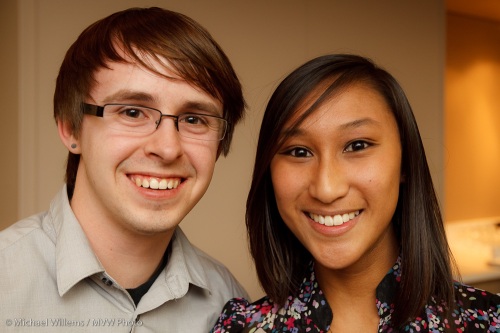
This also shows that I have taken over 10,000 images with my new 1D Mark IV already. And that I always carry a camera, even when I am a speaker, not a shooter.
Learn to use great light

As said, Joseph Marranca, one of Canada’s most experienced commercial photographers, and I are organizing a unique weekend advanced light workshop at my country home in Mono, Ontario, just an hour north of Toronto.

Strictly limited to 6-8 advanced or emerging pro users, this will be a unique two-day opportunity to learn lighting (indoors, outdoors, and mixed, and using studio strobes as well as speedlites) and come home with portfolio shots.

The dates are April 10 and 11. For further detail, look here:  http://www.cameratraining.ca/Mono.html

Shooting an event: choice of shots

A few tips, on and off over the next few days, about shooting events. Events such as parties, clubs, openings: lots of people and they are camera aware.

Today: What to shoot. I recommend that you shoot “all three views”:

  • Overview shots, showing “the whole thing”: wide shots with the entire venue, entire room, and so on.
  • Medium shots, with one or two people
  • And finally: detail shots. An aspect of the room. The stereo and a CD that’s playing Notes on the fridge. Or like in this shot, the food:

(Can you see that I bounced the flash off the ceiling behind me?)

If you shoot plenty of all three views, you will have plenty of material for a great album. And people remember the details!

Learning Lighting

I think it is very important that you learn how to use flash in manual mode (manual flash, that is, as well as manual exposure!) before you move to today’s sophisticated eTTL or iTTL modes.

That way, you get predictable results. And you can use Pocketwizards.

The above shot was lit with only a few lights.

Here’s your tip for today: when a fireplace does not light, use a flash with a red gel (I used a 430EX equipped with a Honl speedstrap and Honl red gel; all fired with Pocketwizards).

NEWS! Joseph Marranca, one of Canada’s most experienced commercial photographers, and I are organizing a unique weekend advanced light workshop at my country home in Mono, Ontario, just an hour north of Toronto. Strictly limited to 6-8 advanced or emerging pro users, this will be a unique two-day opportunity to learn lighting (indoors, outdoors, and mixed, and using studio strobes as well as speedlites) and come home with portfolio shots.

The dates are April 10 and 11. Email me if you want further detail!