ISO to the rescue

A beginners tip, today. About ISO.

All being engineers, you all know that ISO stands for the International Standards Organisation, of course. And you all know that the engineers in Japan chose this term to indicate the camera’s sensitivity setting. You can set the sensitivity of your camera, where more sensitivity means you can take pictures in the dark.

It also means faster shutter speeds. Try this: have someone wave at you indoors and, with your camera set to 100 ISO and with its flash turned off, take a picture. You will see this:

Now set the camera to 1600 ISO.

That means 16 times higher sensitivity (four stops) – which means 16 times shorter shutter speed, as the camera does not need as long to gather the same amount of light; hence 16 times less time for motion blur.

So now you get this:

The price? Noise. More noise, just as when you turn up the radio when you are hearing  a weak signal. The volume will  increase, but so will the noise. In photos, we used to call this “grain”, after the larger silver crystal grains that captured the light on negatives.

But usually, that is a small price to pay if you want to avoid blurry hands.

Best setting for… stadiums

Reader Ray asks about shooting in a stadium. In this case, he will be shooting Monster Jam at the Air Canada Centre.

Whether you are shooting monster trucks or skaters like the young lady below (who is not exactly in a stadium but is in similar light), this kind of shoot is interesting.

Here are some pointers and questions:

  • Are you even allowed in with a long lens? Many venues restrict this.
  • It may seem like there’s lots of light, but if you are shooting action (things move!) you need fast shutter speeds, so your light may still be insufficient. Look through the camera: do you see a shutter speed twice the lens length or more (if 200mm, you want 1/4ooth sec or faster)? Depending on the action you may need much more.
  • So to get this, turn up your ISO as needed. 1600 ISO is not uncommon, although in bright stadiums you may not need to go this high.
  • Use the fastest lens you can get (lowest “F-number”). This is important!
  • Pan with the action (follow the action). When panning, turn your IS/VR off, or to “mode 2” or “Active” if your lens has that.
  • Shoot RAW.
  • White Balance is unimportant when shooting RAW. Still, you may want to set it (e.g. to “Fluorescent”).
  • Use manual exposure mode (“M”) and check the histogram to set it. The light will not vary so you should use manual to ensure that your exposures are consistent. Use evaluative metering. You can start at, say, 1/250th sec at 1600 ISO at f/5.6 and vary from there (you’ll probably need to open up more or, alas, slow down the shutter, if you are using a kit lens).
  • Set your camera to continuous shutter release
  • You may want to use “AI Servo” / “AF-C” continuous focusing if the subjects move to ward you or away from you.
  • And finally: shoot a lot. A lot! You will get some good shots. The better your lens, the more you will get, but even with a less bright lens, you will get some winners if you shoot a lot!
  • Shoot when the subject is “standing still”, e.g. when the truck is at the top of an arc as it jumps.

Using all those guidelines should help!

Also – check out my book, which will be coming out soon, for many such “Quick Recipes”.

Michael

One more "Studio" post

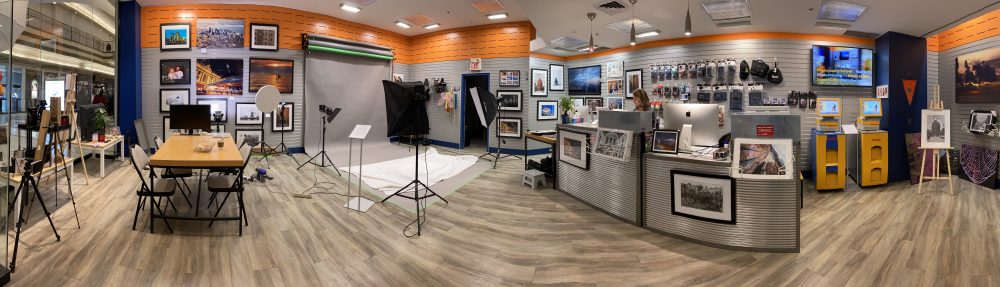
I thought I would add one more picture of the small studio, and how it works.

This consists of:

  • A grey background
  • A main (“key”) light: a Bowens 400 Ws monolight, fired into a Bowens 60×80 softbox.
  • This light is activated through a PocketWizard; all other lights have a photocell that follows this light.
  • A fill light, 250 Ws fired into an umbrella
  • A 100 Ws background light with a yellow gel
  • A 250 Ws hair light with a snoot
  • A stool for the victim to sit on

The camera is set to manual exposure and has a Pocketwizard on it which drives the flashes. Don’t forget to set your camera to manual low ISO, and to check that your exposure time is under the synch speed (e.g. 1/125th second). Then meter for the right light (meter key and fill lights individually).

And this very vanilla setup leads to:

Photographers will know: the biggest challenge is to focus on yourself. That is why we are always hassling people to model for us.

Opus Non Magnum

A word about that Opus studio flash that you saw in that previous picture the other day, at the top:

I have owned nine Opus lights, and seven of them have failed. They are sometimes dead in the box (the nine above do not include the one that was dead when I opened the box). If they do work, they die, or they malfunction later. Seven out of nine – I have never seen worse.

The importer, after I wrote a few times, told me:

It sounds like the equipment you’re using has been discontinued by Opus.
These unit were designed for the “Home User” looking to experiment with strobe lighting with out paying the premium for professional lights.

Meaning what, that failing is OK for home users?

He adds that the lights have a two-year warranty. But having seen so many of these Opus lights die, and having heard many photographers describe Opus catching fire, I cannot recommend them in any way.

For affordable monolights that also offer quality, I can recommend the Bowens lights.

Snap

Me, snapped by a student last night:

The Nikon D80 camera is on manual. That means aperture and shutter speed are set manually, but it does not mean that the flash is manual!

The flash is still fully automatic – the camera fires a preflash, measures light return, and sets flash power for the actual flash accordingly. We call that TTL (iTTL, part of CLS, for Nikon; E-TTL II for Canon). The flash was turned back toward the ceiling behind the photographer:never fire straight into your victim’s face if the flash is the main light source.

Simple setup for budding pros.

You saw my picture the other day. That was shot quickly, and I’ll explain how.

Here’s a very simple studio (or portable studio) setup for such quick portraits:

  • Two lights aimed either at a white wall behind you or into (or through) umbrellas. Both of these 45 degrees above, on either side. (45 degree high and 45 degrees left or right).
  • The main light (which is usually two stops above the other, fill, light) preferably through an umbrella; the fill light can reflect off an umbrella.
  • One light behind the subject aimed at the wall behind him or her, perhaps through a grid.
  • Optionally a hair light, perhaps using a snoot.
  • As a starting point, set your camera to manual mode, 1/125th second, f/5.6, at 100 ISO.
  • No flash on the camera, of course.
  • Check the histogram. Adjust aperture or light power accordingly.

For the shot here, we aimed both lights at the wall/ceiling: quicker than an umbrella and since here we did not need accurate pointing and shaping, it did fine.

When the histogram looks good, finally remember to get your subject to smile, as my colleague photographer Dani Valiquette did today, when I asked her to take a portrait for me. I don;t smile, except she made me.

And hey presto, one minute later you have a simple portrait.

You need to click and then view at original size to see exactly how sharp this is. Bright flashed pixes are sharp pixels.

Personally, I prefer the serious one, but I am told by many that I look less handsome when grumpy. Surely not?

This will be a common occurrence for you as a photographer: you like one shot, and the subject likes another – often the one you think is the inferior one. Get used to it and shoot both. Without giving up your artistic integrity, you can give the customer what they want.

Snow

I have a reminder for you of how to expose for snow.

Snow and sand (yes, beaches to a camera look just like snowscapes) are brighter than your average scene.

So to get them to look natural, i.e. to get them to look bright, you need to tell the camera it is looking at a bright scene.

Unless you do this, the scene will look dark.  The camera, by virtue of its reflective light meter technology, tries to make everything look mid-grey (we call this “18% grey”). Like this:

Not bad. But unless you want the dark look for effect, it’s not good either; it was brighter than that outside my second home, the other day.

With +1 stop exposure compensation (that’s the plus/minus button), it looks like this:

And that is better. Your guideline:

  1. Snow should look white, not grey.
  2. The histogram should have a peak (the snow) on the very right, just before the end of the graph.

So use Exposure Compensation, have fun, and dress warmly.

Or if your thing is a beach, don’t dress at all.

Pocketwoes

Nah, I exaggerate. Pocketwizards (specifically, the non-TTL model, namely the Pocketwizard II Plus, of which I own five) are great. But I do want to draw attention to two issues to watch out for.

First: what am I doing. I am firing a Pocketwizard, as in my post a few days ago. Meaning I have this setup:

The camera contains a TTL flash, plus from the PC-contact (the X-contact) I am firing an additional flash, set to manual at low power.

I even have three brand-new Pocketwizard-to-hotshoe cables [link] from Flashzebra – recommended, both the equipment and the company. My order arrived promptly via US mail (as did the mounting brackets that you see under the PW – these allow neatly mounting the PWs onto lightstands). No UPS ripoff.

The Gel on the flash above is a Honl Photo blue gel, to add a splash of colour to a photo I was working on.

To my surprise, I have found this Pocketwizard setup to not always be reliable.

When I mount the PW onto the top of the camera hotshoe, no problem. But when I use the PC connector on the side of the camera, and a cable supplied with the Pocketwizard, no go sometimes. I can fire the camera or even press the local PW’s button, and I get intermittent remote flash firing.

I have so far narrowed the issue to the following three causes:

  1. Bad X-sync contact. I needed to use contact cleaner and squeeze the connector a bit to ensure good contact.
  2. Antennas need to be polarized equally (if the sender is vertical, ideally the receiver needs to be vertical as well).
  3. Maintaining the distance from the speedlite is a good idea: Speedlites can interfere.
  4. Radio signal: when I continuously press the sender’s test button, the receiver’s LED should stay on. Normally this happens. Even when I hold my hand by the sender’s antenna, the receiver normally stays solid. But when I attach a cable to the PW, even when it is dangling in mid air and not connected to the camera, it is much less reliable.

I mean this:

With that cable, whether connected to the camera or not, the sender seems to send out less power than without. This is not surprising: the wire probably affects radiated power and pattern. But it is good to be reminded this is a radio transmitter and radio is black magic (and I am a licensed radio ham, VA3MVW, so I have some appreciation of this).

The moral of this story: Watch out, the rock solid reliability of Pocketwizards, which I had always taken for granted, is not guaranteed. Especially when not using the hotshoe.

But by watching all factors above, I think I have it down to a reliable setup -and when I have issues at least I know what they are and how I can address them.

Update: see the post I wrote a few hours later about RF chokes
Add a splash

I recommended recently that you might want to add a  splash of colour every now and then. So here’s an example.

Our Christmas “tree”, lit with just a bounce flash. The background is exposed properly (I used -1.3 stops exposure compensation in Av mode). But still: kinda bland, no?

So let’s add a dash of colour. A pocketwizard connected to the camera, and one behind the tree connected via a hotshoe cable to a 430EX flash. The flash was on manual at 1/16th power, and on the flash I had a Honl Photo speed strap with a Honl Bright Red gel conveniently velcro’d on. Now we’re talking!

If I had had more cables (I am awaiting a shipment of hotshoe cables…) I would have added a green one as well. But this is already much better thwanwhat I had before.

Oh and just to show what the flash alone would have done: if I disable the bounce flash, here’s what that same shot would look like:

Bit overly dramatic, but add some more light and it has potential!

Here’s the setup:

(Small note: I have, I must admit, found the X-sync to Pocketwizard contact unreliable and I am not entirely sure why: Maybe the connector itself? But the hotshoe contact is flawless.)

And finally. I wanted red and green, but had only one working flash I could drive with a pocketwizard.

Solution?

Which, after a bit of back and forth with manual exposure, flash compensation, and remote flash power, gives me this:

Or, if you prefer a brighter room, this:

You see how much fun playing with colour and light can be?

Family snapshot tip

If you are new to cameras, let me give you a quick tip for the holidays.

When you shoot pictures of your family, use “slow flash” (enable “slow” on Nikon, or use Av mode on Canon)  and an ISO of 400 or even more if it is dark indoors. That allows the background light to show, as well.

You will need flash, too, around the tree. But rather than the popup flash, use an external flash. And above all, do not do this with that flash:

Instead, do this:

That’s right – point the flash backward above you. Your happy snaps (photojournalists call them “grip and grins”)  will be infinitely better.