Accountants of the wild frontier

Today was a good example of n event shoot.

Colleague Joseph and I got to the Metro Toronto Convention centre to shoot a few hundred accountants pointing laser pointers at the ceiling. A very un-accountant-like event!

So we set up ladders and camera with the light just right. We use a combination of ambient and gobo’d flash. Test shots of the room looked like this:
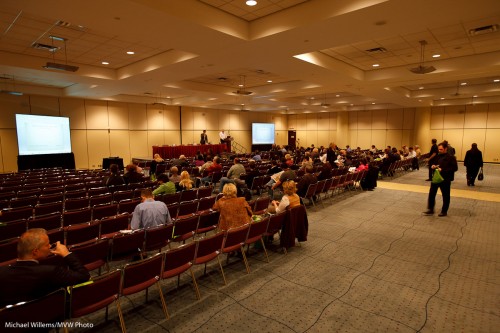
Convention hall

Convention hall

The event starts. And as the fog machine we had arranged starts and on command, the accountants’ laser pointers aim… unexpectedly, someone dims the lights to just about zero.

So we get this:
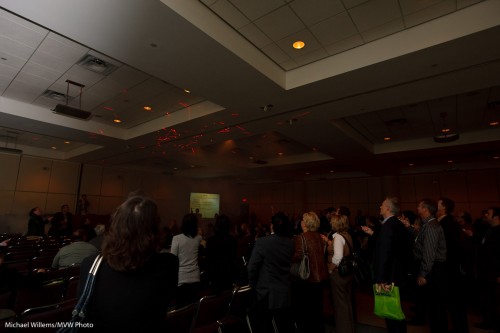
Convention hall

Convention hall, lights dimmed

No time to say anything: we only have moments to shoot.

So I quickly had to:

  • open up the lens to f/2.8,
  • shoot at 1/15th second,
  • at 800 ISO,
  • I quickly set the flash to 1/16th power manual and bounced behind me (if I had had more time I would have gone up to 1/8th power),
  • ….and then at home, push the exposure another stop!

In the end, this gives this:
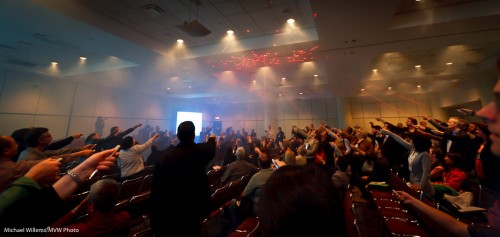
Convention hall with lasering accountants

Convention hall with lasering accountants

Not too shabby eh? Ever seen such a fun group of accountants?

The moral of this post: you have to be quick on your feet and problem-solved instantly when someone is hiring you for a shoot. You cannot come home with excuses: need photos instead.

And it never hurts to shoot RAW.
Side lighting

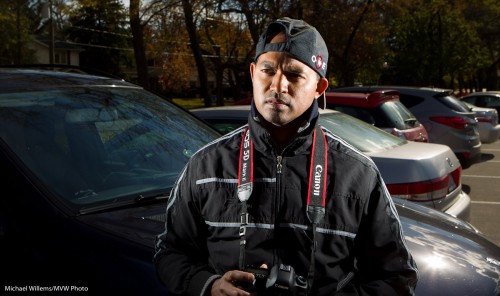
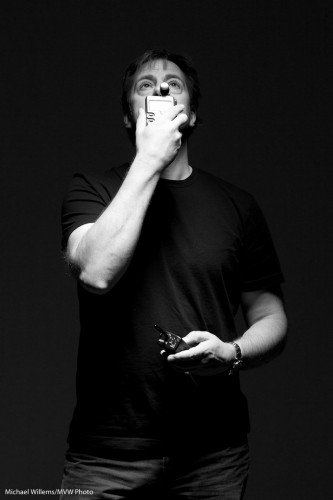
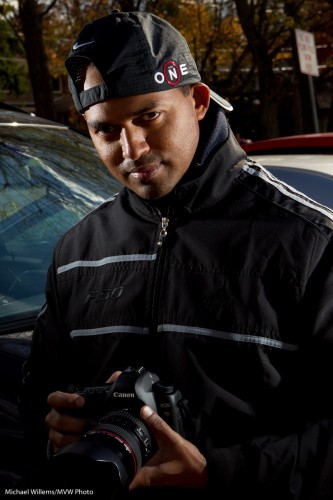
Look at this picture, of a photographer student I shall call “Rapper MA” (although he is not a rapper of course – it is just the look and the light and the hat!):

Edge-lit Photographer (Photo: Michael Willems)

Edge-lit Photographer

This was made in bright sunny daylight.

How did I light it?

  • Camera on manual
  • 100 ISO, 1/160th second.
  • Now set aperture to expose for the background. In this case f/13.
  • Use two flashes, left and right, slightly behind the subject.
  • Flashes on stands, aimed at subject.
  • Connected to Pocketwizards via Flashzebra cables.
  • Pocketwizard on the camera.
  • Set power to that aperture (using the light meter). Adjust shutter/aperture as needed.

That’s how.

Here’s one more illustration with a bit more background:

Edge-lit Photographer (Photo: Michael Willems)

Edge-lit Photographer

Small speedlites can overpower the sun. That is why this site is called “speedlighter”. Have fun with your speedlights!

I was having a coffee…

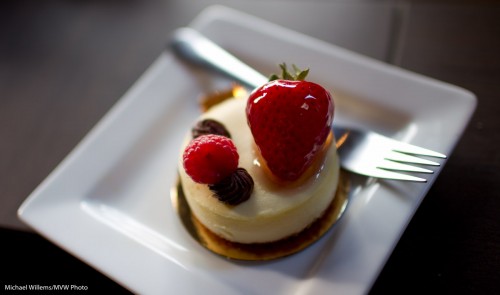
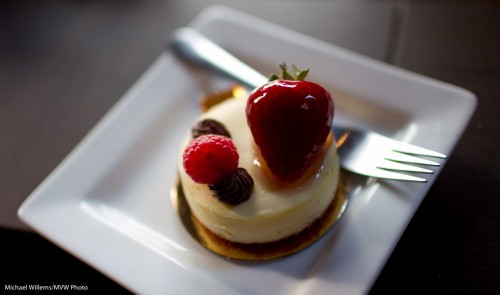
…when I decided a cheesecake would be good. So I bought a piece.  And shot it.

Cheesecake (Photo: Michael Willems)

Cheesecake

35 mm lens, f/1.4, 1/60th second at 100 ISO. You see what those nice fast lenses can do? I cropped a tiny bit of light from the top – no other adjustments.

The moral of this post:

  • Be ready to shoot your food.
  • Fast prime lenses are good: available light works.
  • You do not always need flash.
  • Low ISO is good.
  • Wide open is good: selective focus is great.
  • A wide angle lens can be used to shoot a macro food shot!

Exhaustion prevents me from working more tonight – but more soon.

Henrys yesterday

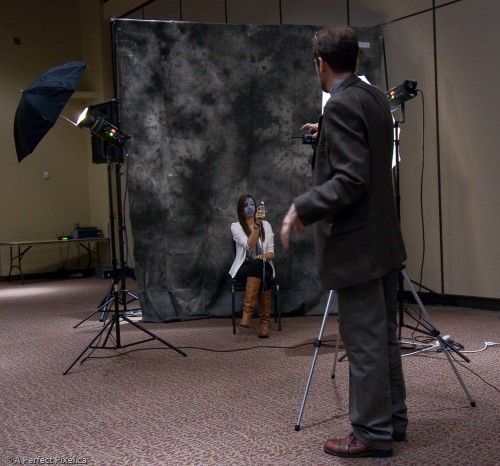
My friend and student Ray made this picture of me at the International Centre, at the Photo Show, setting up a shot:

Imaging show, Michael Willems and model

Imaging show, Michael Willems and model

She is, as you see, holding the light meter.

No that is not heavy make-up. It is body paint.

I was in front of a crown of hundreds and am now setting off for day three of the same. Flash, portrait lighting, and Travel Photography. Fun!

Darkness

Can be good. As in this recent low key portrait of my friend and colleague photographer Joseph Marranca:

Joseph Marranca

Photographer Joseph Marranca

A low key portrait is a portrait where background and clothing are dark, and only a small part of the image is lit.

We used one small beauty dish. Straight above Joseph. And the white studio walls, because they got no light, turned dark. This is key: umbrellas would have spilled light onto the background. This small directional light allowed the background to remain dark.

(The dish failed to perform: it did not make Joseph beautiful).

Sunburst

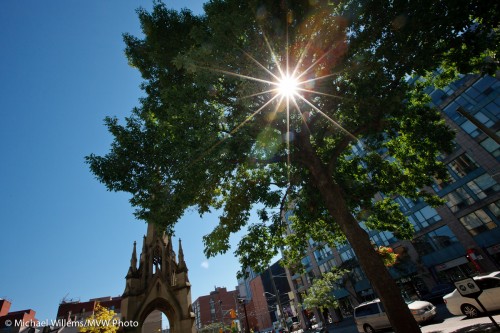
Look at this recent sunburst picture:

Sunburst

Sunburst, Toronto

For a picture like this, a few things may help:

  • You need a small(-ish) aperture to get the effect
  • Feeding the light through an object (like the tree) is essential for several reasons. One, to enhance the effect. Two, to protect your eyes, Three, to protect your camera.
  • Do it quickly. No sense burning the camera.
  • Remove filters. They can cause more flare.

Oh…. and can you see that I used a speedlight to light up the tree?

Portrait note

One more from Sunday’s course.

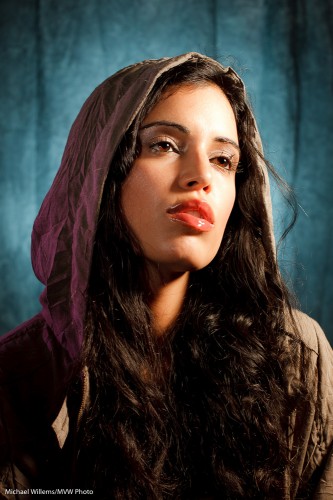
This time, a portrait of model Tara that I made to help explain multiple flash TTL. Straight out of the camera it is:

Multiple-flash TTL lighting

Multiple-flash TTL lighting

How was this made?

With a small Traveller 8 softbox on the main light, a gridded gelled flash for the background, a snooted flash for the fill light, and a gridded gelled flash for the edge light.

Four speedlights, and all using TTL.

A few things to remember in such portraits:

  • You need a catch light in the eyes.
  • Set your white balance to “flash”.
  • If you have space, longer lenses are good (in this case, though, I use a 50mm prime lens).
  • Avoid the ambient light doing any work: choose 1/125th second at f/5.6 or f/8, say; and be sure to disable “Auto ISO”.
  • Lighting is all about what you do not light: avoid bathing the room in photons. Think about what you light, and how.
  • With Canon’s e-TTL or Nikon’s CLS/iTTL, you only get two or three groups of light. So if you have four lights, some of them will have to be in the same group. My fill and edge light are thus both in group “B”.

Keep those in mind and your portraits will be well lit.

A shot from the course

At the Mono “Creative Light” workshop,  we do different portfolio shots every time.

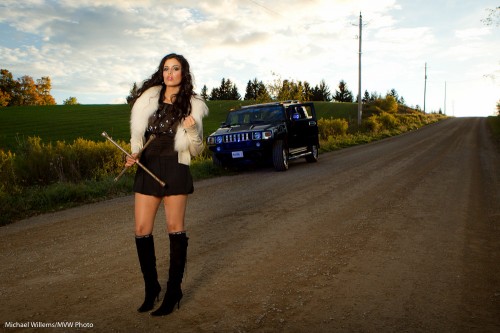
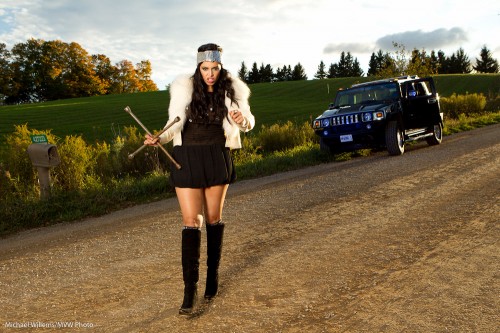
So imagine our delighted on Sunday when a student turned up in a Hummer. This was immediately put to use by model Tara:

Tara Elizabeth and Hummer

Tara Elizabeth and Hummer

That was lit how?

This is how: with a softbox, to our left. And a small speedlight to our left aimed straight at the car – with a blue Honl gel. Both were fired using pocketwizards (the speedlite using a Flashzebra cable). Metered using a light meter, of course.

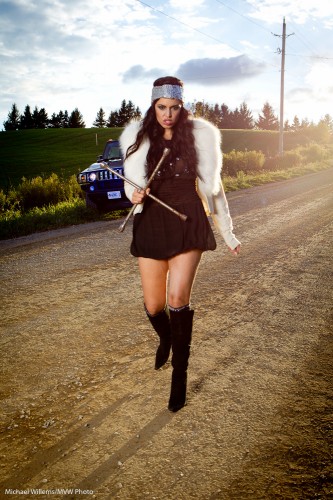
Here is an alternate take:

Angry Tara Elizabeth, with Hummer

Angry Tara, with Hummer

That was taken just a few minutes before. Can you see how every minute counts when shooting in beautiful late day light?

Okay, one more. Just to show that lens flare – which should normally be avoided – can sometimes be OK:

Angry with tire iron

Angry with tire iron

You avoid flare by:

  • Using a lens hood
  • Shielding the lens with your hand
  • Avoiding lens filters
  • Pointing slightly away from the light source

Have fun!

Guess what.

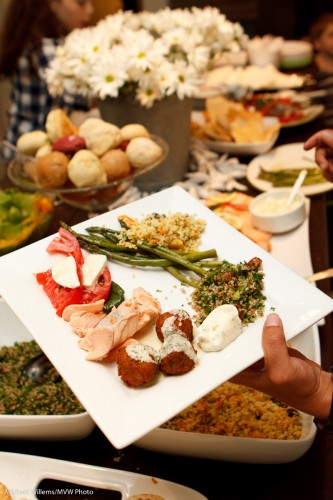
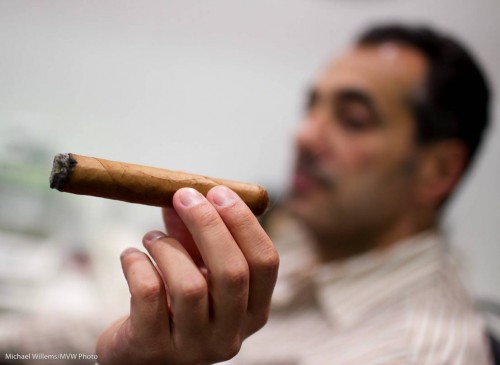
Two techniques today that I have pointed out before, and I will do it again until everyone uses them regularly.

  1. Close-Far
  2. Selective focus with supporting background elements

Like here:

Food, and food

Food, and food

And here:

Cigar and person

Cigar and person

These pictures:

  • Make the foreground subject really stand out
  • Achieve perspective (close-far: get close to your close object!) and
  • Provide environment, or context, where theuser has to put two and two together to create the story. The eye goes to close object – background – back to close object.

One more example – then go out and shoot some!

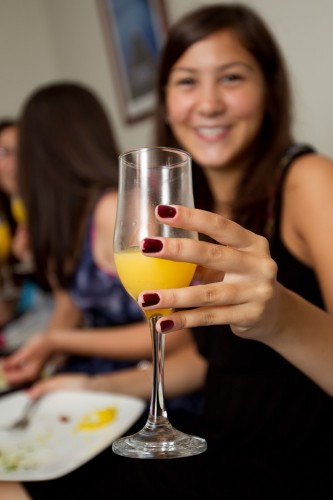
Cheers (Teen with orange juice)

Cheers (Teen with orange juice)

Instuctions, should you need them:

  1. Wide lens, often the wider the better
  2. Get close!
  3. Focus on the close object.
  4. Use the largest aperture (smallest “f-number”).

Have fun!