Bad light

Have you ever thought, or said, the following?

Waah. It’s raining, I can’t take pictures.

There’s no sun, I can’t take pictures.

Don’t you believe it. A cloudy, rainy day is better than a sunny day in so many ways.

  • No harsh shadows to wrinkle clothes (or faces)
  • No squinting eyes
  • Saturated colour
  • No impossible contrast to handle
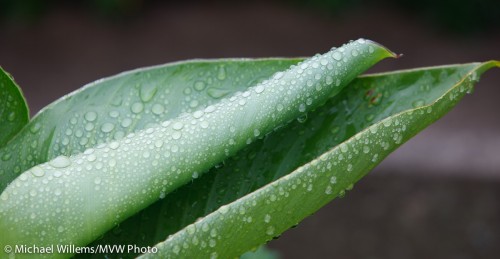
  • Those great raindrops

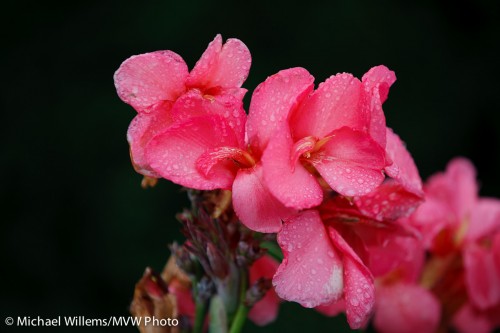
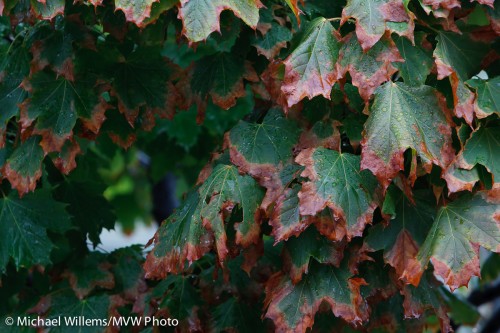
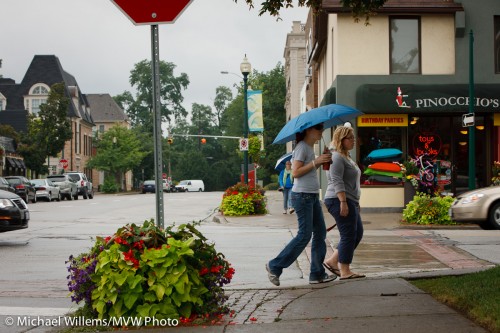
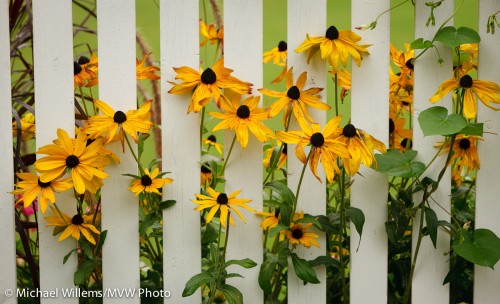
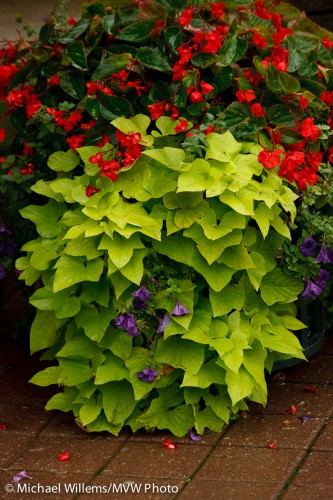
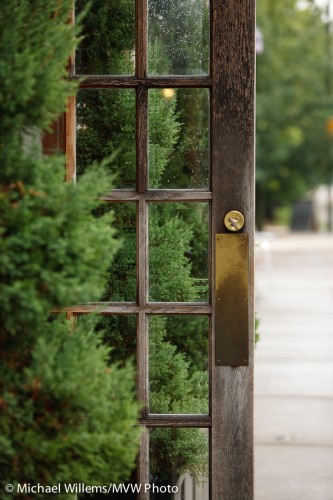
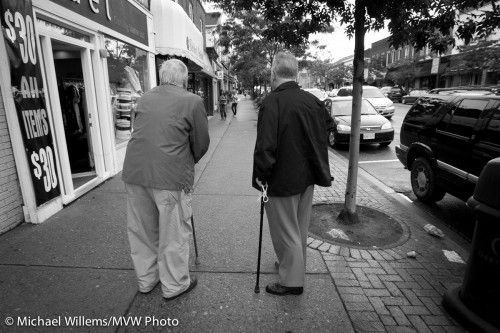
The other day, I took a few snaps during the Henry’s Creative Urban Photography walkaround. Here’s a few of them: are those saturated colours not beautiful?

Leaf in the rain, by Michael Willems

Leaf in the rain

Flower in the rain, by Michael Willems

Flower in the rain

Turning Leaves in the rain, by Michael Willems

Turning Leaves in the rain

Oakville in the rain, by Michael Willems

Oakville in the rain

Tired Flowers, by Michael Willems

Tired Flowers

Oakville plants in the rain, by Michael Willems

Oakville plants in the rain

Oakville door, by Michael Willems

Oakville door

A rainy, overcast, dreary day: provided you expose properly (remember exposure compensation. Hint: it’ll likely be “minus”), there’s really nothing quite like it.

Colour has to be real

Right?

Um, no, of course not: colour is a tool for you to use in your artistic endeavors.

And colour can be anything you like.

A few nights ago, I though I would see how long it would take me to recreate a lighting setup that my friend Dave Honl (yes, he of the excellent Honl Photo modifiers) did recently. So I looked at his shot and put it together the same way he shot it, in exactly 20 minutes:
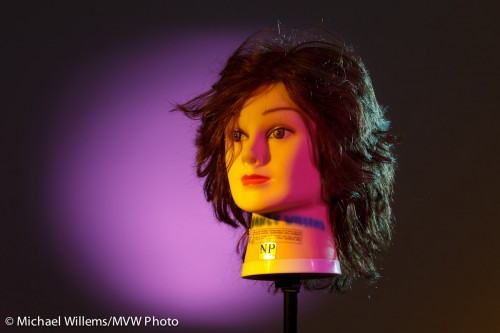
Fun with gels, Photo Michael Willems

Fun with gels

That is including:

  • Setting up four light stands.
  • Connecting four flashes (3x 430EX, 1x 580EX) to Pocketwizards using Flashzebra cables.
  • Mounting these on the light stands using ball heads etc.
  • Equipping the key light with a 1/4″ grid and an Egg Yolk Yellow gel.
  • Equipping the fill light with a 1/4″ grid and a Follies Pink gel.
  • Equipping the hair light with a small snoot and a Steel Green gel.
  • Equipping the background light with a long snoot and a Rose Purple gel.
  • Setting the power levels correctly (by trial and error, combined with histogram: key light = 1/4 power, fill=1/8, hair=1/8, background=1/16).
  • Setting the camera up correctly (I used the 7D and set it to manual, 100ISO, 1/125th, f/6.3).

Huh? Egg Yolk Yellow, a crazy bright colour, to light the face? Are we crazy?

No, just having fun. Yes, of course Dave could have made his shot using no colour. Here’s what the same shot looks like without the gels. (Of course I switched the camera to an aperture one stop tighter, namely f/9, to compensate for the extra light once I removed the gels):
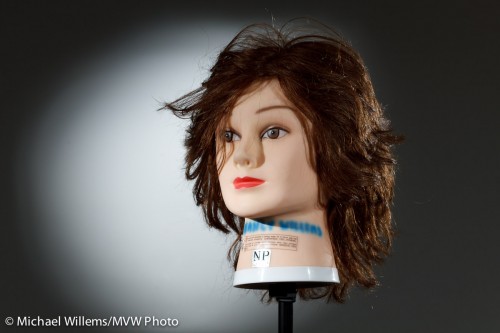
Grids and snoots, photo Michael Willems

Grids and snoots

Yeah, nice, and appropriate for a corporate head shot. But compared to the previous, it is kinda boring, no? So next time you shoot someone, unless they are a law firm executive, you might have fun and try some colour. You don’t need to go crazy and use four colours, but a splash here and there can really help your picture come alive.

By the way, what was the colour of the backdrop?

White.

Remember the following equation:

White – light = black

Similarly, in practice, black + enough light = white.

And finally, a real person: my son Daniel (“sigh, not again, Dad”):
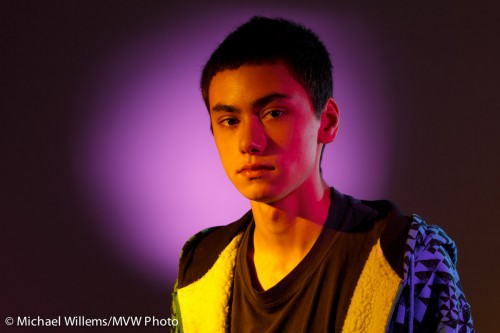
Daniel, photo Michael Willems

Daniel in colour

But here’s the thing. After seeing it, he grinned and said “Rad.”. That‘s a first!

Light is what you make it

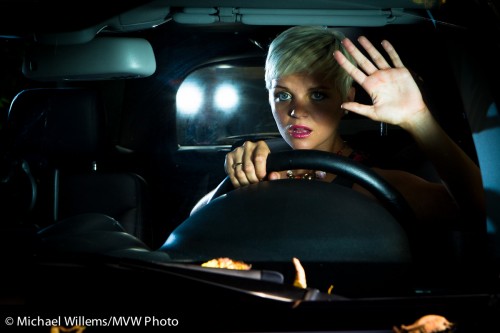
Night time? No.I took this shot in open daylight, last Saturday during the Advanced Flash course Joseph and I taught at Mono, Ontario:

Scary Drive (Photo Michael Willems)

Scary Drive (Photo Michael Willems)

The lesson here is not how that is done (it is involved, and needs speedlites, pocketwizards, reflectors, light stands, and my SUV), but it is that it can be done. Daylight can look like a scary stormy night.

On the advanced light course we teach you the details – but even before that, you can start playing with flash. Right now. Using one or more external flashes (not the pop-up).

And you should. Because flash can:

  • Make flat surfaces round;
  • Separate subjects from backgrounds;
  • Make dull subjects sharp;
  • Make wrinkled surfaces flat;
  • Make cold surfaces warm;
  • Make blurry motion sharp;
  • Make day into night;
  • Direct the eyes where they otherwise would not go;
  • Give you nice catchlights in the eyes;
  • …even create cars where there aren’t any.

That’s why this blog is called “Speedlighter” – speedlights and other flashes can be the most useful tool a photographer has, after the camera.

So my advice:

  • Get yourself one or more speedlites;
  • Find a way to fire them off-camera: TTL, flash cable, or pocketwizards;
  • Get some modifiers;
  • Stay tuned here, take a course: learn how they all work;
  • And above all, keep shooting.

And your photos will go up to the next level of professionalism and creativity.

Speed

When we say “pick the right moment” we often mean “freeze that moment in time”. Like the ball floating just above the ground here:

Picking the right moment, photo Michael Willems

Picking the right moment

To capture something like that,

  • Go so shutter speed priority (S/Tv) on the dial on the top
  • Select a shutter speed of, say, 1/500th second. faster is the object moves more quickly of course.

Try it today: go freeze a few moments!

Four more days

Saturday I’ll be here:

Mono, country home with flash

Mono, country home (with flash)

But it will be rearranged and full of lights. This is my Mono, Ont. Country home, where Joseph Marranca and I are holding our all-day Advanced Flash workshop.

That snap was taken with the little Panasonic GF1, with its built in little flash raised to very successfully fill in the shadows.

KISS: Simple, again

Today, another shot in the “Keeping it simple” series.

Relatively simple, anyway:

Evanna Mills, photo Michael Willems

Model Evanna Mills, photo Michael Willems

For this photo, taken during our last Creative Lighting workshop, I could have used large strobes with softboxes and portable lead-acid batteries. Instead, I used two simple speedlites.

  • The main light: a Canon 580EX II flash fitted with a Honl Traveller 8 Softbox. Inside that softbox, a half CTO gel.
  • The hair light: a Canon 430EX flash with a Honl Photo 1/4″ grid.
  • Both flashes on cheap, simple stands.
  • Camera on manual/ 1/160th second, f/9, and set to “Flash” white balance.

This is simple and can be reproduced easily and consistently.

I used Pocketwizards and manual settings to fire the lights, because that way I was able to use any flash (even a very cheap one!) and to hand the Pocketwizard to each student in turn to shoot the shot and get consistent results immediately, but I could equally well have used TTL.

The next Creative Lighting workshop in Mono is August 14.

Another version

…of the recent “rain”-shot Joseph and I put on at our Mono workshop. I asked recently which one you preferred. Here’s mine:

Evanna, photo by Michael WIllems

Evanna, photo by Michael Willems

Overall, I slightly prefer this one, because:

  • She is larger in the shot.
  • The wet road looks more realistic.
  • It looks like she is in the rain, now – rain drips off the umbrella.
  • I like the lit umbrella, to provide contrast with the hair.
  • Her face is part lit, not evenly lit.

But that is my opinion. Yours may differ. Validly! In interpreting art, a lot of it is valid opinion.

Less can be more

Less can be more. We sometimes make things complicated as photographers: we get gear-itis. Yeah, me too.

But you can keep it simple. Richard Avedon shot much of his work with a view camera and a white sheet on the shady side of a building. Period. For the longest time, Robert Mapplethorpe shot with a simple Polaroid camera with no settings to speak of.

So while I teach complex lighting, and I teach making complex technologies like TTL understandable, sometimes it can be simple.

Look, for example, at this recent shot of model Lindsay:

Model Lindsay, photo by Michael Willems

Lindsay, photo by Michael Willems, 2010

This is simple how?

  • A simple background. A white wall. I love white walls.
  • Simple lighting equipment. Just one flash, namely a 580EX speedlite on the camera.
  • Simple lighting setup. That flash was aimed at the wall and ceiling behind me. Using TTL, so no metering was necessary (just flash exposure compensation of about +1.3 stops)
  • Simple colour (namely: no colour. I love black and white).
  • Simple clothing. White top for high-key effect. Jeans for a contrasty dark area.
  • Simple pose.
  • Simple post work (just slight exposure adjustments as needed and skin fixes where necessary).

Sometimes less really is more. Don’t you think?

So here is your assignment, should you wish to accept it: find a white room and shoot a high-key portrait like this. Aim the flash behind you. Expose well: to the right. Have fun!