But.. but… it’s complicated!

Well, sometimes things need work.

I often have students who ask “do I really need two lenses?”, “do I really need a reflector”, “do I really need a tripod”? “Must I really use manual”, … and so on.

The other day I attended a very entertaining shoot with Ivan Otis, and this shoot was a typical example of “how it’s done”.

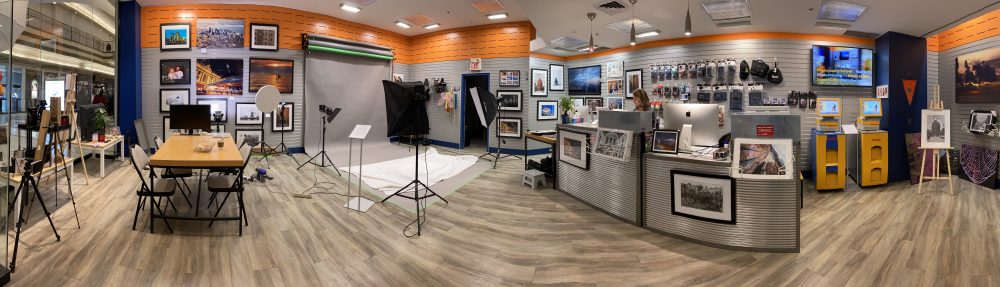
Even a simple fashion shoot like this involves cameras, light stands, reflectors, computers, umbrellas, light meters, batteries, cables, softboxes, pocketwizards, props, two assistants, a make-up artist (“MUA”), a hairdresser, lunch, and of course a model and a photographer.
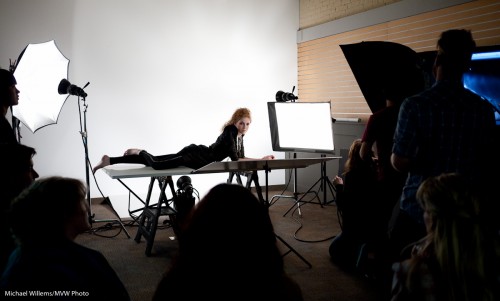
A Fashion Shoot

A Fashion Shoot

A more involved fashion shoot would also have fashion advisors, a creative director, and more.

So the answer to “do I really need all this” is “it depends, but you cannot always do everything with one handheld camera, a 50mm lens, and a pop-up flash”.

The complexity in a shoot like the one above is not done just to make things complicated! As I always say, the Sports Illustrated swimsuit-issue model cavorting happily on the beach looks good only because there is a guy with a big reflector cavorting along right behind her.

That said: you do not need to over-complicate things. Simple means can often achieve great results. Like this, taken at a recent Mono workshop Joseph Marranca and I taught:
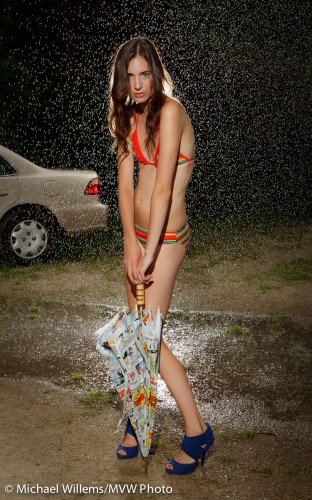
Evanna Mills in the rain

Evanna Mills in the rain

That used just three bare speedlights and a handheld camera.

(On that note: our next “advanced lighting” all-day workshops in Mono, Ontario, will be held on 3 October and 20 November, and as of the time of writing, there is still space).
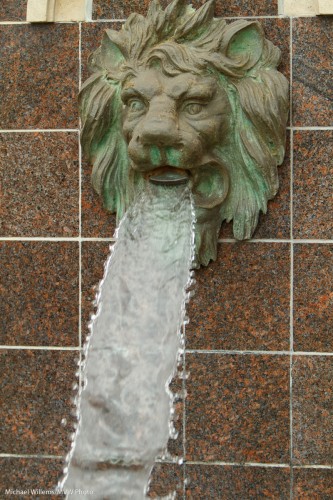
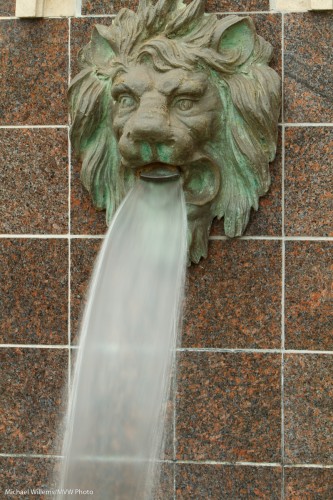
Vomit, or silk?

So when I shoot a flow, like a rapidly moving car, or a gently flowing river, or a famously gushing fountain (uh oh, I am beginning to sound like Dan Brown), should I “freeze” that motion? Or should I somehow show it?

This is a shot from the other day’s Creative Urban Photography walk, shot as an instant, a moment in time (using S/Tv mode, shot at 1/500th second):

Fountain, moment in time (Photo Michael Willems)

Fountain, moment in time

Uh oh. Matter of taste – but to me, that looks like vomit. Or perhaps a chainsaw.

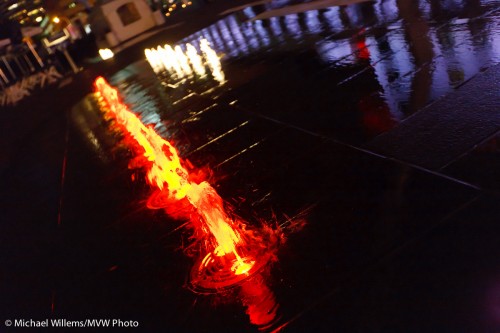
And here’s the same, now using S/Tv mode at 1/10th second, so it shows a  stream:

Fountain, as a flow (Photo Michael Willems)

Fountain, as a flow

Ahhh…. a beautiful silky flow.

So now you tell me. Matter of taste, yes. So according to your taste, should a flow be portrayed as a moment, or as a flow?

Eat.

OK, do not eat quite yet.

I shoot events. All the time. It is what I love to do.

And these events are organized by corporations, or wealthy people, or governments, or charitable organizations. You name it. People like to get together. And all these people have paid a lot for the food – or sweated, making it.

And food is ephemeral: it’s there – then it’s not.

This is where photographers do a very useful job. One good photo, and that food exists forever. Like beauty, or youth.

And like these delicious strawberries, which I shot at a very nice private event in Toronto on Labour Day:

Strawberries, by Michael Willems

Strawberries, by Michael Willems

There. And this too:

Food Shot, by Michael Willems

Food Shot, by Michael Willems

The way to do this:

  • Set your camera to manual exposure mode.
  • Expose two stops below ambient (choose aperture and shutter so that the meter reads -2. This might be 400 ISO, f/4, 1/60th second).
  • Make sure your aperture is fairly open (that’s the “f/4”).
  • Bounce your flash off the ceiling/wall behind you.
  • Focus on the closest part.
  • Tilt as needed.

Your images will be loved by your client. The book can now include food shots as background or detail shots. The food is now good forever. The investment is secured for all eternity. And the story is a better one: not just grip-and-grin images, but also “background”.

Blur is bad. Always. Or…?

Or is it?

Bike, photo by Michael Willems

Bike, Toronto, Aug 2010

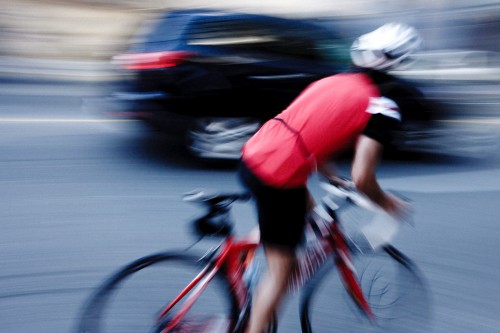
Indeed not. That is why you have a shutter speed priority (Tv/S). Sometimes you want to show motion, and you do that by blurring things.

I took the shot above while panning at 1/15th of a second (and f/22 at 100 ISO: it was a bright day in Toronto). It shows “in a hurry”, dynamic motion much better than a “frozen” picture of the same subject would do.

Negative Space

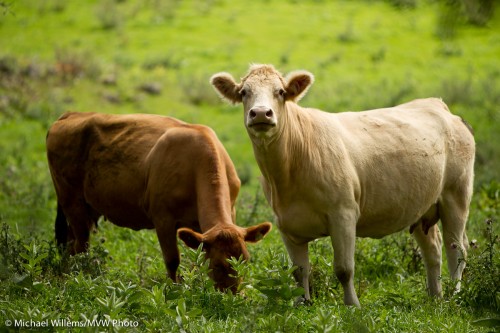
Instead of making your subjects big, like so:

Moo! Cows (Photo by Michael Willems)

Moo!

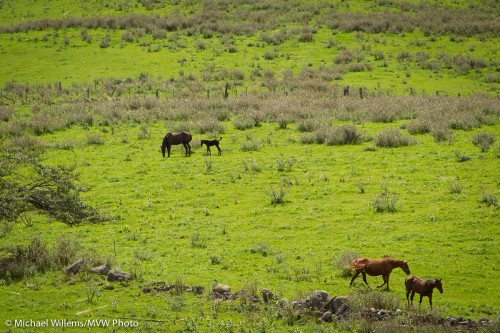
…you can also make them small, like so, and surround them with “nothing much”:

Horses in Mono - Photo by Michael Willems

Horses in Mono

We call that using “negative space”.

The use of Negative Space is a great way to show your subject not as huge, but as interconnected with, and inhabiting, a large area.

The negative space needs to be just that: negative space, i.e. devoid of meaningful content. It does not have to empty: just empty of information.

Dark

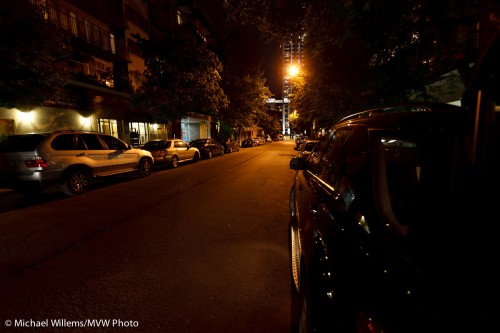
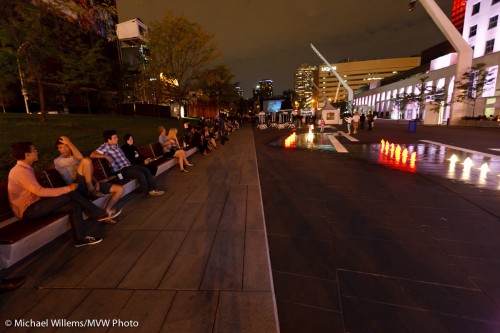
Always carry your camera, even at night.

I just got back from teaching, after an executive portrait shoot this morning.

But I want to talk not about light, but about lack of light. And how when it gets dark, you do not put away your camera. Like I carried mine, just the other night in Montreal:

Montreal, night scene, handheld photo by Michael Willems

Montreal, night scene, handheld (Aug 2010)

Montreal, night scene, handheld photo by Michael Willems

Montreal, Rue Hutchison, Aug 2010

Montreal, "The Shining", handheld photo by Michael Willems

Montreal, "The Shining", handheld

All those were handheld shots.

Tips for those:

  • Hold the camera steady!
  • Use a wide lens, since they are more forgiving of motiong
  • Make it a fast one the fastest you can get (I used a 16-35mm f/2.8 on a full-frame camera);
  • Use a high ISO if handheld (but low if using a tripod);
  • Expose down 1-2 stops (use manual, or use aperture mode and Exposure Compensation “minus”) ;
  • Shoot multiple times to make sure!

If you do it that way, it is easy. And you will be happy with your images.

Piece it together

I have mentioned this before: the need to have your audience piece things together themselves.

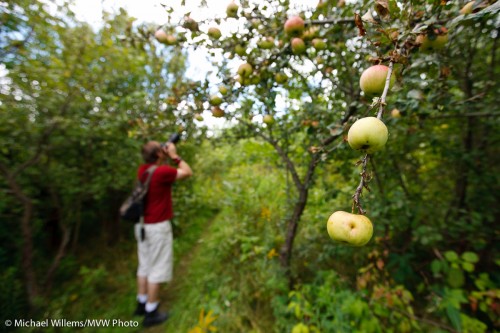
One way is to use selective depth of field. Like in this snap from a recent outing in Mono Cliffs Provincial Park:

Mono Cliffs Provincial Park, photo Michael Willems

Mono Cliffs Provincial Park

You see the apple first, then a blurred out view of the photographer, then you figure out what it is, then you slowly see what’s happening.

This snap also shows the benefit of wide angle lenses. As does this:

Mono Cliffs Provincial Park 2, photo Michael Willems

Mono Cliffs Provincial Park 2

Depth! And I also used a bit of flash, with a half CTO gel.

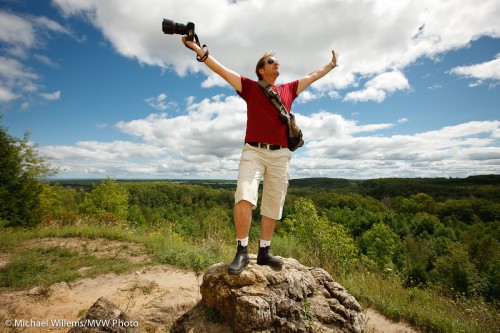
And one more, finally: colleague Joseph Marranca in the park at the lookout point. Also shot with a little fill flash with a half CTO gel, with the camera’s white balance set to flash. After first exposing properly for the background, of course.

Mono Cliffs Provincial Park 3, photo Michael Willems

Mono Cliffs Provincial Park 3

What we are doing there? tracing out  the route for the upcoming Nature Walk course!

All those shots were taken with a wide angle lens. Wide meaning 16mm (or 10mm if you have a  “crop factor” digital camera, i.e. one that is not “full frame”). Wide angles rock.

Size matters.

…the size of your umbrella, anyway.

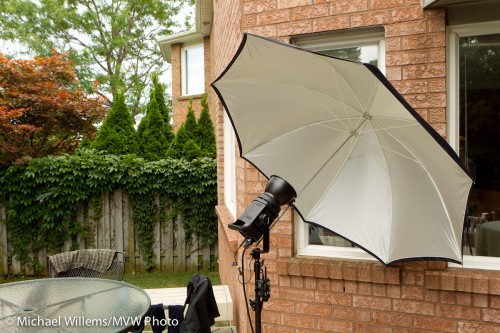
I am using a big Photoflex umbrella today. How big? Here’s how big:

Big Photoflex Umbrella

Big Photoflex Umbrella

This umbrella, which can be used to shoot into, as I am doing here, or to shoot through, is huge. Which makes the light softer.

It is also very reflective, more than most. And that helps: I was able to overpower daylight on an overcast day with the single Bowens 400 Ws light set to 3 (out of 5), somewhat close to the subject. With my regular, smaller and less reflective umbrellas, I would have used a setting of 4 to 5 for that shot.

So, all this amounts to:

  • Softer light (since the source is larger),
  • Greater distance I can bridge,
  • Less spillover behind the umbrella (which in a studio is important)
  • A lot more shots out of my battery pack,
  • Faster recharge time between shots.

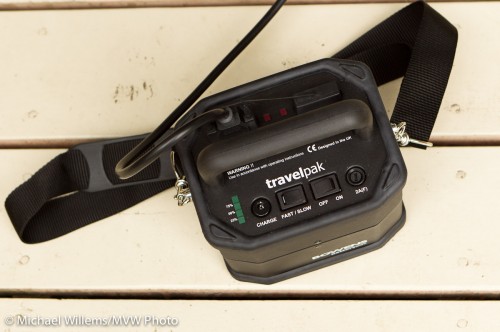
Here is that battery pack:

Bowens battery pack

Bowens battery pack

At full power, I get 150 shots out of a small battery (attached at the bottom); at power level 3, it is closer to 300 shots.

So by using a nice umbrella, metering to minus two stops ambient (minus three if metering off the dark garden), then setting the flash to the aperture thus achieved, which was f/5.6), I get this shot:

Nancy, photo by Michael Willems

In the back yard, lit by flash

As you can probably see, I am also using a speedlite on the camera left, to separate the hair from the background and to give some edge lighting interest. That speedlite is fitted with a Honl Photo 1/4″ grid to avoid the lens flare I would otherwise get.

Time for this snap: couple of minutes.

If all that is confusing, as it will be to beginners, then just take one of the flash courses and learn how to do this. It is fun, and well within reach of amateurs – not just for pros!

Michael’s Quick Judgment:

  • Photoflex large reflective umbrella: recommended.
  • Bowens Travelpak power pack: recommended.

Why is my picture blurry?

Why is my picture all blurry?

I hear this all the time from both experienced and new photographers.

Well, here’s why.

Focus:

  • You have not focused properly. Solution: select ONE focus point; focus; hold it; and only then shoot.
  • You are using a shallow depth of field. At f/1.4, it is hard to focus.

Subject:

  • Your subject is moving fast. Solution: pan with the subject or increase ISO, open aperture, or shoot the subject at the apex of its jump, say.

Shutter speed:

  • You are using a slow shutter speed (slower than twice the lens length, say, so on a 100mm lens you are using a shutter speed slower than 1/200th second). Solution: open the aperture or increase the ISO).
  • You are using a long lens (say a 300mm lens). On that lens, fast enough shutter speeds are hard to obtain). Solution: Zoom out, increase ISO, open the aperture, or use a tripod.
  • You are not using a tripod when you ought to. Solution? use a tripod!
  • You are using a slow lens. An f/3.5-5.6 consumer lens will never do as well as an f/2.8 pro lens. Solution: need I say?
  • You are using a small aperture, like f/8, when you should be using f/2.8. Solution: open your aperture.

Miscellaneous technique:

  • Your subject is in the dark – where it is muddy and blurry. Solution: Light your subject well.
  • You are not using flash when you should be. Solution: need I say?
  • You are  not using IS/VR. These are great features: stabilized lenses are superb and give you several stops. Solution: get an IS/VR lens.

Equipment:

  • Your camera is faulty – this is very unlikely, but have it checked out.
  • Your lens is faulty – this is also rather very unlikely, but have it checked out.

Clear? (Pun intended). Try all these and you will see your images improve amazingly.  Yes, I know, there are a lot of them. Yes, it’s complicated. But yes… you will take brilliant images once you get all of these right.

Remember these tips:

  • Bright pixels are sharp pixels (that is Willem’s Dictum);
  • Flashed pixels are sharp pixels;
  • VR/IS works;
  • Use one focus spot;
  • Hold the camera right;
  • A tripod is a good thing.

Have fun – a crisp, razor sharp picture really is a joy.

Speed

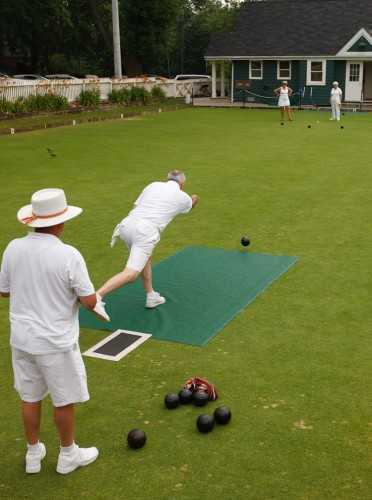
When we say “pick the right moment” we often mean “freeze that moment in time”. Like the ball floating just above the ground here:

Picking the right moment, photo Michael Willems

Picking the right moment

To capture something like that,

  • Go so shutter speed priority (S/Tv) on the dial on the top
  • Select a shutter speed of, say, 1/500th second. faster is the object moves more quickly of course.

Try it today: go freeze a few moments!