Oakville Sunset

Friday evening, this was the sunset as I was almost home:

Oakville Sunset, photo by Michael Willems

Oakville Sunset, photo by Michael Willems

That colour is not photoshopped: it was real.

For sunset pictures, remember this:

  1. Set your white balance to “daylight” (on the camera or, if shooting RAW, in Lightroom later).
  2. Expose right (if using evaluative metering, then use -1 stop Exposure Compensation). This saturates the colours.

I prefer to set the WB on the camera even when shooting RAW. That way, I can see on the LCD roughly what I may be getting.

MUA? What MUA?

Why do photographers need a make-up artist (a “MUA”) at a shoot? What does a make-up artist do? I thought that might be worth a few words today.

First of all, a make-up artist does make-up. D’oh.

Make-up is important for everyone – ask a TV producer: who ever appears under the cameras without make-up? Almost no-one. Richard Nixon lost an election because of his unkempt appearance.

Right, Michael. But surely young models, who are not Richard Nixon, do not need make-up? Right?

Sure they do. Even Angelina Jolie (or fill in your dream person).

Let me illustrate that.

Below, Angelina’s skin photographed close-up with a modern DSLR and a 100mm lens:

A wall. Photo Michael Willems

Not Angelina. Photo Michael Willems

Okay, maybe that is not Angelina’s skin, but you get the idea. No-one is perfect – people are people. Young and old, male and female: we all have pores, freckles, blemishes. Young models are, well, young, so they also have acne. The dream angels you see in Vogue have been photoshopped. They’re called “dream” for a reason.

So that is one reason you need a MUA: to fix flaws. So that the photographer does not have to spend hours in Photoshop or Lightroom “fixing” them.

And then the MUA does hair. Straighten, brush, whatever it needs: the MUA knows, and keeps a look out during a shoot.

Once all that is done, a very important function is to match the mood with the look. A good MUA knows how to do this. And to match the make-up and hair with the outfit: this too is very important. The MUA talks to the creative director and the photographer, and helps create the perfect look.

A further reason is to help with things in general. A shoot is always hectic and an extra pair of hands is great. And an extra pair of eyes. Runny eye shadow? Non-glossy lipstick? Hair in the way? The MUA keeps a close lookout for these things.

I would say that the final reason is one of the most important: a good MUA makes the model (male or female, young or old) feel good about themselves, and confident in their abilities. Feel great, feel beautiful, feel like a million dollars – and that translates to looking great.

To illustrate all that, here’s one more shot from Sunday’s workshop:
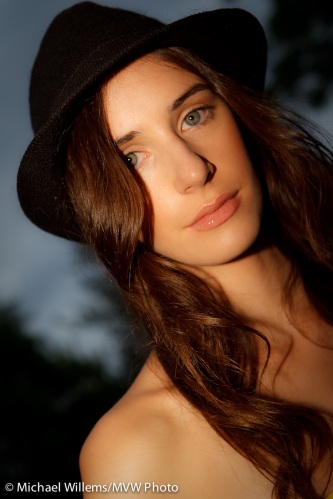
Evanna Mills, photo by Michael Willems

Evanna Mills (photo Michael Willems, Make-up Liz Valente)

Side note: I have been asked why we use young women as models in the workshops. Do we just like photographing young women?

Sure we do. But you would be surprised how little the photographer actually cares about the type of things he shoots. That is, you can have the same amount of fun shooting women or men, young or old; shooting jewelery or forests, shooting products or buildings. Old men are just as great as young women, creatively speaking. But models, most of whom are young women, are a good choice for several reasons.

One: they get paid to be there and they are very patient. Two: they have infinite energy. Posing all day takes it out of you. And three: they know how to pose for the camera. Finally, most importantly, they are not afraid. A good model is unselfconscious and will not worry for each shot how they look.

And the MUA reinforces that confidence.

Have you ever seen the rain?

Evanna Mills, photo by Michael Willems

Evanna Mills, photo by Michael Willems

Model Evanna Mills, photographed on yesterday’s Pro Workshop featuring Joseph Marranca and myself. Liz Valenta did the make-up.

It was raining.

Actually, it was a garden hose.

Lit mainly from behind, plus additional fill from the front. With the exposure set manually to create a dark background. The lights were both simple speedlites, fired using a pocketwizard.

And here’s one more. Now I am shining that back light through the black umbrella, making it almost white:

Evanna Mills, photo by Michael Willems

Evanna Mills, photo by Michael Willems

You see how much you can do using very simple means? This is what we teach on workshops, and it is also what photographers should keep in mind at all times.Simple technique can do a lot.

One more quick recipe

Quick recipe for you.

Remember this shot, done in the workshop I taught three days ago in Las Vegas with David Honl?

Yasmin Tajik in Las Vegas, by Michael Willems

Yasmin Tajik in Las Vegas

Shot how, you ask? I mean – at what settings and such?

  • Camera: 1D Mark IV with 35mm f/1.4L prime lens.
  • 100 ISO.
  • Camera on manual, 1/320th second at f/16 (slightly exceeding the 1/300th sec synch speed).
  • Flash is an SB900, also on manual (“M” rather than “TTL”); set to full power (“1/1”).
  • Flash is on a boom, and is fitted with a Honl Photo Traveller 8 softbox (notice the nice round catchlights), and is held a couple of feet from Yasmin’s face.

And you know that at full power, with a softbox, an SB900 will give you those settings.

A 430EX will need to be about twice as close to her face.

Try your own flash at those settings: how close do you need to hold it to ensure proper exposure, using the modifier of your choice. Once you know that, it will always be the same. Simple, really.

Note: the SB900 flash will overheat at these settings, especially in Las Vegas. A dozen shots in you will suddenly get no more flashes. The Nikon flash cannot be used at full power, while the Canon flashes can. With a Nikon SB800/900 flash, I would simply go to half power and live with that. If I needed more light, I would add another flash.

Want to know more? Want to learn all this and go home with a few cool portfolio shots? There is still space on the all-day Advanced Flash workshop Sunday in Mono, Ontario. Book now to get a spot.

Oh, one more thing. Am I cheating? Is this just sunlight lighting up Yasmin?

I think not. Here is the same shot without firing the flash (always a good thing to do to test your settings!):

I rest my case.

Flash tip

When your flash is grossly overexposing your pictures…

  • The flash is not seated correctly, or the contacts are dirty
  • The flash is set to MAN (manual), instead of TTL
  • You are using + Flash Exposure Compensation (or on a Nikon, also Exposure Compensation).
  • You are simply too close.

Those are four obvious starting points.

Here is me, pictured by David Honl in Las Vegas the other evening. Using a Leica X1 with off camera flash equipped with CTO gel and Honl Photo Traveller 8 softbox.

Michael Willems, shot by photographer David Honl

Michael Willems, shot by David Honl using a Leica and flash

Flash tip

Today, a quick but important (and as far as I can tell, pretty unique) TTL flash tip.

So you want to know if you can do a certain shot? TTL outdoors is fighting against the sun. Do you have enough power to do the shot? It’s always a battle.

You can of course fire a test shot. If the flashed area is dark, try exposure compensation, maybe. Or spot metering, or using FEL (flash lock). Or rely on the LCD display on your flash to tell you the expected distance. All very time consuming and uncertain. What if I just want to know “do I have enough power in my flash to do this shot” and then if yes, figure it out from there?

I am glad you asked.

  1. Set your camera to highlight review mode (“blinkies” on)
  2. Set your flash to MANUAL
  3. Set power on the flash to FULL (100%, a.k.a. 1/1)
  4. Take the shot!

Now you know:

  • Blinkies means yes, you have enough power. Turn the flash back to TTL and go from there.
  • No blinkies means that however you compensate or meter, nothing you can do. Get closer, or increase your ISO, and try again.

Simple, innit? This trick has saved me countless times.

Tricks like this one, and many more, is what you will learn in Las Vegas next week, and in Mono, Ontario the week after. Come join me and David Honl in Vegas and me and Jospeh Marranca in Mono to learn more!

Manual focus? Six reasons.

Should you ever focus manually? When?

Well, yes. Indeed there are circumstances where manual focus (setting lens or camera switch to manual focus, and turning the focus ring yourself) is the way to go.

And here’s a few of those circumstances. I can think of six right away:

  1. Macro. When shooting macro, for instance when shooting flowers, bugs, food or jewelry, use live view and zoom in electronically if you can, then use manual focus.
  2. You are using a Nikon D40/60/3000/5000 and a fast 50mm lens. Those lenses do not autofocus on those low-end Nikon cameras, so you have to do it by hand.
  3. It is night. Your camera cannot focus well in the dark.
  4. When shooting through glass, like on an airplane.
  5. The subject has low contrast. Ditto – you may have to do it by hand.
  6. When the subject is unpredictable in time but not in space – like fireworks. Or sports, when you know where the action will be. Pre-focus there manually!

Tip: Do not confuse manual focus with “using one focus point”. When using autofocus, you should always (or virtually always) use one focus point. When the camera chooses it will choose what you do not want to see sharp.

Homework: go take ten pictures right now where you focus manually. You;ll see how easy it is, and how consistent once you get it right.

Enlarging the moon

One aspect of wide versus telephoto lenses is how large the background gets. As in “If you want a large moon, use a long lens”.

Huh? What do you mean, Michael?

I shall illustrate with a couple of shots I took of a student during a “Creative Urban Photography” outing the other day. One with a long lens, and one with a wide angle lens.

Ignore the light (I was using a flash with a warming gel on one camera, and no flash at all on the other), and look instead at the size of the blurred-out car in the background:

Here’s picture one:

Student during recent CUP outing, Oakville

Student during recent CUP outing, Oakville

Now look at picture two (where by moving my position I have kept the subject the same size):

Student during recent CUP outing, Oakville

Student during recent CUP outing, Oakville

See how that car magically grew much larger in the second picture?

Do I need to explain which picture was taken with a wide angle lens, and which one with a telephoto lens?

So now imagine the person is a tree and the car is the moon at night, or the setting sun. So what lens would I be most likely to use if I want a large moon or a large setting sun?

July 4 fireworks tip

Quick recipe for fireworks, US friends!

Fireworks, by Michael Willems

Fireworks, by Michael Willems

Technical tips:

  • Mode: Bulb, with remote release
  • ISO: 100
  • Aperture: f/8 – f/11
  • Shutter: 1 to 30 sec; usually 2-5 seconds
  • Focus mode: Manual, prefocused “where it will happen”
  • Shutter mode: One shot
  • Camera mount: Tripod (this is mandatory!)

And the usage tips:

  • Set up your camera on a tripod, and aim at the fireworks source
  • Avoid being downwind (the smoke will ruin some of your pictures).
  • Manually pre-focus where the fireworks will go up (or on “infinity”).
  • Use wire/radio release, so you do not need to touch the camera.
  • Start when a particular firework goes up, and hold the shutter open until that one  is done (but avoid getting the next one in the picture, unless it is aimed differently). This will usually take 2-5 seconds.

And above all, have fun, and happy 4th of July!

Flash tip of the day

When you are using TTL flash (metered, automatic), you sometimes get too-dark foregrounds.

This can be because a setting is wrong, or because there is just not enough power available from your flash. It is important to know which one it is!

The settings that affect your flash brightness are:

  1. Aperture
  2. ISO
  3. Shutter, after a point (because exceeding the synch speed and using “fast flash” means you lose power)
  4. Distance
  5. Flash Power
  6. Flash zoom

My trick: to ascertain whether it can be done at all, fire a test shot using manual flash at full power!

  1. Set your camera to its max sync speed (eg 1/200th sec)
  2. Set flash to manual (take the flash off TTL and set it to M).
  3. Adjust it to full power (not TTL but M, and power at 1/1, or 100%).
  4. If your subject is centered, zoom in the flash head (lighting edges that have no subject only wastes power).

If your picture’s flash subject is now still too dark, it cannot be done. Open the aperture or get closer.

But if your flash subject is now blown out, it means your picture can be done with current distance. Go back to TTL, figure out what you are doing wrong, fix it, and try again!