Today, my friend Steve at the car dealership asked me to do a quick headshot snap of his managing director.
No time to think: right now!
Never to be one to shy away from a challenge, I quickly did the following:
- Move to the available backdrop with corporate logo.
- I used my Canon 1Ds MkIII with a fast prime lens, the Canon 50mm f/1.2L.
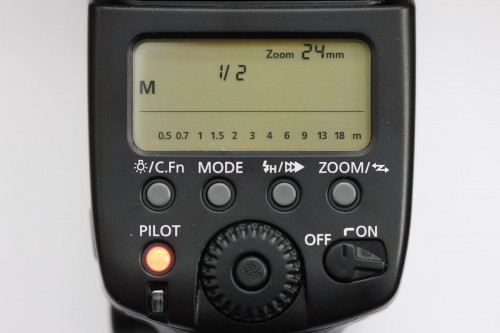
- Quickly, as we walked to the backdrop I put a flash on it: a 580EX II speedlight.
- Looking around, I saw a white ceiling above me so I knew I could bounce the flash off that ceiling.
- I ensured I bounced the flash 45 degrees up behind me, so that the light would come from “in front” of the subject. At a slight angle to my left, so as to aim light onto his face straight on from a 45 degree up-angle. Now this is important. If I had aimed up, or even worse, in front of me (a classical beginner’s mistake!), then this gentleman would have had raccoon eyes, reflective glasses, and a shiny head. If I had aimed straight behind me I would have had “broad lighting”: also not what I wanted.
- To mix a bit of ambient light, I set my camera to manual, and selected 1/100th second at f/2.2 at 100 ISO. I did a test shot.
- I found that this mixed too many different colours for my liking (flash and tungsten and fluorescent), so I decided to go “flash only”. To do that, I selected 1/250th second at f/4.0 at 100 ISO. That made sure no ambient light took part: the light was all flash. The open aperture at f/4.0 gives me that beautiful bokeh: the creamy softness of the background.
- I used TTL (through-the-lens automatic) flash metering, and in view of the white background, I selected a flash exposure compensation (“FEC”) setting of +1 stop.
- I positioned the subject at a slight angle.
- Now I did my second shot. Checked it on the back. Bingo, all good. Catchlight, check. Sharp, check. Exposure, check. Loved it. Took a few more just for safety’s sake.
That is ten steps in less than one minute. As an event and news photographer, I have to be quick. “Hang on while I think” is never acceptable when photographing executives.
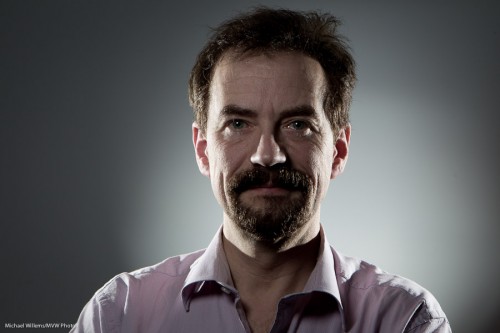
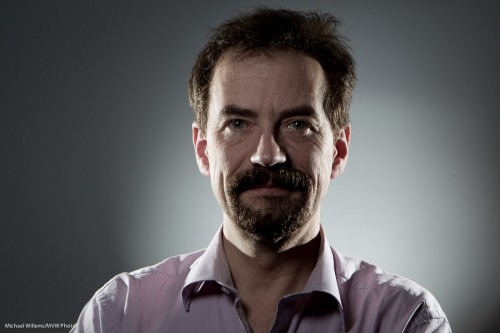
The result is below, and I think you will agree it is a shot that, especially when you click through to see it at original size (you like sharp? I give you sharp!) cannot easily be distinguished from a studio shot.(I really encourage you to click though a few times until you have the full size pic, then view it at full size).
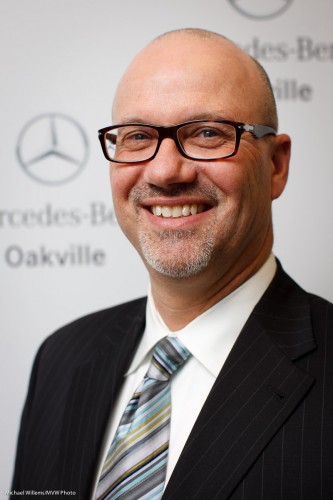
Managing Director Mark LeRoeye
All that in one minute!
If I had had time? I might have tried softboxes, a longer lens, and even more different angles. But I would have produced roughly the same. As a photographer, I need to be able to think on my feet. As you will have to – so my advice: practice a lot, until these things become automatic.
Just like in flying airplanes, where engine failure automatically results in the pilot going through a sequence like “trim up – turn with wind – look for field – check fuel switch – check primer locked – check main switch on – mags left/both/right/both – carb heat on – mixture rich – check oil T&P – check fuel sufficient – line up – use flaps if needed – brief passengers – radio mayday – main switch off”. No more complex, and no less complex, than what I did for this shot.
Practice makes perfect, they say. In photography, practice makes consistent.