Flash restraints

When working out a photographic scenario, it is often useful to think in terms of restraints – i.e. “what to watch out for”. That can help you handle tough situations.

When using flash, especially in mixed light (e.g.outdoors) the following are the major restraints to watch for:

  1. Flash synch speed. When using flash, your camera cannot exceed the speed beyond which the shutter no longer fully opens. This is around 1/250th second on most SLRs. (Tip: open the aperture on your camera all the way at 1600 ISO and point at the sky. Check shutter speed. Now turn on the flash, and see what the shutter speed is now reduced to – that is your flash sync speed).
  2. Flash range. Your flash range gets smaller the more you close the camera’s aperture. The guide number divided by the aperture tells you the full power range. (Tip: the flash may display it on the back – most modern flashes do, when the head is pointed straight forward.)
  3. Usable Aperture Range. On the one hand, you want a small aperture number (a large aperture, say f/2.8) for blurred backgrounds – but that may be difficult due to constraint (1) above.  On the other hand, you may need a large aperture number (a small aperture, say f/11) to make backgrounds darker, but that may be difficult due to constraint (2)

Geez, life is full of impossibilities, isn’t it!

But if you keep those constraints in mind at all times, you will know when you are about to run into trouble – conversely, staying clear of those constraints guarantees trouble-free shooting. Like in this recent shoot:
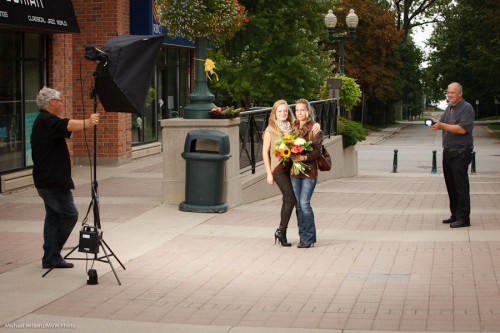
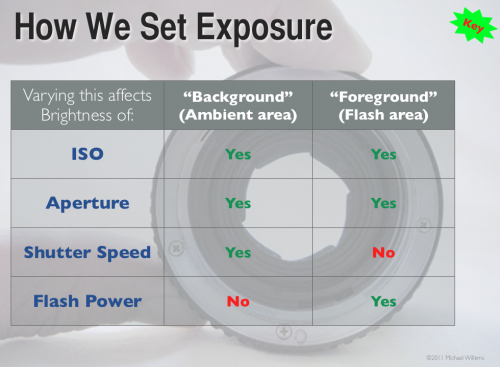


Table of Truth

In case you, like many photographers, wonder how aperture and shutter, as well as ISO and flash power, affect your flash pictures – here’s how!

Study that graph – a good photographer knows this graph off by heart – in fact, a good photographer has made this chart part of his or her DNA.

Note that if you set your camera to an automatic mode (like P), or if you set your flash to an automatic mode (i.e. TTL), you’ll get confused, since the camera varies things! So when learning, keep everything on manual.


Back to basics

You know that as an event shooter, I use TTL (through-the-lens flash metering, using a preflash) very widely. Much as it is sometimes hard to predict, it is the only thing you can use when things are moving quickly. Like at an event.

But sometimes, things go wrong. I had flash maslfunctions for part of Saturday’s shoots. You see, TTL is not really unpredictable -once you know how it works (metering bias to the focus point, for instance, and an assumption of 18% grey where it meters) it is predictable. So a malfunction is when it becomes actually unpredictable.

As it did Saturday with my dying 580EX II flash. Here’s three consecutive shots – I do everything the same, and yet I got, in rapid succession in the same setup, one dark shot, one light shot, and one OK shot:

Too dark. And the next one, way overexposed:

And the third one, almost OK:

I cannot live with this craziness. So then what do I do? I go back to basics. Actual basics. The basics we used in 1980. Namely, I set my flash to manual power setting (my camera, of course, is already on manual exposure settings).

One quarter flash power ought to do it, I thought, looking at where I was bouncing and what my settings were – and that worked great:

So then for the next dozen or two shots I stayed in the same place, shot people at the same distance, and kept the flash and camera set to the same. Bingo, predictable shots.

So when life hands you unpredictability, force predictability on it If you use the same settings and it’s all manual and your distance to the subject stays constant, the pictures will all be the same.

Sometimes, 1980-style basics work just great. Actually, they quite often do. My camera is very often on the “manual” exposure setting, for instance.


Flash assist

Sometimes when shooting an event, I cannot easily bounce my flash. In that case, I will first try to use mainly available light –  meaning, turn up the ISO. That gets me shots that are borderline acceptable, like this from Saturday’s event shoot:

So here’s the message: even when I am not using the flash as the main, overpowering, major light, I still use it in these cases.

Turning the flash on and bouncing it behind me, while I lose most of that light in this room, still gives me a better picture:

This gives me what I would call a “flash assist” image:

  • Better light, brighter whites
  • More control over direction of the light
  • Fewer shadows where I do not want them, and softer shadows overall
  • Better control over colour balance
  • “Bright pixels are sharp pixels”.

So why did I take the first picture above?

Simply because my 580EX II flash failed. It fired intermittently Saturday, This is why pros always carry spares: I grabbed my other, second, 580 EX II and put that on my camera instead. The first 580 will have to be retired – a blow, because it’ll cost me more than I earned in the shoot to replace it – but them’s the breaks.


Fashion flashin’

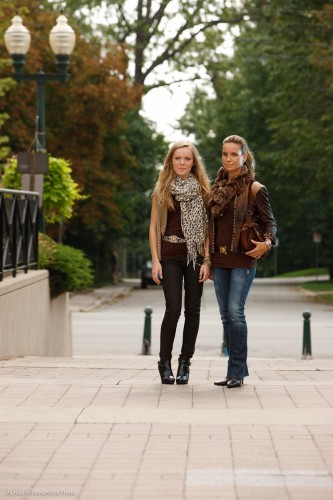
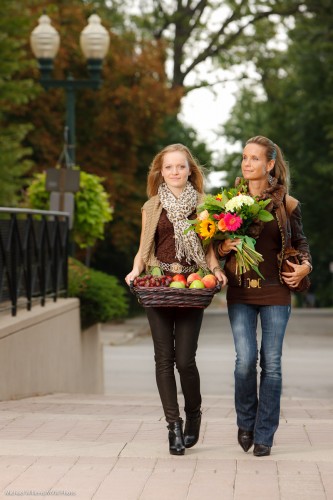
Sunday morning, around mid-day, in downtown Oakville I shot a fashion shot for a magazine front cover.

Outdoors fashion is, as always, a matter of many things coming together at once. One of those is light. Without light, even on a wonderful overcast day (wonderful in photo terms), the image lacks something. The mother and daughter models lack a certain je-ne-sais-quoi.

Actually I do know – they lack light:

Models in Oakville (Photo: Michael Willems)

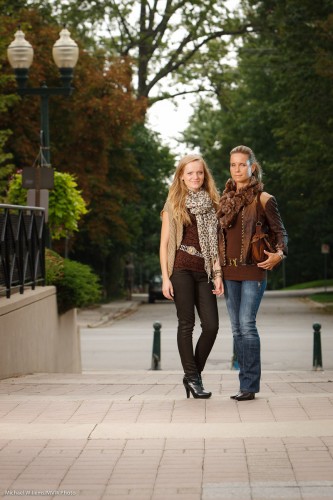
So we add a flash. I used a Bowens 400 Ws strobe, although I could have used speedlights. The sequence is as follows:

  1. I set my camera to manual.
  2. I select 1/200th second and 100 ISO.
  3. That gave me, on this particular day, an aperture of f/5.6 for a nice saturated background. (To arrive at this, I can use my in-camera meter or my light meter set to ambient.)
  4. I now add the strobe, set it to 80% power about 6ft away, and test this with the meter (now set to flash mode). Well have you ever:  the meter immediately indicates f/5.6! (This is just experience. If you are less experienced, no worries – just turn the light up and down until you do read f/5.6).

That gives me:

Models in Oakville (Photo: Michael Willems)

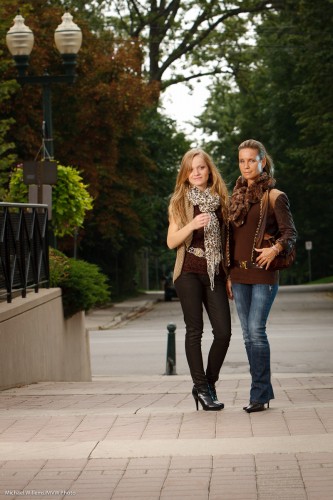
If I want the background a little darker I change the speed to 1/250th (still in my flash sync range):

Models in Oakville (Photo: Michael Willems)

Okay, we are set. If the sun comes out a little more,  I go to 1/250th, and if it gets a tad darker I go to 1/160th.

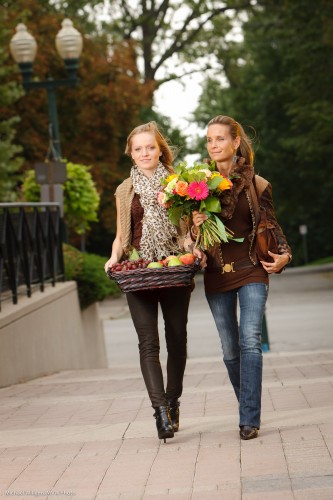
The idea of this shot is autumn – so we now bring out the props. Autumn flowers and fruits and vegetables now gives us this:

Models in Oakville (Photo: Michael Willems)

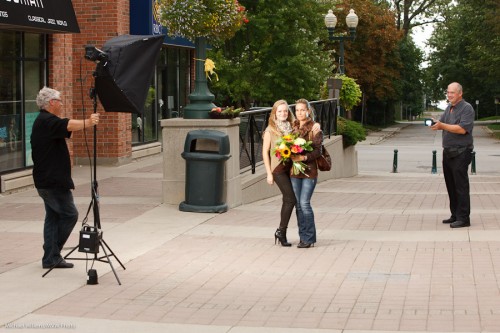
Notice the speedlight with a blue-green gel as accent/hair light on our right? The speedlight was held by Kurt, who assisted on this shoot, and was set to 1/4 power (again – experience tells me that setting will probably work – and it did).

The final step is to make that an egg-yolk yellow gel instead of a blue-green gel – yellow accentuates the late day setting sun feeling that is synonymous with autumn. (I use Honl Photo gels).

Models in Oakville (Photo: Michael Willems)

And there we have the image. (In fact this is not quite the image – that one went to the client, and I do not like to publish images in this open forum before the customer has used them!). Also – note that these are shot a little wide since this is for a magazine front page, so there needs to be space for text.

Notes:

  • Umbrellas and softboxes outdoors will be blown away, so hold on tight.
  • If the models move, use AF-C/AI Servo focus mode.
  • With two models, be very aware of the danger of blinking – one of them will blink in very many images, so check, and take many images.

The setup was as follows:

Fun shoot.

(And perhaps also, a shoot that explains why photography costs money: A car full of equipment, props that get used just once, two sets of clothing, and five people taking several hours. All this costs money!)


The Importance of being colourful

Colour is an interesting thing. It can help or hinder your pictures. It helps if you are using it where it is wanted; it hinders if you use it when it is not, or if you fail to use it when it is.

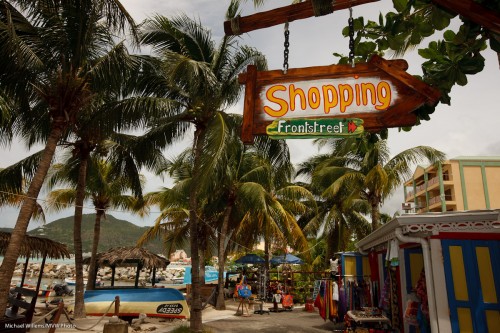
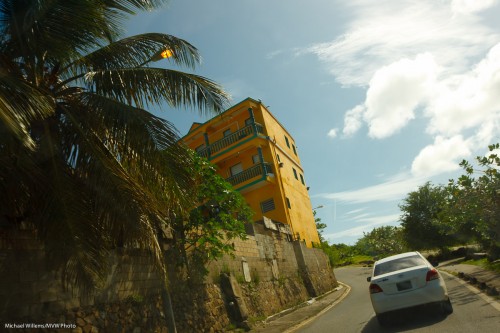
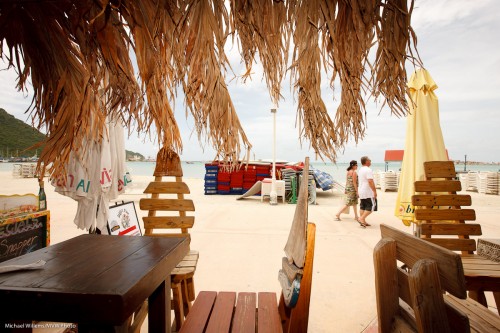
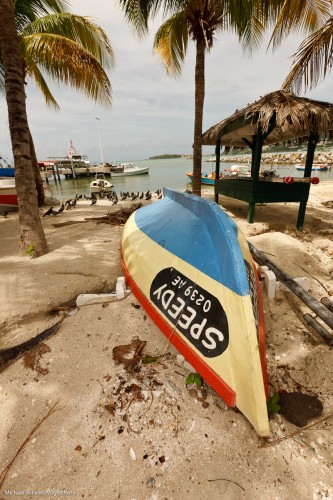
The Caribbean is all about colour. People are happy, the sun is hot, and everyone uses wonderful bright colours. So a scene like Philipsburg, Sint Maarten, needs colour:

Philipsburg (Photo: Michael Willems)

Technique needed:

  • Flash: I needed to use my Canon 580EX flash for this sign.
  • Exposure: I made the colours vibrant by exposing the rest of the image down a little: 1/200th at f/13 at 100 ISO.

In the following image, I needed no flash – or rather, it would not have done anything:

Sint Maarten (Photo: Michael Willems)

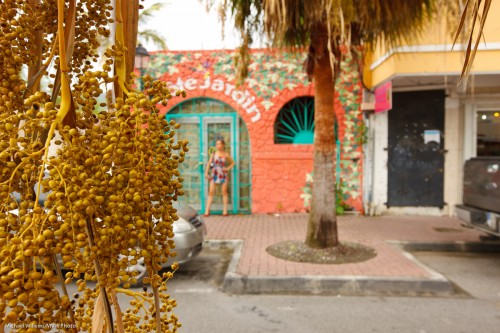
In the next example, I needed the flash just to light the plants that make up the roof, or they would have been black:

Sint Maarten (Photo: Michael Willems)

And one more, where I used the flash:

Sint Maarten (Photo: Michael Willems)

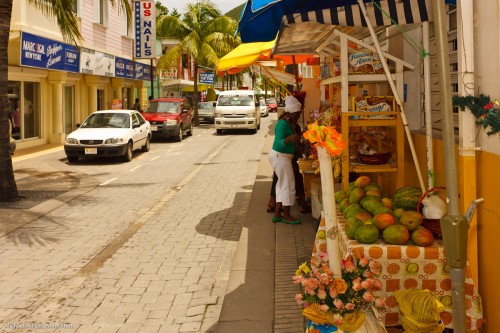
One more – a street grab:

Philipsburg vendor (Photo: Michael Willems)

And one more, again showing wonderful Caribbean colour:

Philipsburg (Photo: Michael Willems)

I suppose this all boils down to a few simple rules:

  1. Decide if color is needed; is it an important part of the image?
  2. If so, expose well – underexposing ever so slightly will make colours more. saturated; overexposing leads to washing out. (Note: you are allowed to “expose to the right and fix in post – you get better quality).
  3. Use a flash if needed to light up areas that need lighting up.
  4. Use the right white balance.
  5. Consider a polarizer on sunny days.
  6. Add a little saturation in post if you have to.


All very logical once you think about it.


Outdoor flash

Summer is still here, so I think it might be a good time to repeat a couple of flash tips for the summer. Especially as I plan to disappear into the sun for a week, Friday.

Outdoors you often need flash. Sunlight is harsh: so you need to fill in the shadows.

Outdoors you need max power. So keep your speed below the synch speed – 1/250th second on my 1Ds camera. Else you need to use high-speed flash, which loses power. Which you can ill afford on those sunny days.

Outdoors you can use direct flash, aimed at your subject. It is better to have studios and umbrellas and such – but outdoors you do not have that luxury, and you do not want to lose light.

So use a direct flash, and really, it can look very good. Especially if you take the flash intensity down a little (that’s what we call “fill flash” – 1-2 stops below ambient).

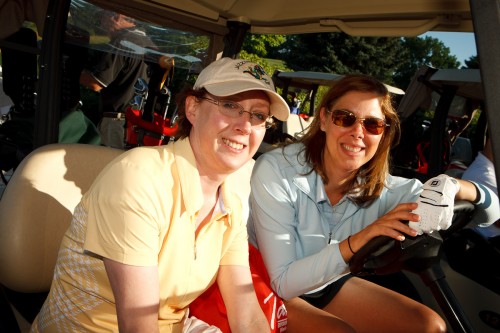
For a recent example of fill flash, see this image I shot at Minister Takhar’s Golf Open the other day.

Golfers (Photo: Michael Willems)

Not high art – but you can see the faces, and they are not half black. And often, that is all we want from a picture.


On-camera softbox outdoors

When taking a picture outdoors on a sunny day, you may, as said many times here, want to use flash. Else you get this:

Sunlight bad. Shadows, brrr.

So instead, you use a flash.

But you all know that on-camera flash is bad. It has three major drawbacks:

  1. Harsh light.
  2. Non-directed – flat light.
  3. And the speedlite is not powerful enough.

True. But you can solve these three problems – as follows:

Harshness: use a softbox on the on-camera flash. Like the Honl Photo Traveller 8 softbox. Flash on camera; softbox on flash; aim straight ahead.

Non-directionality: a-ha. So if your model is looking to the right, say, then you turn the camera to the right, so the light is coming from the right and hitting her in the face from there. Yes, that is contrary to the way you normally hold a camera in vertical orientation! The shutter is now below, instead of on top. Bad technique normally; but here, necessary!

Power: if you want a dark background on a sunny day, you need to shoot at 1/200th second (stay below your sync speed!), 200 ISO, f/16. the only way to use a flash with that small an aperture is to be close. So you get very close!

So that is:

  1. 1/200th second, 200 ISO, f/16
  2. flash on camera
  3. softbox on flash
  4. flash aimed straigh ahead
  5. camera turned so that the flash is on the side of your subject’s face
  6. get close

And that gives you:

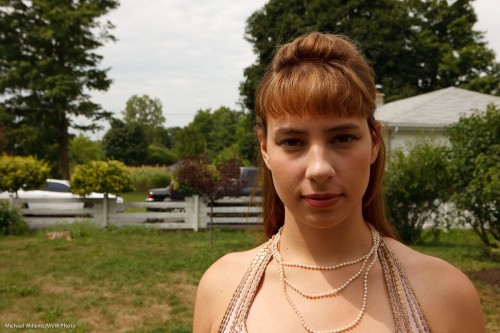
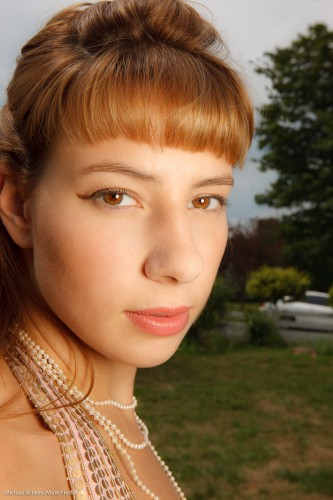
Jenna Fawcett, model (Photo: Michael Willems)

Not bad for an on-camera flash snap, huh? I used a Honl Photo Traveller 8 softbox, which was essential in this shot. It also gives you those wonderful round catchlights. Beautiful.

(I took this shot as a demo for students in the all-day Creative Light workshop we did Saturday. Stand by for more dates soon. ou can do this – it’s a matter of knowing the technique!)


Hay there girl!

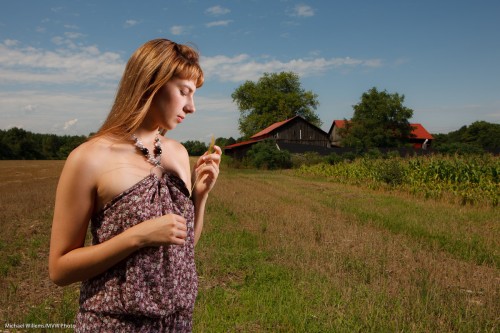
Here is model Jenna Fawcett, as I photographed her in yesterday’s Creative lighting workshop:

Model Jenna Fawcwtt (Photo: Michael Willems)

To make a picture like this, several things must come together.

Namely:

  1. A location. Simple, beautiful, with red and green and blue together. You have heard me before: red, green and blue in one shot, especially if saturated, make for a good picture.
  2. A subject. In this case a model, and clothing-make-up, props.
  3. The right equipment – camera and lens.
  4. Now, first of all, exposure set to expose the background properly.  Meaning nice and dark – “saturated” means “not overexposed; not mixed with white light”. The camera’s meter points at, say, -2.
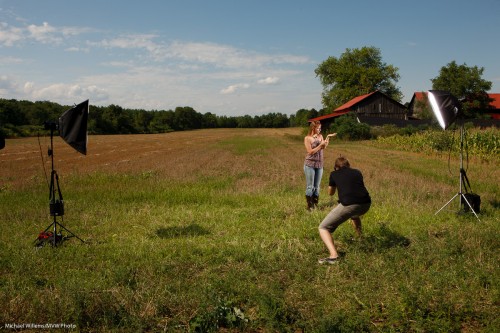
  5. Light to light up the subject. Meaning flashes-  in the case of a sunny day – biiig flashes, with octoboxes, umbrellas or softboxes. Battery-powered if you are in a field in Ontario. One on the right; one on the left.
  6. Proper exposure of this flash light (this may need a light meter). Becasue you underexposed the background, your subject, if exposed “normally”, will now stand out wonderfully.

And that’s the story. This setup looks like this:

Model Jenna Fawcwtt (Photo: Michael Willems)

Is a sunny day better for these shots? No – a sunny day is much more difficult. Nasty shadows, and you need very high power to be able to “nuke the sun”. So for a sunny day you need strobes, and power.

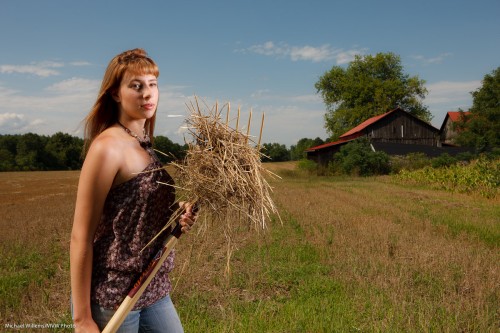
Why did I call this post “Hay there”? Here’s why:

Model Jenna Fawcwtt (Photo: Michael Willems)

Can I learn this? Yes. Easy – follow the rules above.

Yes, you need to learn lots of finicky stuff about aperture, shutter, and ISO – but it’s worth it. Read this blog daily. Try. Take a course. And take one of the workshops Joseph and I do – they are quite the experience, and include beer and wine and portfolio shots – and great images to take home!


Yesterday

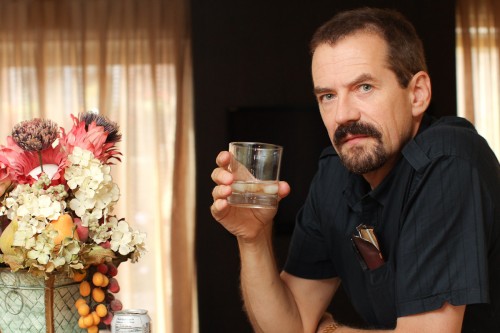
A student took this snap of me yesterday:

Photographer Michael Willems

He did this as follows:

  • He used his Canon 60D with my 50mm f/1.2 lens.
  • He used his new 580 EX II speedlight, bounced off the ceiling behind him.
  • The camera was set to manual exposure, f/5.6, 1/30th second
  • He selected 400 ISO.

Typical “indoors flash” settings.

The 50mm lens was set to f/5.6, so that means you could have done the same with any lens in the range of 50mm. This kind of lens length (meaning 80mm on a full frame body) is great for portraits. Which is why the 50mm (crop body) or 85mm (full-frame body) are such popular lenses.

If you do not yet own a 50mm prime lens, go get one. 50mm f/1.8, or if you can afford it, f/1.4 – or go all the way as I did, and get the 50mm f/1.2, but you will not using it at f/1.2 much.