Learn to use great light

As said, Joseph Marranca, one of Canada’s most experienced commercial photographers, and I are organizing a unique weekend advanced light workshop at my country home in Mono, Ontario, just an hour north of Toronto.

Strictly limited to 6-8 advanced or emerging pro users, this will be a unique two-day opportunity to learn lighting (indoors, outdoors, and mixed, and using studio strobes as well as speedlites) and come home with portfolio shots.

The dates are April 10 and 11. For further detail, look here:  http://www.cameratraining.ca/Mono.html

Jewellery

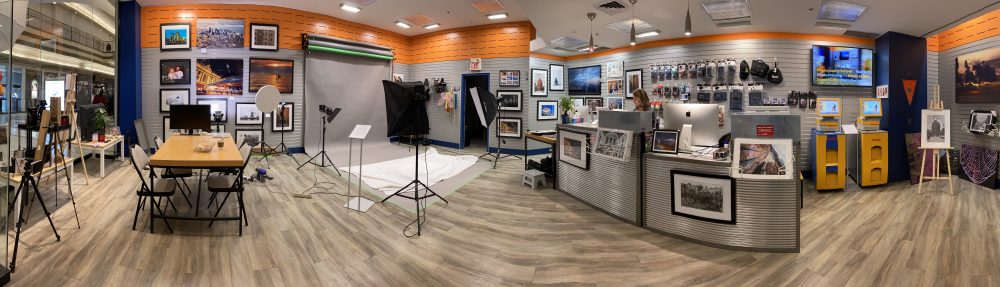
Thanks to fellow local photographer Anita, I shot Jewellery yesterday, on location in St Catharines. This was the setup in the store:

An improvised table with a curved white background, lit by two speedlites in an umbrella, with an opposite reflector; then one”sparkler” speedlite in a Honl snoot to aim at the jewellery.

I used

  • A 580EX II on the camera
  • Two 430 EX flashes in an umbrella
  • Wireless TTL with +2 stops flash compensation
  • A 100mm f/2.8 macro lens
  • A Canon 1D Mark IV camera.

A few tips:

  • Use aperture in the 5.6-16 range. More is better, except when you go much above f/8-ish, most lenses get blurrier again.
  • Use a tripod!
  • Focus using manual focus. Use Live View and x10 magnification to set this focus accurately.
  • Expose carefully, using flash compensation as needed. Use the histogram and “highlight alert” to verify.
  • Use the sparkler straight on to add life, especially to diamonds.
  • Watch reflections carefully
  • Use a black reflector if needed to add the black reflections in diamonds.
  • White balance carefully.
  • Clean the jewellery well.
  • Use Photoshop to clean up any remaining dust. Jewellery photos need to be finished in photoshop.
  • Use Play-do to mount rings, etc.
  • Consider an acrylic stand to separate jewellery from the background – this avoids shadows.
  • Black acrylic works too – nice reflections. Black slate can work, too.
  • Did I mention you should use a tripod?

This got me shots like this one:

Jewellery can take many hours to shoot, so yesterday worked out well – 20 products shot in four hours.

Shooting an event: choice of shots

A few tips, on and off over the next few days, about shooting events. Events such as parties, clubs, openings: lots of people and they are camera aware.

Today: What to shoot. I recommend that you shoot “all three views”:

  • Overview shots, showing “the whole thing”: wide shots with the entire venue, entire room, and so on.
  • Medium shots, with one or two people
  • And finally: detail shots. An aspect of the room. The stereo and a CD that’s playing Notes on the fridge. Or like in this shot, the food:

(Can you see that I bounced the flash off the ceiling behind me?)

If you shoot plenty of all three views, you will have plenty of material for a great album. And people remember the details!

Bag it

A quick tip today- but a useful one.

Always carry a plastic bag.

Plastic bags are essential for:

  • Carrying things that fall off
  • Putting things down in a dirty surface
  • Absorbing shocks in camera bags
  • Putting your camera in when it starts raining
  • Putting your camera in and closing before going from a very cold to a very warm area
  • Throwing up into when you get sick on your travels

Never go out without a plastic bag or two – put them into your camera bag right now.

3D

A reminder of how to make your photos three-dimensional.

You do this by:

  1. Using a wide angle lens, the widest you can
  2. Getting close to something

In the photo of the Israeli tank, I used a 16mm lens on a full frame camera – this would be a 10mm lens on your crop factor camera.

The “close-far” effect is due to you being close to one thing and far from others. The wide lens enables you to compose like that.

So – get wide – get close!

Learning Lighting

I think it is very important that you learn how to use flash in manual mode (manual flash, that is, as well as manual exposure!) before you move to today’s sophisticated eTTL or iTTL modes.

That way, you get predictable results. And you can use Pocketwizards.

The above shot was lit with only a few lights.

Here’s your tip for today: when a fireplace does not light, use a flash with a red gel (I used a 430EX equipped with a Honl speedstrap and Honl red gel; all fired with Pocketwizards).

NEWS! Joseph Marranca, one of Canada’s most experienced commercial photographers, and I are organizing a unique weekend advanced light workshop at my country home in Mono, Ontario, just an hour north of Toronto. Strictly limited to 6-8 advanced or emerging pro users, this will be a unique two-day opportunity to learn lighting (indoors, outdoors, and mixed, and using studio strobes as well as speedlites) and come home with portfolio shots.

The dates are April 10 and 11. Email me if you want further detail!

Tonight:

I just got back from The Distillery District, where today we opened the second ever showing of “IV”. It is raining tonight:

That’s Av and two stops negative exposure compensation, and 5,000 ISO. Here’s another one:

I took this handheld. That meant:

  • Aperture mode
  • Minus two stops exposure compensation.
  • Because of the darkness and the lack of a support I used high ISO of 5,000.
  • This gave me 1/15th second at f/5.6 (I wanted depth of field).
  • The lens was a 16mm lens on a Canon 1D Mark IV, crop factor 1.3, so really 16×1.3 = 21mm.
  • Finally – because it was hand held, I took five or six shots.

Now relaxing a bit… tomorrow, teaching Flash at Henry’s in Oakville, and Monday a PPOC guest appearance at Fanshawe College in London.

High speed flash

Tip of the day:

When using your flash outside, you have to be careful: you cannot exceed your camera’s maximum flash synch speed – normally around 1/200th second. This means in bright light you cannot use a wide aperture like f/4 (which after all might mean you would need 1/800th second, say, even at 100 ISO).

But if you have a suitable external flash you can exceed that speed (the flash pulses at 30 kHz-50 kHz instead of flashing all at once).  If so, high-speed flash, or FP Flash, can be engaged on your flash.

On Nikon cameras, and on Canon cameras built after 2005, you can leave this on, and it will engage when the speed exceeds your flash sync speed, but it will not be used if not needed.

The drawback of fast flash: you get less effective power. Half at best, at smaller apertures much less. Meaning less flash range: but at least you can get outdoors portraits with large apertures.

Manual

Be careful when you say “manual”.

You could mean several entirely unrelated things, including:

  • Manual exposure (that’s the “M” on the dial!)
  • Manual focus
  • Manual flash power
  • Manual focus point selection

Assuming you mean the first one, when do I use manual exposure mode?

  • When using flash indoors, always.
  • When I want full control (such as when shooting macro or art).
  • When I want consistency, such as when shooting a panorama or snow scenes.
  • When I am shooting impossible-to-meter subjects like fireworks.
  • When I am shooting important-to-get right subjects like product or food.
  • When the light varies constantly and I want my exposures to be stable.

Hope that helps.