Sunburst

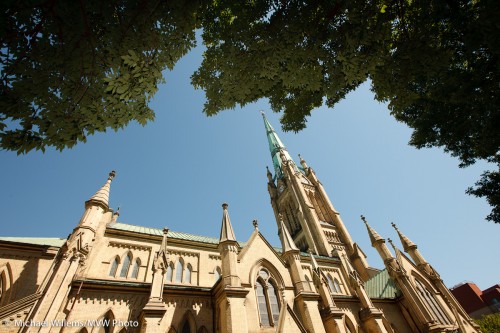
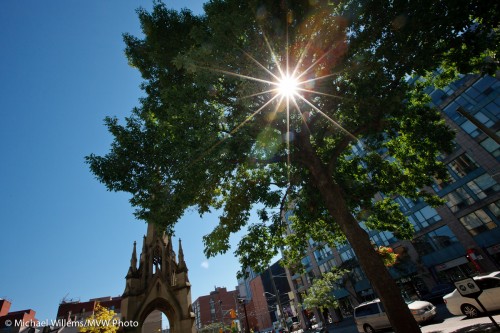
Look at this recent sunburst picture:
Sunburst

Sunburst, Toronto

For a picture like this, a few things may help:

  • You need a small(-ish) aperture to get the effect
  • Feeding the light through an object (like the tree) is essential for several reasons. One, to enhance the effect. Two, to protect your eyes, Three, to protect your camera.
  • Do it quickly. No sense burning the camera.
  • Remove filters. They can cause more flare.

Oh…. and can you see that I used a speedlight to light up the tree?
Repeat picture

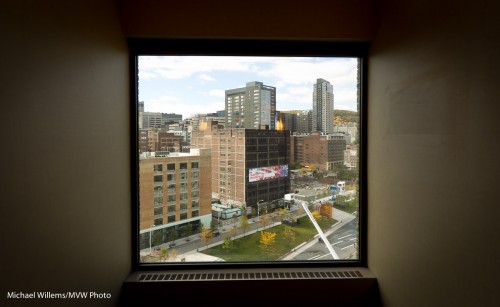
A repeat from a previous post – not the same post but I shot the same picture of the Quartier Des Spectacles again in the Montreal Hyatt Regency hotel the other day:

Montreal-Framed

Montreal-Framed

The framing did it for me, and the shadows.

We talk about framing as a useful device to draw attention to our subject. We frame pictures with whatever we can frame them with. Walls. Branches of a tree. Or a window frame, like in this picture.

Or indeed by branches:

St James Cathedral

St James Cathedral, Toronto

Can you see how I used a very wide angle lens, and I used my flash to light up the tree? I am known as the speedlighter for a reason!

Night.

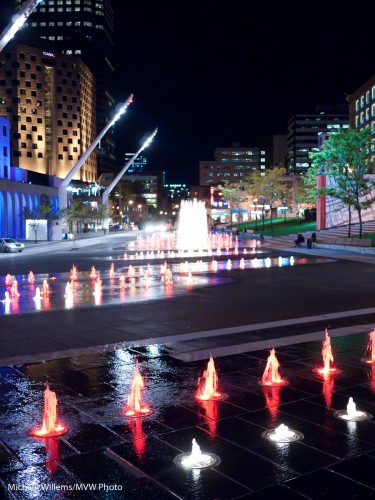
In Montréal. Last night!

Montreal, 9 Oct 2010

Montreal, 8 Oct 2010

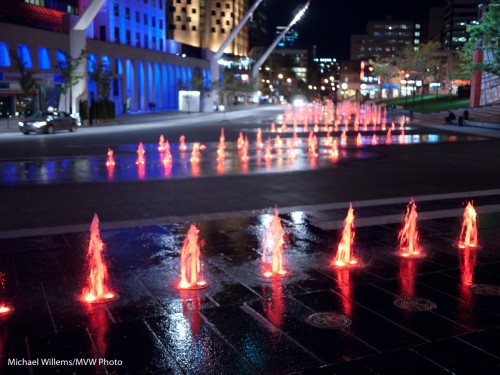
Taken at 800 ISO, 1/30th sec, f/1.7.

Because of the fast (f/1.7) 20mm lens on the Lunix camera I was able to shoot at 800 ISO. Had I had a regular point and shoot, I would have had to shoot at a higher ISO speed, much higher.

Here’s another one:

Montreal at night, 8 Oct 2010

Montreal at night, 8 Oct 2010

So the tips for today are:

  • Use a tripod if possible.
  • If not, then open your aperture as wide as you can.
  • And go to a wide angle if you can.
  • Use exposure compensation if needed, usually -1 to -2 stop. Ensure the black sky is black.
  • Go to a high enough ISO so you get a reasonable shutter speed.
  • Hold still.
  • Shoot multiple times.
  • Select the best shots!

And above all: bring the camera. And have fun.

Yellow balance

Just a quick note today, since I am travelling to Montreal and Quebec City.

White balance is the process your camera uses to make white white.

But you can also use it to distort an image’s colours to your liking.

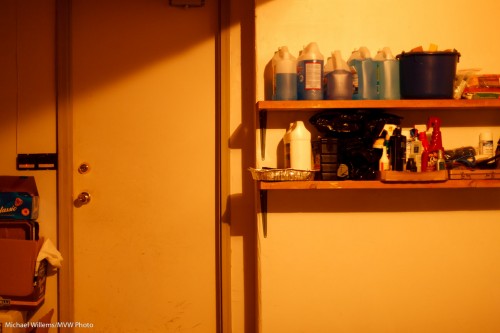
To turn white yellow, for instance. This shot is Tungsten light, but shot with the camera’s white balance set to flash:

White or orange?

White or orange?

You can, and should, experiment with white balance! Turn images blue or orange. Play a little!

Of course if you are only using one light source and you shoot RAW, this makes no actual difference, but it is still worth setting, if only (as I have pointed out here before) because you save timelater – and becasue you get to see an idea of what the image will look like in the end.

Light creatively

After last Sunday’s Creative Lighting workshop, and working up to next week’s Henry’s Digital Imaging show, at which I will be presenting for three days, I am thinking about light. As I always do.

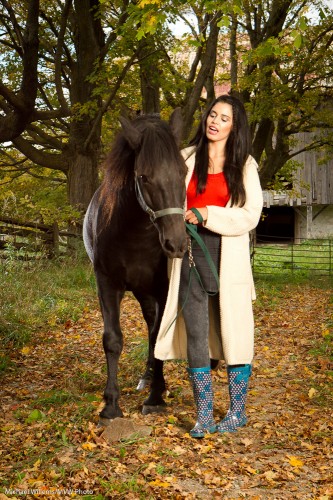
Look at this shot from last weekend: model and friend:

Model and horse

Model and horse

Lit by natural light?

Not on your life.

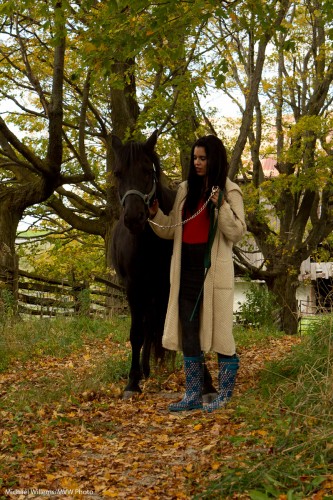
Here is what they look like in available light:

Horse and model - available light

Horse and model - available light

Now you see why we use softboxes, kicker lights, and so on.

Used in the first shot:

  • Softbox with a monolight, to our right.
  • Small speedlite with Honl grid, to our left – see the sheen on the horse’s coat?
  • Pocketwizards (2x) and Flashzebra cable (1x)

Simple, innit?

Well, maybe not that simple, until you are shown. Come take a full-day lighting workshop and I will teach you this, and come see me at the upcoming Henry’s show also, where I will do tethered portrait shooting to demonstrate all this.

Portrait note

One more from Sunday’s course.

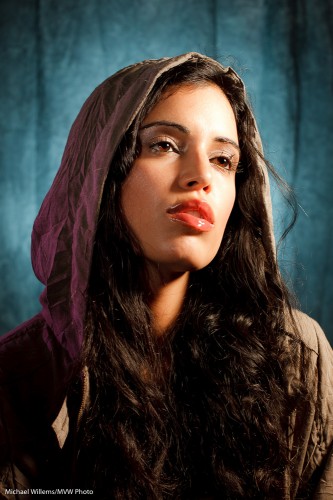
This time, a portrait of model Tara that I made to help explain multiple flash TTL. Straight out of the camera it is:

Multiple-flash TTL lighting

Multiple-flash TTL lighting

How was this made?

With a small Traveller 8 softbox on the main light, a gridded gelled flash for the background, a snooted flash for the fill light, and a gridded gelled flash for the edge light.

Four speedlights, and all using TTL.

A few things to remember in such portraits:

  • You need a catch light in the eyes.
  • Set your white balance to “flash”.
  • If you have space, longer lenses are good (in this case, though, I use a 50mm prime lens).
  • Avoid the ambient light doing any work: choose 1/125th second at f/5.6 or f/8, say; and be sure to disable “Auto ISO”.
  • Lighting is all about what you do not light: avoid bathing the room in photons. Think about what you light, and how.
  • With Canon’s e-TTL or Nikon’s CLS/iTTL, you only get two or three groups of light. So if you have four lights, some of them will have to be in the same group. My fill and edge light are thus both in group “B”.

Keep those in mind and your portraits will be well lit.

A shot from the course

At the Mono “Creative Light” workshop,  we do different portfolio shots every time.

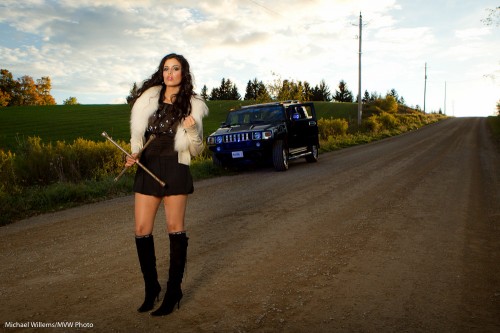
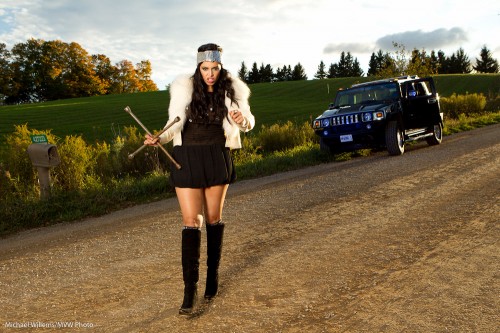
So imagine our delighted on Sunday when a student turned up in a Hummer. This was immediately put to use by model Tara:

Tara Elizabeth and Hummer

Tara Elizabeth and Hummer

That was lit how?

This is how: with a softbox, to our left. And a small speedlight to our left aimed straight at the car – with a blue Honl gel. Both were fired using pocketwizards (the speedlite using a Flashzebra cable). Metered using a light meter, of course.

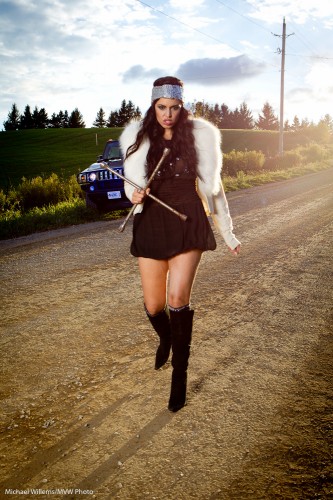
Here is an alternate take:

Angry Tara Elizabeth, with Hummer

Angry Tara, with Hummer

That was taken just a few minutes before. Can you see how every minute counts when shooting in beautiful late day light?

Okay, one more. Just to show that lens flare – which should normally be avoided – can sometimes be OK:

Angry with tire iron

Angry with tire iron

You avoid flare by:

  • Using a lens hood
  • Shielding the lens with your hand
  • Avoiding lens filters
  • Pointing slightly away from the light source

Have fun!

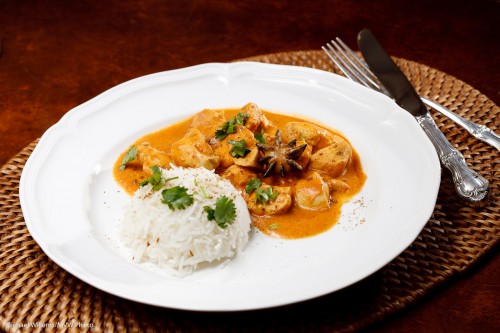
Yum

Today, I have a quick starting point for food photography for you.

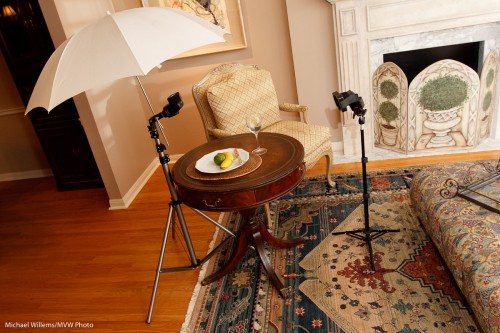
Food Photography

Food Photography

  • Lighting: small speedlights are good.
  • Use one umbrella on top, and one gridded light from behind to add accent (and to light the steam. If there is steam, try to use a dark background)
  • You may want to shoot from a low angle.
  • Blur out backgrounds.
  • These backgrounds can contain a cup or glass, cutlery, etc.
  • Prepare the food: If you have no food stylist, you are it. Every detail counts. Make it look great. Add some “green stuff”. Use a brush with oil to make surfaces shiny and yummy.

And do not forget to eat the food, afterward.

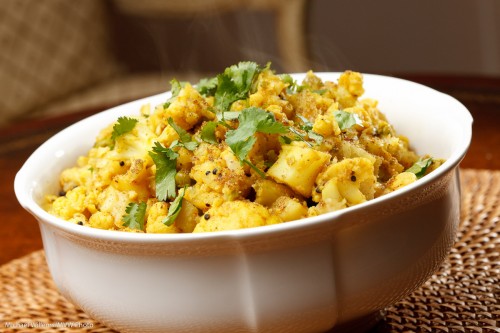
Indian Food Photography

Indian Food Photography

(Although you would be surprised how many food shoots use fake food. Ouch!)

One more, for good measure (I shot these for West of the City magazine early this year).

Indian Food Photography

Indian Food Photography

Dragging the shutter

A quick note for you today (and this is the kind of thing my students learn at length in my advanced courses, like the one tomorrow in Mono – there’s still some space).

Every had your camera react unpredictably when using flash? Yeah, I thought so. You flash and then the shutter stays open for a second and it’s all a blur. Or you flash and the background is dark black.

Why?

When you shoot indoors, say, and use your flash, your camera behaves differently in different modes – and this behaviour varies per camera.

Aperture mode (A/Av):

  • Canon: the shutter will be as slow as needed to expose the background too (caution: this may lead to very long shutter speeds if ambient light is low).
  • Nikon: the shutter is restricted to 1/60th of a second or faster (this can be set).  But… if you also engage “SLOW” mode, the shutter will be as slow as needed to expose the background too (caution: this may lead to very long shutter speeds if ambient light is low).

Program mode (P):

  • Canon: the shutter is restricted to 1/60th of a second or faster.
  • Nikon: the shutter is restricted to 1/60th of a second or faster (this can be set).  But… if you also engage “SLOW” mode, the shutter will be as slow as needed to expose the background too (caution: this may lead to very long shutter speeds if ambient light is low). .

So

  • Canon is simple: Av = long shutter speeds, P = 1/60th or faster.
  • On Nikon cameras, both modes are restricted to 1/60 or faster normally, but either mode can be freed from this by using the “SLOW” setting.

So what is the best mode when using flash indoors?

Ah, that would be Manual. That way the camera does exactly what you want. But we will get to this again another day.

TIP: if you want to try Manual indoors flash, start at 400 ISO, 1/30th second, f/4. And bounce your flash off the ceiling/wall behind you.

Expose, experiment

As photographers, we sometimes get stuck in ruts. Like the rut that all exposures have to be “natural”, and show the world like it is.

And this is a misconception. When we use fl;ash, we are showing it in an unnatural way, aren’t we?

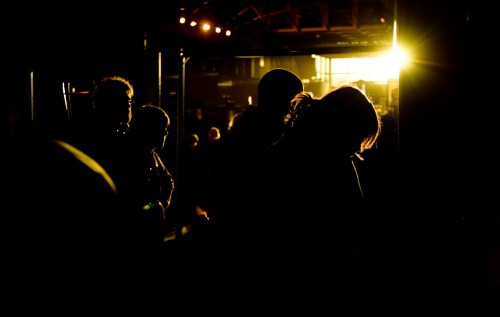
And even when not using flash, you can create interesting effects by exposing more, or less, than you normally would. Less, like in this shot:

Royal Show, Crowd

Royal Show, Crowd

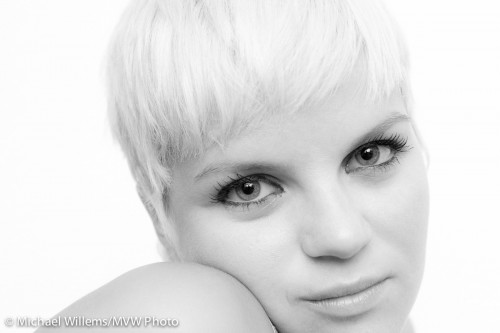
Or more, like in in this high-key portrait of model Lyndsay:

Lyndsay Biernat, High Key portrait

Lyndsay Biernat, High Key portrait

To do this you simply either:

  • Use exposure compensation (+ is brighter, – is darker)
  • Spot meter off something bright (makes the picture dark) or dark (makes the picture bright)
  • Use Manual exposure mode and watch the meter: – is dark, + is bright

As an assignment, today, take a few pictures darker or lighter than your meter would normally make them.