Dragging the shutter

A quick note for you today (and this is the kind of thing my students learn at length in my advanced courses, like the one tomorrow in Mono – there’s still some space).

Every had your camera react unpredictably when using flash? Yeah, I thought so. You flash and then the shutter stays open for a second and it’s all a blur. Or you flash and the background is dark black.

Why?

When you shoot indoors, say, and use your flash, your camera behaves differently in different modes – and this behaviour varies per camera.

Aperture mode (A/Av):

  • Canon: the shutter will be as slow as needed to expose the background too (caution: this may lead to very long shutter speeds if ambient light is low).
  • Nikon: the shutter is restricted to 1/60th of a second or faster (this can be set).  But… if you also engage “SLOW” mode, the shutter will be as slow as needed to expose the background too (caution: this may lead to very long shutter speeds if ambient light is low).

Program mode (P):

  • Canon: the shutter is restricted to 1/60th of a second or faster.
  • Nikon: the shutter is restricted to 1/60th of a second or faster (this can be set).  But… if you also engage “SLOW” mode, the shutter will be as slow as needed to expose the background too (caution: this may lead to very long shutter speeds if ambient light is low). .

So

  • Canon is simple: Av = long shutter speeds, P = 1/60th or faster.
  • On Nikon cameras, both modes are restricted to 1/60 or faster normally, but either mode can be freed from this by using the “SLOW” setting.

So what is the best mode when using flash indoors?

Ah, that would be Manual. That way the camera does exactly what you want. But we will get to this again another day.

TIP: if you want to try Manual indoors flash, start at 400 ISO, 1/30th second, f/4. And bounce your flash off the ceiling/wall behind you.

Flash power

A few notes on speedlites today.

How does a flash set its power level? Not by making itself brighter or darker, but by shining for longer or shorter. Using light in pictures is like using a spray can: the longer you spray, the more you get.

So how long is a flash? That depends. It is 1/1000th second on full power. 1/2000th second on half power, 1/4000th on quarter power, and so on. So if you want very short flashes, fire at low power.

How do I fire at low power? Just get closer to your subject or use higher ISO settings. Then set low power (if you use TTL, the camera will do that automatically for you).

But what if I use high-speed flash? Then rather than firing one flash, it fires many very short flashes, at a rate of around 40 kHz. This simulates continuous light, which you need when using fast shutter speeds (over, say, 1/200th sec), where the shutter does not open all the way at any time.

Product release: Those of you who shoot Nikon can go get SB-600s while they last, and then upgrade to the SB-700, a major improvement, if slightly less powerful than the SB-600. And hopefully it will not overheat too easily, like the SB-900 does.

Catchlights

Typically, a portrait needs to show catchlights in the eyes.

Those little sparkles of light. Like in this portrait of a recent client, Mo Vikrant, an amazing (and amazingly well educated) young financial advisor in Toronto:

Mo Vikrant, photo by Michael Willems

Mo Vikrant

Can you see how those dots of light add life, add sparkle, to this portrait?

Now, I am not as adamant as PPOC, the Professional Photographers of Canada, that every eye must have a catchlight (and only one), or it is a failed portrait. But I do think that typically, yes, they need to be there, and they need to be round.

So I used a speedlight shot through (not reflected off) a partially-unfurled umbrella for that portrait.I cold also have used the Honl Traveller 8 softbox – this too would have given me nice round catchlights.

Detail is important!

Eat.

OK, do not eat quite yet.

I shoot events. All the time. It is what I love to do.

And these events are organized by corporations, or wealthy people, or governments, or charitable organizations. You name it. People like to get together. And all these people have paid a lot for the food – or sweated, making it.

And food is ephemeral: it’s there – then it’s not.

This is where photographers do a very useful job. One good photo, and that food exists forever. Like beauty, or youth.

And like these delicious strawberries, which I shot at a very nice private event in Toronto on Labour Day:

Strawberries, by Michael Willems

Strawberries, by Michael Willems

There. And this too:

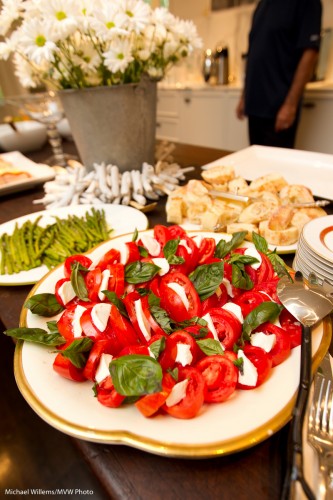
Food Shot, by Michael Willems

Food Shot, by Michael Willems

The way to do this:

  • Set your camera to manual exposure mode.
  • Expose two stops below ambient (choose aperture and shutter so that the meter reads -2. This might be 400 ISO, f/4, 1/60th second).
  • Make sure your aperture is fairly open (that’s the “f/4”).
  • Bounce your flash off the ceiling/wall behind you.
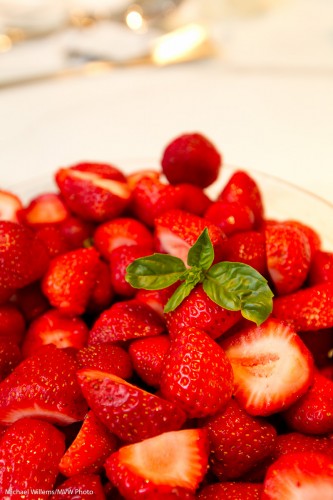
  • Focus on the closest part.
  • Tilt as needed.

Your images will be loved by your client. The book can now include food shots as background or detail shots. The food is now good forever. The investment is secured for all eternity. And the story is a better one: not just grip-and-grin images, but also “background”.

Learning light

In an intensive half-day custom course, I taught my student Melony some glamour photography techniques a few days ago. From flash techniques to colour to modifiers to using a light meter to posing.

She brought her daughter as her subject, and both did excellent work.

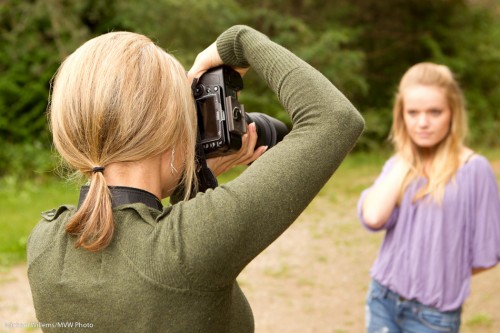
Student shooting model

Student shooting model

(By the way, did I ever tell you to make the viewer work in interpreting an image? Yes I did. And the blurred out daughter in the background is an excellent way to do that. Don’t tell the whole story, let the viewer figure it out.)

But anyway. Student Melony also kindly photographed me:

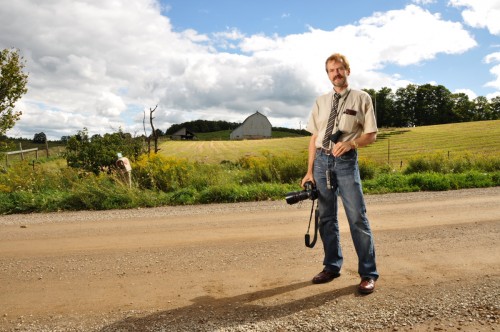
Michael Willems, by Melony McB.

Michael Willems, by Melony McB.

That is a great portrait.

And I can say that because it is the photographer who makes the portrait, in this case, more than the subject.

So how did we do this? Why does it work?

This works because:

    1. The light is good. First, Melony exposed the background properly (i.e. she did not overexpose it: exposing less is good, so that the subject, not the background, becomes the “bright pixels”). Willems’s Dictum: “Bright Pixels are Sharp Pixels”. Also known as “blurriness hides in the shadows”.
    2. Then, I am lit by the sun from the right (aided by a speedlight, but as the sun came out just at the right moment, this was no longer necessary). That gives us the nice shadow.
    3. But then, in a twist, and that twist is what does it, I am lit by a strobe with a softbox on the (camera) left – that gives the “ultra-realistic” look. Light from the back -and yet I am bright in the front.
    4. This image also show good use of appropriate props – I am holding the camera, which for a photographer is part of the story.

      Pocketwizards and a battery-powered Bowens light, as well as a speedlight, were used here.

      And kudos to those of you who spotted the other essentials, around my neck: a Hood Loupe by Hoodman, and a flash meter.

      Light makes a photo. Creative light makes it better. And it is simple. Once you know it.

      This is the sort of stuff I teach at my workshops, and Joseph Marranca and I are doing several more in October: check the schedule on www.cameratraining.ca !

      And yes, I wear a tie almost every day.

      Light

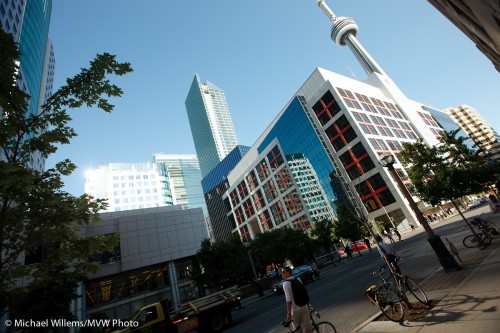
      I like the light in modern downtown areas of some cities – like Toronto.

      Why? Because you get light like this, in a hot I took the other day during a Microsoft even shoot:

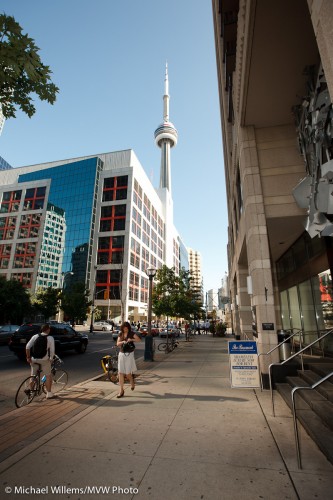
      Toronto Downtown Light, John Street, photo by Michael Willems

      Toronto Downtown Light, John Street, Aug 2010

      Look at the light illuminating the woman and the bike. Crazy. Unnatural – in a good way. Hyper-realistic light.

      The light in the very foreground, the first two metres of sidewalk, was due to my flash (the Speedlighter never travels without his speedlight!), but how about that side light? The picture looks like an HDR shot!

      Exactly like the runner in Mono I showed you not long ago. Light from two directions, a spotlight with shadows: spotlight, or a huge softbox, on the left while the sun is on the right. Impossible light, and that is why it appeals.

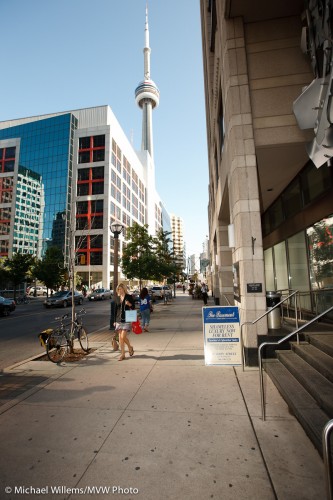
      No, very possible, and here’s why:

      Toronto Downtown Light, John Street, photo by Michael Willems

      Toronto Downtown Light: mirror action

      See that big mirror?

      Wonderful. Saved me the effort of using a huge softbox.

      Here’s another example:

      Toronto Downtown Light, John Street, photo by Michael Willems

      Toronto Downtown Light, John Street, August 2010

      The moral of this post: always look for light – train your eye to look for unusual light, and use it in your pictures.  I thought to get these shots it was worth foregoing my Starbucks visit (that’s what I was actually doing, during a break in the event shoot).

      Gizmo of the day

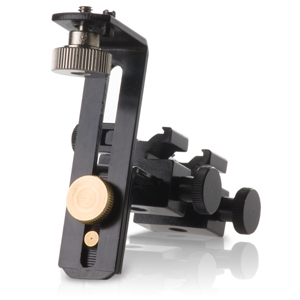
      The gizmo of the day is this Photoflex bracket:

      Photoflex dual flash bracket

      Photoflex dual flash bracket

      Intended mainly to put two small flashes in a softbox. For which it works well. Adjustable just like it should be.

      But I have another use for it.

      You see, I am a speedlighter. I use small flashes. And pocketwizards, when I am not using TTL. So I am always looking for ways to mount those flashes and Pocketwizards, and no-one has yet come up with any good ways to do it.

      So that’s where this bracket comes in. I use it to put one flash and one Pocketwizard onto a light stand. I mount it on a ball head, which I put on the light stand.

      In order to do so, I had to use a metal saw to remove the little tag that sticks out: you can see it on the very top, sticking out next to the screw. I am not sure why they put that there: much better without.

      But that done, I now have a bracket that allows me to securely, safely and sturdily mount two flashes, or a flash and a pocketwizard, for use on a light stand.

      Michael’s Quick Judgment: recommended, provided you have a saw.

      Colour has to be real

      Right?

      Um, no, of course not: colour is a tool for you to use in your artistic endeavors.

      And colour can be anything you like.

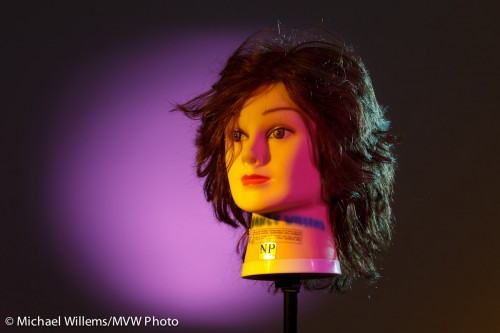
      A few nights ago, I though I would see how long it would take me to recreate a lighting setup that my friend Dave Honl (yes, he of the excellent Honl Photo modifiers) did recently. So I looked at his shot and put it together the same way he shot it, in exactly 20 minutes:

      Fun with gels, Photo Michael Willems

      Fun with gels

      That is including:

      • Setting up four light stands.
      • Connecting four flashes (3x 430EX, 1x 580EX) to Pocketwizards using Flashzebra cables.
      • Mounting these on the light stands using ball heads etc.
      • Equipping the key light with a 1/4″ grid and an Egg Yolk Yellow gel.
      • Equipping the fill light with a 1/4″ grid and a Follies Pink gel.
      • Equipping the hair light with a small snoot and a Steel Green gel.
      • Equipping the background light with a long snoot and a Rose Purple gel.
      • Setting the power levels correctly (by trial and error, combined with histogram: key light = 1/4 power, fill=1/8, hair=1/8, background=1/16).
      • Setting the camera up correctly (I used the 7D and set it to manual, 100ISO, 1/125th, f/6.3).

      Huh? Egg Yolk Yellow, a crazy bright colour, to light the face? Are we crazy?

      No, just having fun. Yes, of course Dave could have made his shot using no colour. Here’s what the same shot looks like without the gels. (Of course I switched the camera to an aperture one stop tighter, namely f/9, to compensate for the extra light once I removed the gels):

      Grids and snoots, photo Michael Willems

      Grids and snoots

      Yeah, nice, and appropriate for a corporate head shot. But compared to the previous, it is kinda boring, no? So next time you shoot someone, unless they are a law firm executive, you might have fun and try some colour. You don’t need to go crazy and use four colours, but a splash here and there can really help your picture come alive.

      By the way, what was the colour of the backdrop?

      White.

      Remember the following equation:

      White – light = black

      Similarly, in practice, black + enough light = white.

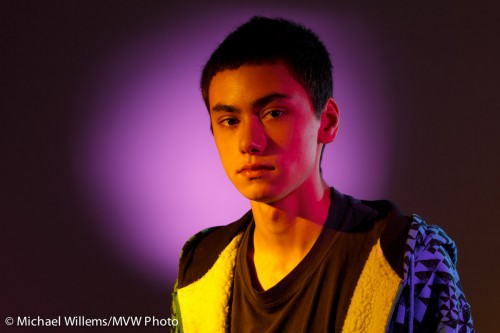
      And finally, a real person: my son Daniel (“sigh, not again, Dad”):

      Daniel, photo Michael Willems

      Daniel in colour

      But here’s the thing. After seeing it, he grinned and said “Rad.”. That‘s a first!


      Size matters.

      …the size of your umbrella, anyway.

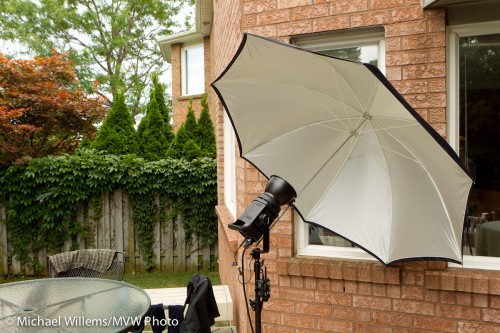
      I am using a big Photoflex umbrella today. How big? Here’s how big:

      Big Photoflex Umbrella

      Big Photoflex Umbrella

      This umbrella, which can be used to shoot into, as I am doing here, or to shoot through, is huge. Which makes the light softer.

      It is also very reflective, more than most. And that helps: I was able to overpower daylight on an overcast day with the single Bowens 400 Ws light set to 3 (out of 5), somewhat close to the subject. With my regular, smaller and less reflective umbrellas, I would have used a setting of 4 to 5 for that shot.

      So, all this amounts to:

      • Softer light (since the source is larger),
      • Greater distance I can bridge,
      • Less spillover behind the umbrella (which in a studio is important)
      • A lot more shots out of my battery pack,
      • Faster recharge time between shots.

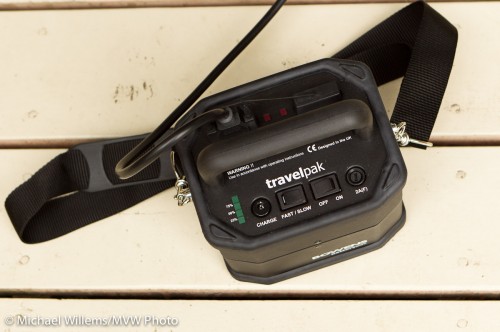
      Here is that battery pack:

      Bowens battery pack

      Bowens battery pack

      At full power, I get 150 shots out of a small battery (attached at the bottom); at power level 3, it is closer to 300 shots.

      So by using a nice umbrella, metering to minus two stops ambient (minus three if metering off the dark garden), then setting the flash to the aperture thus achieved, which was f/5.6), I get this shot:

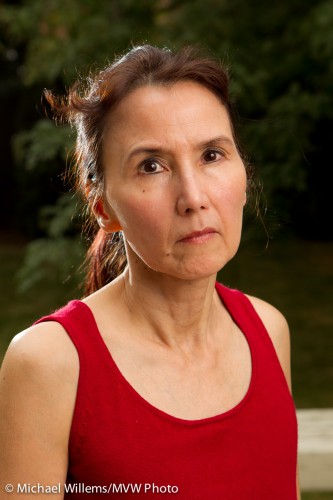
      Nancy, photo by Michael Willems

      In the back yard, lit by flash

      As you can probably see, I am also using a speedlite on the camera left, to separate the hair from the background and to give some edge lighting interest. That speedlite is fitted with a Honl Photo 1/4″ grid to avoid the lens flare I would otherwise get.

      Time for this snap: couple of minutes.

      If all that is confusing, as it will be to beginners, then just take one of the flash courses and learn how to do this. It is fun, and well within reach of amateurs – not just for pros!

      Michael’s Quick Judgment:

      • Photoflex large reflective umbrella: recommended.
      • Bowens Travelpak power pack: recommended.