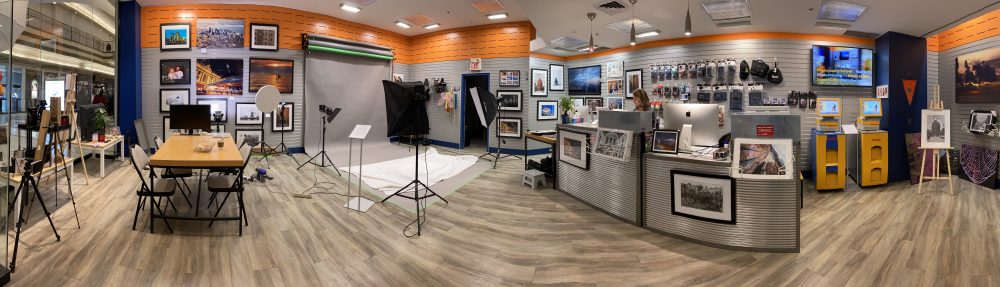
Accessorize.. accessorise.

Especially when it’s useful. Like in this case: the Honl Photo light modifiers’ carrying case. If you don’t have one yet, get one:

Very handy bag to keep all your modifiers, like bounce cards, gels, and snoots in one convenient place. And it attaches to a light stand, camera bag, etc, with a convenient clip.

Mine carries things like the reflector you see David Honl himself aiming at Studio Moirae’s Christie, when he joined me for my flash workshop in Phoenix a few days ago:

These small modifiers really have made a tremendous difference to the utility of small speedlites in professional lighting. If you do not yet have the range of Dave’s bounce cards, reflectors, gels, grids and more, then get them now.

Joe McNally is rumoured to have said that “if your subject is interesting, don’t light all of it”. That would be right if he had, and it is there that Dave’s range of modifiers shine: there and in being small, affordable, light and especially, durable, so that I can use them on the road.

That’s not all. There’s more exciting news coming soon from David Honl soon. Stay tuned until I can reveal the latest modifier.

Add a splash of colour

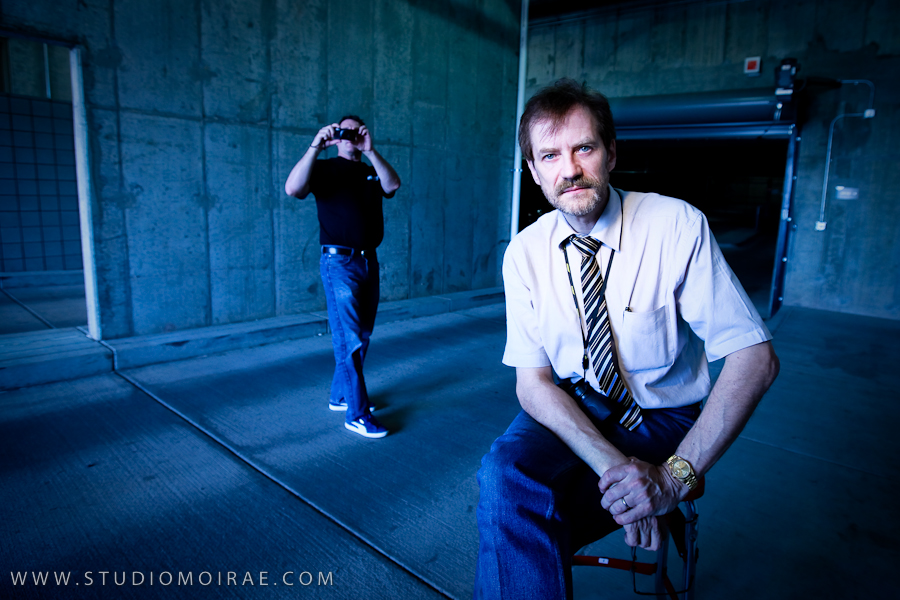
Look at this recent portrait:

You will see standard lighting with a softbox on camera right, a fill light on camera left, a hair light behind him, using a Honl Snoot, and a background light aimed at the background.

This background light has a subtle blue Honl Photo gel on it. Can you see how much of a difference that makes? No gel would mean a grey background, and blue adds a touch of interest as well as a hint of corporate soldity.

More technique:

Here’s me, shot by Christy Smith of Studio Moirae:

Yeah, I model too.

But wait. That cool blue urban look. Was it actually like that?

No. The actual scene was like this. Here’s Christy and David Honl taking a test shot:

So wait. How come it’s all blue?

That’s because Christy and Dave set their camera’s white balance to “Tungsten”. That will turn daylight blue.

But then I would be blue too!

Except they are lighting me with a flash with a CTO (“Colour Temperature Orange”, i.e. Tungsten-coloured) Honl gel and with a Honl Grid to make the light go mainly to my head and shoulders. The flash was aimed straight at me and set to manual, and it was fired with pocketwizards.

That’s the kind of cool technique Dave and I taught the participants who came to the workshops Monday and Tuesday in Phoenix, Arizona. If you have the chance, come to a future one: they’re fun and you will lean sooo much.

Today, part 2 of Phoenix

Today, part two of the Phoenix workshop at Studio Moirae. A repeat with a different emphasis; we go a bit deeper into the technology and we practice TTL multi-flash (both Nikon i-TTL/CLS and Canon E-TTL).

Yesterday, David Honl (yes, the David Honl) joined me, and he and I presented the workshop together. And we had fun: did we ever. A bright and energetic bunch of local photographers here in Phoenix.

Here’s David getting ready. In this shot I set my White Balance to “Tungsten”, which makes the background blue. Then a full CTO gel on the speedlite ensures that the subject, which after all is lit by the flash much more than by the ambient light, does not turn blue, but looks normal:

Here’s one of the set-up shots:

David setting up a speedlite, fired with a pocketwizard, with a half CTO-coloured Honl 8″ gold/silver reflector (while I blind Christy by actually firing the flash):

David carefully adjusting the subject’s head:

Tough job, but someone has to do it.

And here’s my shot of Christy, using this light:

All I can say is, I am glad the model we hired did not show up, because Christy is an amazing subject to work with. Which is rare for photographers.

And finally, fair’s fair: one more picture by Christy of David and me. Slow shutter, turning the camera during the shot.

Can you see that direct flash can be great light? And that shadows do not necessarily need to be avoided?

Phoenix Mon/Tue

I shall be teaching Travel and Advanced Nikon Use at the new School of Imaging location in downtown Toronto tomorrow.

Then Sunday, I am off to Studio Moirae in Phoenix:

….for two days of teaching Advanced Flash.

And some excellent news: I will be joined on Monday by David Honl, too, who is flying in from LA with an assistant to be there (this is a great opportunity: if you are anywhere near Phoenix: There are still a few spaces available, but be quick).

Now, off to bed. Take lots of pictures

Jewellery

Thanks to fellow local photographer Anita, I shot Jewellery yesterday, on location in St Catharines. This was the setup in the store:

An improvised table with a curved white background, lit by two speedlites in an umbrella, with an opposite reflector; then one”sparkler” speedlite in a Honl snoot to aim at the jewellery.

I used

  • A 580EX II on the camera
  • Two 430 EX flashes in an umbrella
  • Wireless TTL with +2 stops flash compensation
  • A 100mm f/2.8 macro lens
  • A Canon 1D Mark IV camera.

A few tips:

  • Use aperture in the 5.6-16 range. More is better, except when you go much above f/8-ish, most lenses get blurrier again.
  • Use a tripod!
  • Focus using manual focus. Use Live View and x10 magnification to set this focus accurately.
  • Expose carefully, using flash compensation as needed. Use the histogram and “highlight alert” to verify.
  • Use the sparkler straight on to add life, especially to diamonds.
  • Watch reflections carefully
  • Use a black reflector if needed to add the black reflections in diamonds.
  • White balance carefully.
  • Clean the jewellery well.
  • Use Photoshop to clean up any remaining dust. Jewellery photos need to be finished in photoshop.
  • Use Play-do to mount rings, etc.
  • Consider an acrylic stand to separate jewellery from the background – this avoids shadows.
  • Black acrylic works too – nice reflections. Black slate can work, too.
  • Did I mention you should use a tripod?

This got me shots like this one:

Jewellery can take many hours to shoot, so yesterday worked out well – 20 products shot in four hours.

New toy

Just received the new Honl Photo bounce card/speed snoot.

It is like the previous ones in that it is small, sturdy, and conveniently attaches to the Speed Strap.

What’s different?

This one has not a white but a gold reflector (equivalent to 1/4 CTO).

That means I can use it to:

  • Shoot with flash in Tungsten ambient light without making the background warm or the subject too blue; or
  • Warm up portraits with a nice warm glow.

Yet another thing to make my light-life easier.

I am going to be once again sharing my Flash expertise in Phoenix next month – 22 and 23 March – for pro and emerging pro users. You can be sure I am going to show how these small modifiers enable a whole new world of flash.

Backgrounds

Another recent user question:

How do you determine the background you use for portraits?

That’s a tough one, because there is no one answer. What’s better? Look at these three “Autumn” and “Hollywood” series Honl gels:

Or this?

Or this?

Of course as usual, the answer is “it depends”.

  • For business, white is good, as is a very light blue.
  • For women, more elegant colours can be used (the purple above, for instance, is not usually considered a male colour).
  • Black is possible for dramatic low-key portraits.
  • Colours depend on hair colour, skin colour and suit colour.
  • You may, for instance, want to contrast with the suit.
  • You certainly want to contrast with the hair – avoid blending your subject into the background. (Or you use a hair light).
  • And sometimes, you may want to match the background to, say, a bright red suit, again in order to make the face stand out.

In general, the most important concerns I have are:

  1. It has to match the mood (conservative is blue, etc)
  2. Ideally, it go with the person’s clothing. That means either complementary colours (yellow and blue, say) or identical colours (A suit with purple in it? Then I can use purple in the background).
  3. Above all, I try to make the face stand out and avoid blending it into the background.

The basic rule: have fun, and keep it simple if you can. Try different colours but avoid very bright colours except for special effect. Have some very subtle blues and yellows and greens available just in case you want to add a splash of tint.

Tint is a good thing. Colour is more difficult!

I hope this gives those of you who use colour gels some ideas to try.

A standard portrait setup

Back to the standard “small studio” setup I described earlier. This time I shall talk a bit not about how it works – I assume light sensitive slave cells and Pocketwizards and cables are all old hat to you now – but instead, I will talk about how to use it.

As a reminder, here is such a four-light setup, again:

Four lights; and after the click, more about how you use them.

Continue reading