Prime primer.

Today, I would like to share another note on prime lenses. An oft-recurring theme here at Speedlighter.ca.

“Prime” lenses, as you know, are what we call non-adjustable lenses, i.e. non-zoom lenses. A zoom lens has varying focal length (e.g. “16-35mm” or “70-200mm”); a prime lens has just one focal length (e.g. “50mm”).

So remind me – why would I want prime lenses, again? Surely zoom is much more convenient?

Yes. As I wrote before, a zoom lens is indeed more convenient. But it is not always better. In fact I shoot with primes as often as I can, for good reasons. Some of those reasons here:
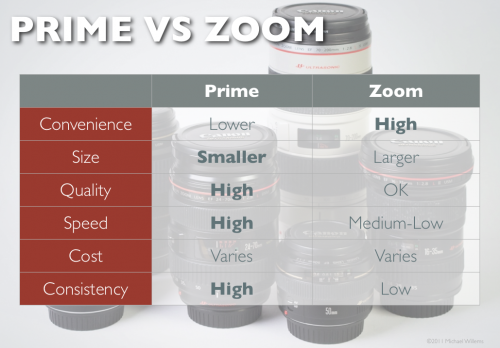
A prime lens is often smaller and lighter, and almost always better quality. Primes are usually faster (they can go to a lower f-number, i.e. they have a larger aperture).

But two benefits are often neglected, and yet these are very important.

When you are learning, the prime lens teaches you the relationship between aperture and depth of field very well. You may recall from the post the other day that aperture, lens focal length and distance to subject all affect the depth of field in a picture. With a zoom lens, it is hard to get a handle on this, since you are changing one of those variables with every shot. With a prime, you really come to feel this relationship.

When you are shooting, a prime enforces consistence and discipline. Instead of every shot being different in look and feel from the last one, you get a “style” for the shoot. Your distance to the subject will be more consistent. Your settings for flash compensation and exposure are more consistent and hence, easier to handle.

And that is why I love to shoot with my three primes, whenever I can.

So yesterday, reader Leaman, responding to a previous post on this subject, asked:

Going through some of your older blogs and came across this post hoping to get some advice.

I have been thinking about getting a second lens for my Rebel series camera and am torn between primes and zooms. Specifically, I was looking at the EF-S 17-55 f.28 zoom vs getting both the 24mm f2.8 and 35mm f2.0 primes. I already own the 50mm f1.4.

Assuming that cost is not a factor, could you give me your thoughts? From my readings in your event photography shoots, you typically use a zoom as a walkaround and swap for a faster lens as needed.

Considering the 24 and 35 primes that I’m looking at are no faster/slightly faster than the zoom lens, would it make sense still to get the zoom lens? The only thing I think the zoom has in benefit over the primes is the versatility of less lens swapping. From reading my reviews (maybe you have your own reviews from experience as well) the build and picture quality between the 3 are not that far off from each other.

Well, first off, I would say that a whole stop faster, since you are talking about one f/2.0 lens, is more than just slightly. That stop can make all the difference, especially with side lenses where it can be tough to get selective depth of field. And for the 24mm lens, the other benefits still hold.

When shooting an event, I regularly use a zoom, true; but there are many situations where I do not. Low-light events, for example. And the 35mm prime lens is my favourite, for the reasons outlined above. But at the longer end, zoom is more important – so I often use 35mm prime plus 70-200mm zoom.

So Leaman, while indeed there is not one right or wrong answer, and it depends on what you shoot – but without knowing more, personally I would recommend the primes.
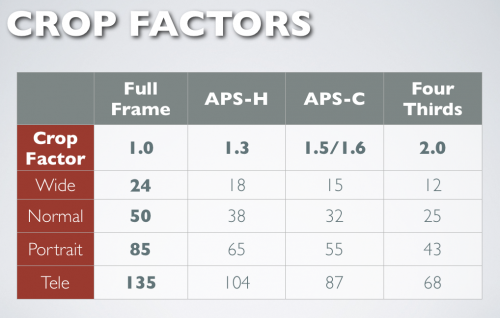

 

How wide is wide?

What constitutes a “Wide” lens depends on whether you have a full-frame camera or a crop camera:

So on a full-frame camera a 24mm lens might be”wide” , while on a crop camera like a Digital Rebel or a D90 you would need a 15mm lens to get the same width.

You may want to keep this table in mind the next time you decide whether a lens is a wide-angle lens or not.


Reader lens question

Richard, a frequent reader, asks:

I have been researching the Canon L series lens’ 16-35 F/2.8 vs 24-70 F/2.8. I have my daughter’s graduation in May, which combines an indoor ceremony with an outside function. I expect I will be further away for most shots, but want sharpness, quality and a fast lens in either case. I also have my Canon 50mm F/1.4 for the real nice inside close-ups, where speed/blur is important. I am leaning towards the 24-70 F/2.8 as I think I will get more long-term use for the various kids events, sport shots, family gatherings etc.

And I agree, Richard.

First: an f/2.8 lens is going to be much better than a f/5.6 “consumer grade” lens – two stops more light, and two stops more blurred background, whenever you like them. Get fast lenses and you will never regret it. Nothing beats low f-numbers.

I actually own both those lenses, so I can tell you about them – they are great lenses both. Both those “luxury” lenses (that is what “L” stands for in Canon-speak) are very sharp, focus quickly, and have good build quality.

What do you use them for?

  • If you own a full frame camera, 16-35 is very wide, and 24-70 is a “wide to almost longish” general purpose lens.
  • If on the other hand you own a crop camera, 16-35 is “wide to standard” and 24-70 is “a bit wide to a somewhat long”.

Wide is great for landscapes, architecture, parties, perspective. The 24-70 range, on the other hand, is a general purpose workhorse lens. Some pros only own this one lens. Yes, 16-35 is fantastic, but not general purpose: 24-70, on the other hand, is general purpose, from weddings to parties to portraits.

So on the whole, I would say 24-70 first, and 16-35 later. For a graduation, 70mm may not be long enough if you cannot get close to the stage, but you can, in that case, always rent a 70-200mm lens for a day. Renting is good!

Another of Richard’s questions concerned extenders – I shall address this at a later point.

Quick tip

Just a very quick tip tonight. Late night, 24 past midnight and getting up at 7am.

But enough time to point out that…

  • Your camera does not need to be switched off between shots. Leave it on, let it time out; then “wake it up” when needed by lightly touching the shutter.
  • You need no camera bag. Cameras want to be free, not locked up in a bag.
  • You can leave the filters in the bag. You need them when it is raining, sandy, snowing, etc – but not all the time.
  • You do not need a lens cap. Lens caps are picture preventers!

Things you DO need:

  • You DO need a lens hood.
  • You DO need a spare battery.
  • You DO need a strap.
  • You DO need spare memory cards.

There – doesn’t that liberate?

Michael

Adding flashes GOOD.

As readers here know, “one flash” gives you “OK light” – provided you bounce it off a wall or ceiling, usually behind you.

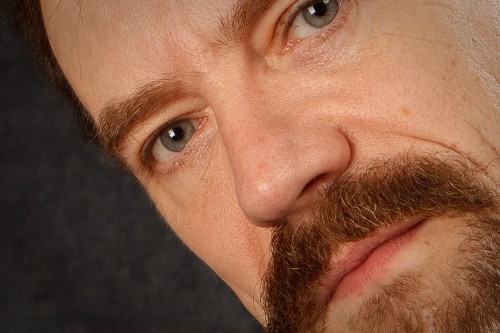
But off-camera flash is better. This image would really not be as good if the flash was on the camera:

Jason in July 2010

Jason in July 2010

That is because good lighting is all about what you do not light.

And multiple off-camera flash is better still.

The great news is that all modern camera systems support multiple off-camera TTL flash.

TTL flash is enormously sophisticated. For instance, a modern TTL flash will tell the camera its colour temperature with each flash fired (yes, it can vary per shot); that way, as long as your camera’s white balance is set to “Auto” or “Flash”, each picture will automatically have the right colour temperature set. Bet you did not know that.

This site is called “speedlighter” for a reason: I teach people this stuff (the last Mono workshop, on April 23, contains a full “Advanced Flash” course). Even before or without that, I strongly recommend you all try some off-camera flash using TTL remote control.

  • On Nikon cameras you need just the camera and its popup flash and any remote flash (SB700, SB900).
  • On Canon 7D and 60D cameras, the same: just the camera and its popup, and any Canon slave flash.
  • On other Canon cameras, a 580EX flash or a wireless IR transmitter on the camera

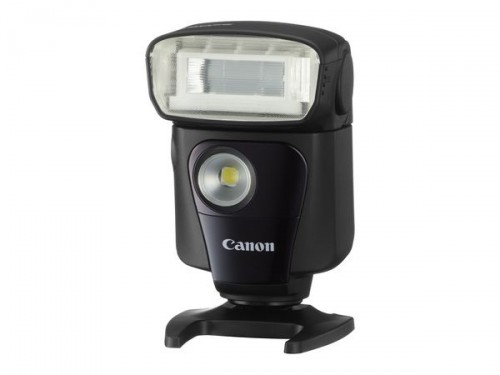
Attention Canon users: two new small flashes are now available. I love the specs on the all-new 320 slave flash, which brings remote flash into many more people’s reach:

Get a few of those and you have a full flash setup. Full slave functionality. 32 Guide number. It also has a continuous LED light for video, and a remote switch – it is a remote control for cameras like the 7D, 60D, 1D, 5D and so on. I am getting one or two as soon as I can!

Why you use good lenses

Lenses are worth the money you spend on them. At the risk of repeating myself, let me show you why.

A good lens focuses fast. It is well-built and strong. It has little aberration and edge distortion. It is silent. It has better coatings and resistance to flare. Most importantly, it has a larger aperture (a smaller “f-number”), hence more glass.

But also very importantly, it is sharper.

Look here. Click on this image and then click on “orginal size”, and then view it at original size. Make sure you follow all those steps.

(24-70 lens at 24mm, at f/8, 1/125th second, 100 ISO; using studio strobes).

When you do that, you basically get to DNA-level.

“But I do not want my face to be so sharp!”.

Yes you do. You want your eye, eyelashes and soon, to be sharp. Skin you can blur later if you wish, but the basic image must be sharp.

And that is why a good lens (e.g. in the Canon-world, an “L”-lens, where “L” stands for “Luxury) is worth every penny. (And they cost a lot of pennies – but the lens will last you twenty years, both technically and in economic terms).

I am repeating myself, I know – but this is important. In lenses, there are few shortcuts (except an affordable 50mm lens, which is why if you do not yet have one, go get one now!)

Metering outdoors

A modern light meter is a flash meter as well as an ambient light meter. And that can be good, but it can also be confusing. How do you meter when using a flash outdoors, when you meter both types?

For instance, for a shot like this?

Here is how I do it:

  1. I set my camera to the mode I want – manual, usually in this case.
  2. Now, I decide on ISO. Say 100.
  3. Then I decide on shutter speed – say 1/200th sec. No more than the camera’s fastest flash sync speed, usually around 1.200th second.
  4. Now I set those values on the light meter and I press the button to meter the ambient light and read the aperture that this gives me. (I can use the light meter in ambient mode, or I can use my camera. I prefer the light meter. )
  5. Then I set my camera to what I want with respect to that, say -2 stops w.r.t ambient. So if the meter reads f/4. I may use f/8 instead.
  6. Then I switch to flash meter.
  7. I now fire a test flash with my flash – and then adjust flash power and distance to give me exactly this aperture.

In fact it is often a bit of an iterative process:if step 3 does not give me a good aperture value (e.g. it gives me f/2.0 or f/16), then I will choose different shutter speed or ISO values until I get a value I like. Or if even at full flash power I cannot get the desired aperture in step 7, I adjust ISO and go back to step 1.

Try this technique: all you need is a manual camera, a manual flash (and a way to fire it), and a light meter.

And then you too can make shots like this:

That shot was taken at one of Joseph Marranca and my Mono workshops.

And there is good news: the last ever Mono workshop, on April 23, is open for booking. And it will be a very special one. Can you say “green screen”, “waterboarder”, and “amazing portfolio shots” as well as “learning great light and flash technique”? Sign up now if you want to have a great photographic learning experience.

Primes. Why?

Today I would once again like to chat for a moment about using prime lenses. This is a regularly recurring theme here at Speedlighter, because primes are beneficial in many ways.

50mm prime lens, set to f/1.2

A prime lens is a lens that does not zoom in or out. It is fixed. Like a 35mm lens, or a 50mm lens, rather than a 17-55 or 70-2oo zoom lens.

So that is a drawback, right? Zooming is more convenient than walking back and forth or than changing lenses all the time.

But prime lenses have many benefits, three of which are pretty well-known.

    1. They are usually sharper than zoom lenses, and often have less distortion around the edges.
    2. They are usually faster (wider aperture,lower “f-number”), meaning blurrier backgrounds and better low-light performance.
    3. They are often smaller and lighter than zoom lenses.

      There are, however, three other benefits, and these may surprise you.

        1. They enforce consistency in a shoot. You do not have a different look and feel for every image!
        2. “Work it out once during a shoot, you have worked it out for all other shots too”. When you zoom, each shot works differently. Use a prime, this is more predictable. Hands up everyone who likes “predictable”?
        3. Primes really teach you about depth of field, shutter speed, and how these work together. Using a zoom lens it can be very difficult to get a grip on how all these factors work together. Using a prime, you get to really understand how aperture, depth-of-field, distance, ISO, and shutter all work harmoniously together – an understanding every photographer needs.

          This is why I shoot with 50mm and 35mm prime lenses as often as I can.

          35mm prime lens

          35mm prime lens

          35mm prime lens

          35mm prime lens

          50mm lens

          50mm prime lens

          If you can, get yourself at least a 50mm prime lens.

          (Note that the examples here were shot on a full-frame camera, so 50 means 50. If you had a crop camera, like a Digital Rebel or a D90, you would want to use 24mm and 35mm lenses where I use 35mm and 50mm lenses.)

          BREAKING NEWS

          MAJOR BREAKING PHOTOGRAPHY NEWS: BBC Reports that Sendai-based Nikon is to suspend all SLR production for one year, following the earthquake/tsunami.

          (Better buy that SLR right now, IF you can still find it in the stores. I’ve seen lineups at Henrys in Oakville and Mississauga.)

          ….
          FOOTNOTE: I would have thought the lineups and the date would have tipped people off! Glad to say Nikon will weather the storm fine, folks. Although – grain of truth: some production is indeed halted temporarily.

          Metering muddles

          A word about light meters again – this time, on how to use them.

          1. First turn on the meter.

          2. Then move the white dome out, not in.

          3. Now set the ISO to your camera’s ISO (press ISO and hold it down while turning the dial, until your camera’s ISO is indicated).

          4. Now set the metering mode. A modern light meter has two separate modes:

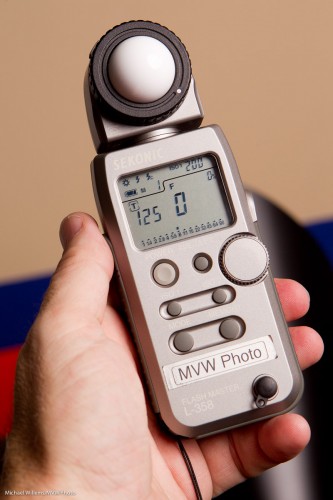
          • Ambient metering (the “sun” symbol at the top left on the display above);
          • Flash metering (the “lightning bolt” symbol on the display above).

          If you want to meter available light for a normal available light photo, select the sun (press mode button and turn dial); but for metering flash, where the meter measures brief flashes of light, select the lightning bolt.

          Assume for today’s post, that you only have flash light to worry about in your shot. So you set the mode to flash, and set the shutter speed to your camera’s shutter speed. Set the camera to 1/125th sec, and set the meter to this time as well.

          Now when the camera measures, since you have told it your camera’s shutter and ISO, when it measures the light it will tell you the aperture to set the camera to. (After all, exposure is a triangle of “ISO – Aperture – Shutter”.)

          5.  Now hold the meter where the subject will be, and aim the white dome at the camera.

          6. Now press the big “reset/test” button on the side. The aperture now reads “0”.

          7. Finally, fire your flash.

          The meter now indicates the aperture you should set set your camera to. If this is different from what you wanted

          • adjust the flash’s power;
          • repeat the procedure, until the meter indicates the aperture you had in mind.

          This is how you use a flash meter.

          In future posts, more.