Light meter know-how

If you are a photographer, you will need to use a light meter sooner or later. Like in studios, when shooting flash, or when shooting outdoors in mixed light. Or for when you want it accurate. Light meters, like my Sekonic L-358, are invaluable.
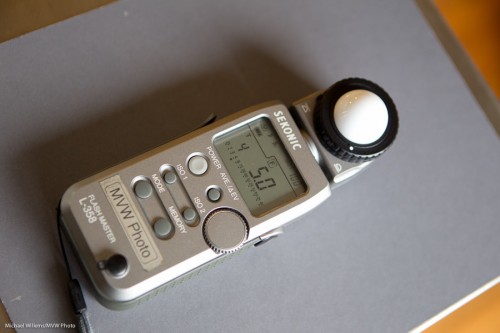
But light meters are not perfect. They can vary between modes, between measurements, and between light meters. Even between ISO settings, or times of day.

The good news: modern light meters can be calibrated, i.e. adjusted, when necessary. The bad news: this is sometimes a little similar to black magic.

If you doubt your meter’s accuracy, here is what I would suggest you do:

  1. Set your camera to aperture mode, f/5.6, 100 ISO
  2. Filling your entire viewfinder, shoot a grey card, evenly lit by diffuse daylight. Avoid reflections. Avoid standing in the light (d’oh).
  3. Check if the histogram is neutral in color (Red, Green and Blue channels, if you can display those, are equally bright).
  4. Now check if the histogram is in the centre. If not, adjust the exposure using exposure compensation, until it is in the middle.

You should now see something like this on the back of your camera:
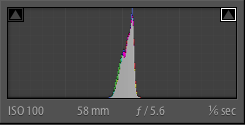
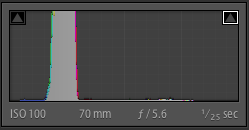
If instead you see a histogram like the one below, the image is too dark – use + (plus) exposure compensation:
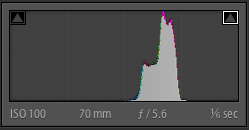
If you see the type of histogram below here instead, then the image is too light – use “-” (minus) exposure compensation:
So. Done? Now repeat the process until this is right.

Now that you have adjusted the exposure to get the histogram into the centre, read the shutter speed you now achieved.

Now:

  1. Set your light meter to f/5.6 and 100 ISO.
  2. Dome extended, put it on the grey card.
  3. Without blocking the light, measure the light.

If your light meter indicates the same shutter speed as you got on your camera,you are good. If it indicates something else, you may need to calibrate your meter.

On my Sekonix, this is done by pressing ISO1 and ISO2 together while you turn on the meter – and keeping them pressed. You can now adjust the meter, + or – as needed, then repeat your measurement. Repeat this until you see the same time on your meter that you saw on the camera before.

Now, take some shots metered with your meter, in various light intensities and types, and verify that the grey card peak is in the centre for most images.

Like I said, black magic.  But now you know. Bet you were not aware your meter was adjustable!
 

Speedlight tip

When you are using a speedlight (such as a Nikon SB-800, say, or a Canon 430EX) and firing it in manual mode by using a Pocketwizard, there is one problem I see a lot.

Namely: after a few minutes, the speedlight turns off. It times out, “goes to sleep”, and the flash stops responding until you wake it up again. Grrr!

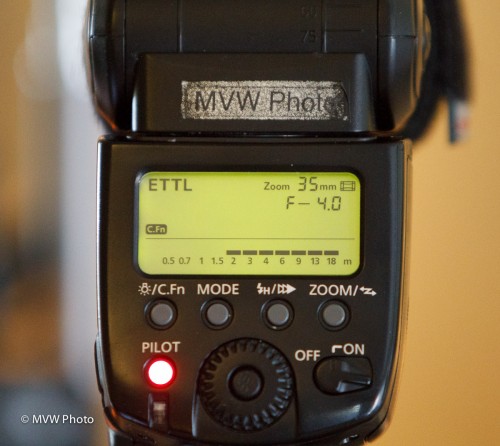
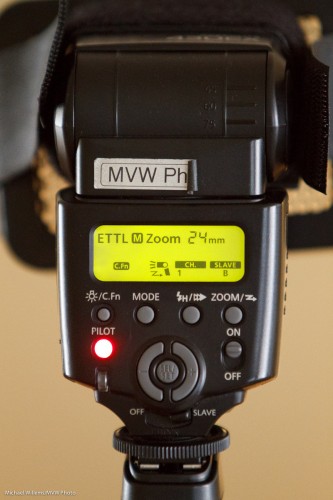
The solution: use a custom function on the flash to disable the timeout. When you have successfully done this, on a Nikon, you will see the timeout words followed by “—“. On a Canon, you will at least see an indication that a custom function has been activated, by the “C.Fn” symbol on the back of the flash:

See, bottom left of the display. (It’s usually custom function 1: check your manual).

Yes, I know – the interfaces used to operate your flash are terrible. Press this button, go right, hold down that button, sing incantations while dancing around an oak tree, then enter the square root of pi: not for the fainthearted. But worth learning!


My Flash is too bright!

Help! My flash is too bright! Michael, I am doing what you say; and I am using TTL; and yet I get shots like this from my on-camera flash – way over-exposed:

What am I doing wrong?

A-ha. Look at the back of your flash, if it is a high-end unit like my 580 EX flash. And you will see something like this (and an SB-900, for example, would do the same):

That flash says “with the current settings, and the flash aimed ahead, you can take pictures roughly from 2 meters to 18 meters distance”. You see, there is a minimum power setting. And hence a minimum distance.

Which in this example means you cannot take pictures of an object (or a person) 1 meter away. The picture will be overexposed if you try!

Solutions?

  1. Pay attention to this warning!
  2. And when needed to get closer, use a lower ISO!
  3. Or use a smaller aperture (larger F-number).

Simple, once you know. Just like brain surgery.

(Bonus point if you know how much overexposed the image will be at 1m. Answer: Twice the distance is 4x the light, hence 2 stops over).


Studio light note

Welcome, all, including new students and reader.

Continuing in the studio lighting technique series of posts, today, let’s look at the effect of a background light.

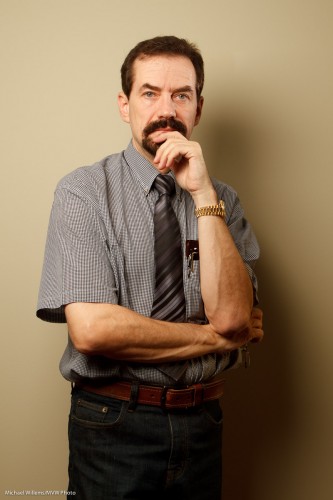
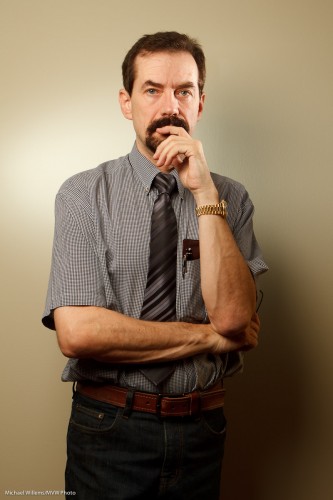
A simple portrait (yes, as you see, I am my most patient model):

That was lit with one strobe in a softbox on our left. Simple, nice, soft light.

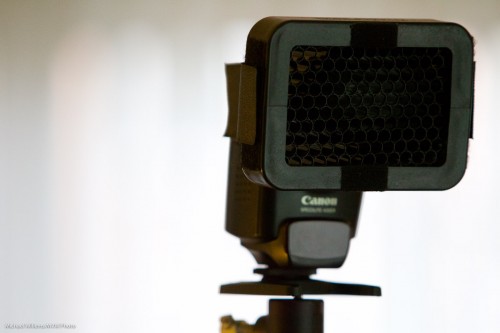
But wait. Perhaps a little more light on the background would help offset the model from the background a little better. For this, we use a speedlight, with a grid (so as to avoid the light going everywhere).

Like this, using a 430EX (similar to a Nikon SB600) fired with a Pocketwizard, and fitted with a Honl grid:

And that gives us very different light.

Now we could turn that background up, or down; or change the direction.

The point is that this allows us to play with “foreground versus background” a little. Offsetting your subject from the background is always good – dark background and light subject or light subject and dark background are both good. There’s no one way – it’s more that there are a number of ways of doing things. And by controlling liught, you control those ways.


Hold it!

Hold your camera, that is. And hold it the right way. Holding your camera correctly ensures that you minimize the shaking, and you make adjustments as quickly as possible, without losing time.

And how do you hold the camera?

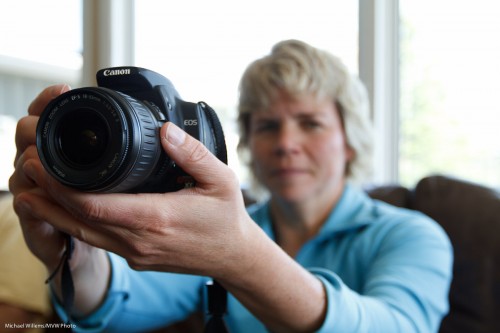
You support the lens with the palm of your left hand, thumb on the left side (not under the lens). I.e. you support the camera like this:

(Of course when you are taking an actual picture, and not just demonstrating, like today’s student, then you would ensure the viewfinder bumper actually touches your face.)

Note how I used “off-centre composition” – the rule of thirds. The subject (the camera, in this case) is not in the middle. Only Uncle Fred puts the subject in the middle in every picture.

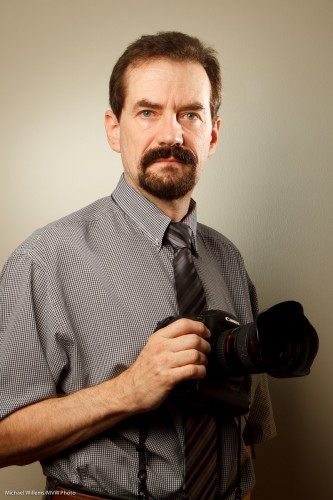
You would also consider turning the camera 90 degrees to the left, to get it into vertical position (i,e. the shutter is on top now, not at the bottom). Shoot vertical when shooting vertical subjects, like towers – or people, like me:

Photographer Michael Willems

(Oh, and one more benefit to holding the camera right: you look like you know what you are doing).


More on those lenses

Fast lenses, and why do you need them for portraits?

“Fast” lenses mean lenses with a large aperture, i.e. a low minimum “f-number”.  Like an f/2.8 lens, or even an f/1.4 lens. These lenses allow shallower depth of field, but they also allow in more light.

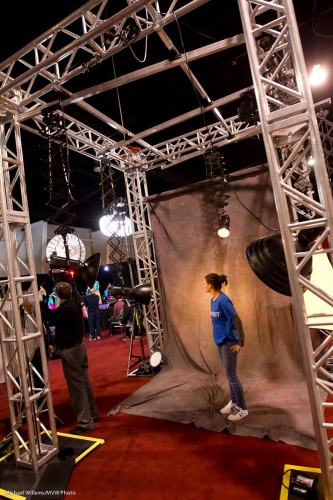
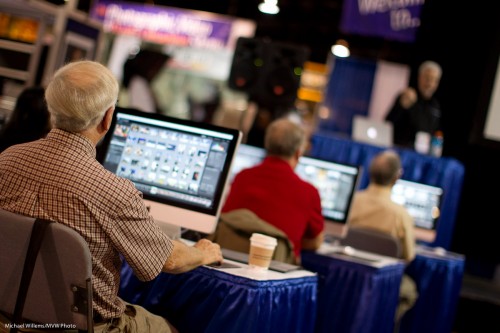
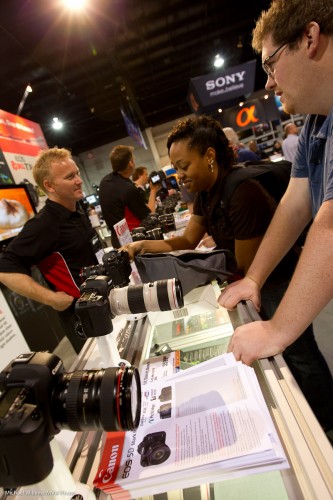
Imaging shooting in a studio. Like this, at today’s Imaging Show, at which I spoke about lenses again:

All sorts of lights, operated by Pocketwizards. Yes, true, you do not need a fast lens for this. A simple f/5.6 lens will do since you will shoot at f/5.6 – f/8. (Though a fast lens stopped down will be sharper than a slow lens wide open).

But. Imagine you want to shoot there using available light. Not the flashes, but the available modeling lights. Or perhaps window light in your room.

This you can do only if you have a fast lens. Set it to f/1.4 and it lets in so much light that in that situation above you can shoot at 1/100th second at 100 ISO (or if you wish,  1/400th second at 400 ISO):

Isn’t that amazing? handheld, Canon 7D, prime 35mm f/1.4 lens, set to f/1.4 at 400 ISO and 1/400th second. And it looks like a studio shot. Due to my use of a fast lens.

(Oh – why did I shoot as I was, at f/1.4 and 400 ISO? Because I was carrying a heavy bag with speedlights and lesens, and two cameras, and a laptop. So I had no spare hand. That’s why!)


Lens thoughts

Lenses make all the difference to your picture. Talking about lenses in the four presentations I wrote for the Digital Photo and Imaging Show at the International Centre makes me realize this more acutely than ever.

And the most important thing, of course, is aperture. A lens needs a large aperture, meaning, as I am sure you all know, a low minimum “f-number”.Like f/2.8 for a quality zoom.

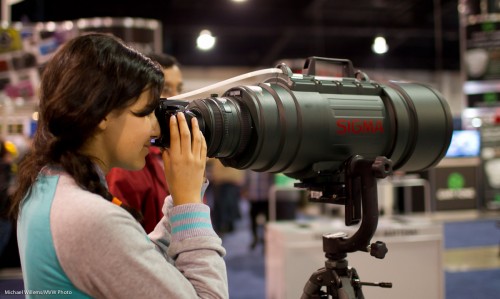
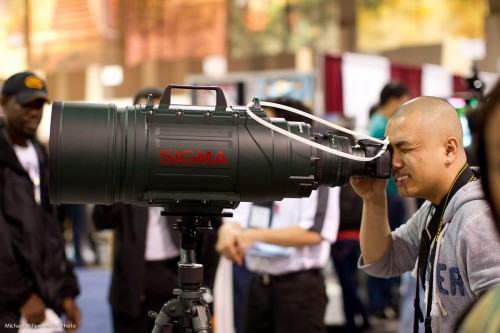
Many people today tried out the various lenses money can buy:

One reason you need fast lenses is the low-light ability of these lenses.

Let me say here now: there is (almost) never enough light.

Let me illustrate what I mean.

With an f/2.8 lens I can get a picture like this at 800 ISO and 1/100th second:

If I had had an f/5.6 lens, that would have been either 3200 ISO, or 1/30th second – both of which would have spoiled the image.

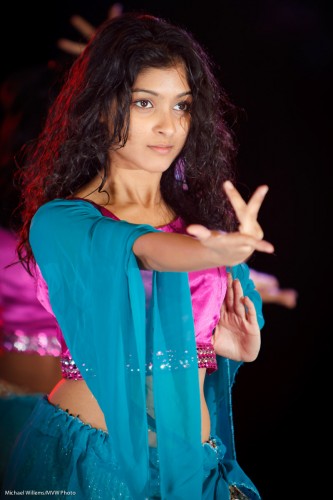
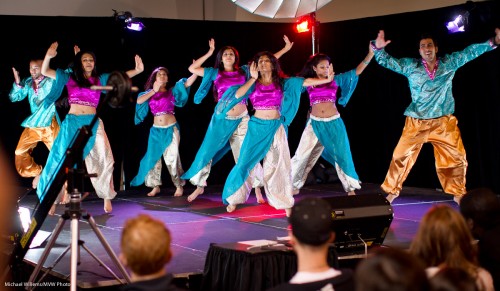
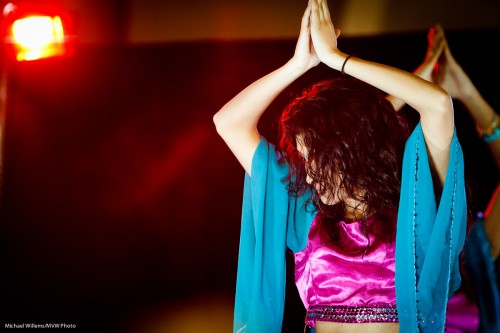
f/1.8, on the other hand, in this type of light today gave me as fast a shutter speed as 1/320th second for some shots, which is enough to show dancers blur-free as they lift off the floor:

And there really is little alternative. If I have to shoot faraway moving objects in low light, therefore (like animals at dusk), I can only do three things other than go to a lower “F-number”:

  1. Add light.
  2. Tell the subject not to move.
  3. Shoot at very high ISO values.

So if I feel wealthy, I might want to buy this, a Sigma 200-500mm f/2.8 lens.

Beautiful. Here it is one more time:

(Of course I also shot those images with a fast lens: a 50mm f/1.2 lens set to f/1.8).

One last picture – again, f/2.8 at 1/100th and 800 ISO.

I could not have done this any other way without getting too much grain, or too much motion blur.

More about this tomorrow at the show: I present Portrait Lenses at 11:45 and unless I am mistaken, 1:45 is Travel Lenses.


Imaging Show

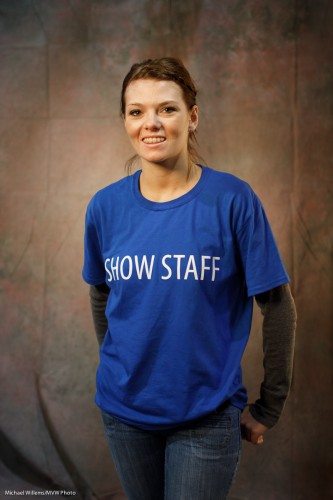
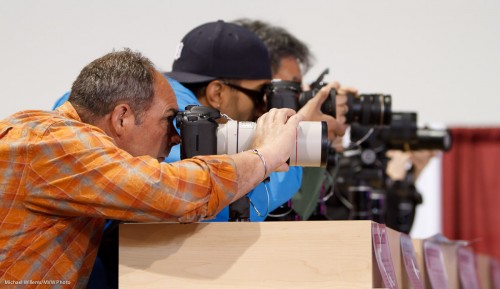
I taught at the Photographic and Imaging Show in Mississauga today and met many interesting people. I wrote four “choosing the right lens” workshops, which I teach there all weekend.

So on that theme: what is the lens I should use for a trade show?

While I usually shoot with flash, at a show like this of course natural light is often a better option. So I want fast lenses.

800 ISO is fine, with a modern camera. And that is enough for 1/500th second at f/1.2 with a super-fast 50mm prime lens. On a 1.3 crop camera, this gives us an effective 65mm:

This type of slightly longer than standard lens focal length gives us slightly compressed perspective while still retaining a natural look.

If instead you want a more dramatic three-dimensional perspective, use a wide lens.  A 16mm zoom set to 16mm (meaning, on this camera, a 35mm equivalent of 20mm), gives us this:

(This was also 800 ISO, but now 1/60th sec at f/4 – meaning an equivalent exposure, just shifted up)

Both images were, as you see, tilted to compose well, and to simplify.

So if I had to give you a quick answer, I would say: “wide or standard, and above all, fast, like f/2.8 or faster”.

More tomorrow!


Batteries for speedlights

A reader called to ask: “what batteries do I use for speedlights”?

Good question. And a very important one. Here are my thoughts:

  1. Bring enough of them. Twice as many as you think you may need. Then some more.
  2. Ensure that they are charged before the event.
  3. Swap them often – after every part of every shoot.

And now as for which ones:

  1. Use NiMH rechargeable batteries. They deliver more current (lower internal resistance while charged) than Alkalines. And they are cheaper since they are reusable.
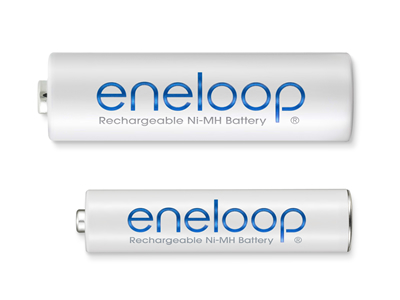
  2. Use “low self discharge” batteries. These are marked as such, or they are marked as “ready to use”. Sanyo Eneloops are the most famous battery of this type.

And now for a very important last factor:

Get a conditioning charger, like a LaCrosse or Maha charger (Google; or just try amazon.com). This type of charger can discharge your battery before charging again; doing this every now and tehn ensures your batteries never develop a memory effect; i.e. they will stay better, longer.

I am off to sleep, since for the next three days I speak at the Imaging Show at Mississauga’s International Centre.


Use the right tool.

“You can only use a 50-150mm lens for portraits”.

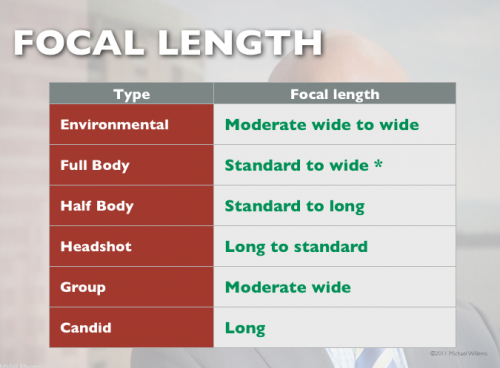
Nope. You can use any lens, just about. It’s a matter of matching the kind of portrait to the most suitable lens. Somewhat like this:

So you do not shoot a headshot with a very wide lens. But as you see, almost any type of lens can be used for portraits of one sort or another.

  • For stand-alone portrait, the longer the better. But you may not have space to use a 200mm lens.
  • For groups, wide or very wide is OK . Keep people away from the edges or they will stretch.
  • A Macro lens makes a good portrait lens.
  • For available light photos, you use a fast lens.
  • For environmental portraits, you use a wide lens, making sure your subject is not too large in the image.

I am going to be at the Henry’s Imaging show in Mississauga all three days, Friday to Sunday, talking about “the right lens for the job”. Come see me if you like!