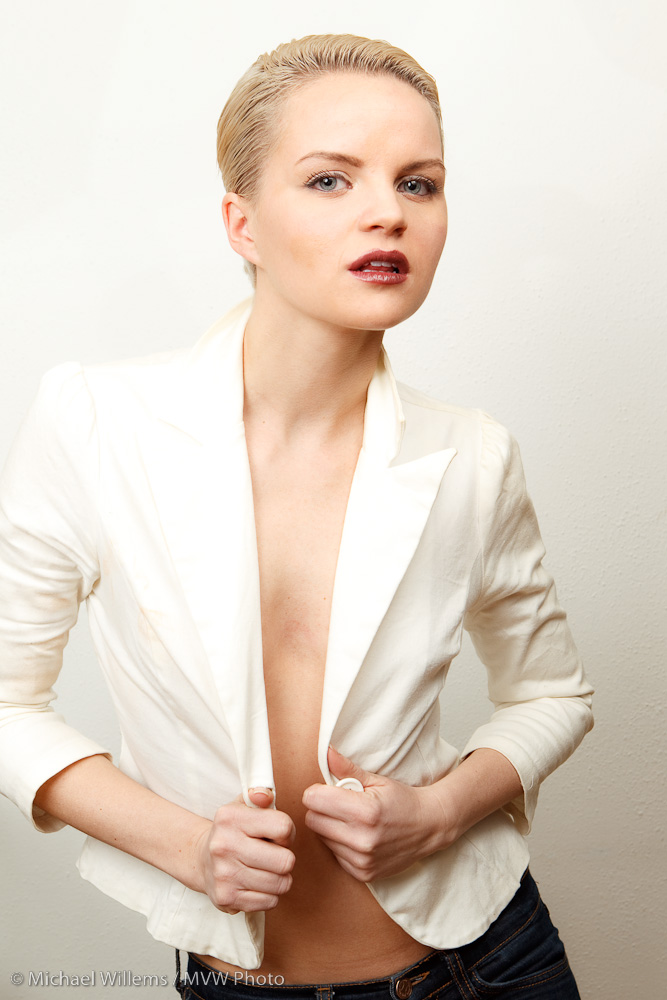
Shot of the day

…of yesterday, that is:

I used my 1D MarkIV, and light was two direct speedlights with Pocketwizards on the left and right (full power), and one behind me for fill (also direct, but on half flash power).

How this is done is something I will explain more on the weekend lighting workshop I am holding, with Joseph Marranca, at my country retreat in early April. Details to follow!

Catch that light

Every portrait, classical rules have it, needs a single “catchlight” in the eyes.  While I am not religious about this, I do tend to ensure that this is present. This very recent portrait shows the catchlights clearly. I used two umbrellas with speedlights, fired with E-TTL, and a light on the camera aimed backwards to add a bit more softening.

This is a high-key portarit: everything bright.

Flash and ambient exposure

What factors affect your flash exposure? There are four:

  1. Aperture
  2. ISO
  3. Flash power
  4. Distance from flash to subject

Two that do not affect flash exposure, or affect it to a lesser degree:

  1. Shutter speed
  2. Distance from subject to camera

What factors affect your “ambient” (available light) exposure?

  1. Aperture
  2. Shutter Speed
  3. ISO

Several that do not affect your ambient exposure, or affect it to a lesser degree:

  1. Flash power
  2. Distance from flash to subject

So you can see that by altering shutter speed, you only affect ambient exposure, while by altering flash power you only affect the flash exposure.

Snow snaps

In preparation for an upcoming two-day Country Photography Workshop I am organizing with a colleague on 3+4 April (ask me about it!), I took a few snaps in the snow yesterday with the 1D Mark IV. Interestingly, it meters more accurately than the 1D Mark III: I needed less exposure compensation since even evaluative metering was biased more towards the selected focus point. (This is odd since focus-point tied spot metering works less often).

Can you tell I like wide angles?

Snow tips:

  • Set exposure carefully for most images, emphasizing background saturation. Use a grey card or spot meter off treees, or off the sky, and adjust starting from that.
  • Bring a spare battery.
  • Careful bringing the camera into the house afterward: use a plastic bag.
  • Meter carefully and use the “highlights” view and the histogram to ensure you are not blowing out the snow – but you are getting close.
  • Use flash to light up close objects (see how I did it?)
  • High-speed flash is needed if the time exceeds 1/250th – it can be left on since the camera will only use it when needed – but it will cut effective flash power by at least 50%.
  • It is very hard to see  your images: bring a Hoodman Hood Loupe and let your eyes acclimatise.

One more snap and it’s back to the order of the day:

Again, flash and careful exposure gives it that nice saturated look.

KISS – Keep It Simple, S.

This picture shows that you do not need a studio with much equipment, necessarily.

I used a Canon 1D Mark IV camera with a 580 EX II speedlite.

And that’s it. Really.

I had the camera on 400 ISO, manual, 1/60th second, f/4. TTL did the rest with the flash.

The flash which was of course pointed behind me, giving “light from 45 degrees above”. Leading to pictures like the one above, and this:

Which when you zoom in enough shows you The Man In The Pupil:

..which of course is me.

Can you see how my flash aimed backward makes a pattern on the ceiling that looks like an umbrella? That’s the  entire point!

Sometimes very simple equipment is al you need for professional work.

New toy

Just received the new Honl Photo bounce card/speed snoot.

It is like the previous ones in that it is small, sturdy, and conveniently attaches to the Speed Strap.

What’s different?

This one has not a white but a gold reflector (equivalent to 1/4 CTO).

That means I can use it to:

  • Shoot with flash in Tungsten ambient light without making the background warm or the subject too blue; or
  • Warm up portraits with a nice warm glow.

Yet another thing to make my light-life easier.

I am going to be once again sharing my Flash expertise in Phoenix next month – 22 and 23 March – for pro and emerging pro users. You can be sure I am going to show how these small modifiers enable a whole new world of flash.

High Key

Here’s an assignment for you all: Take a high-key portrait.

“High Key” means that the entire photo is bright. That means light background, good lighting and light clothing. This makes the subject’s face stand out beautifully as the obvious focus of attention, and it also gives the portrait a bright, cheerful look, as in this portrait of a few days ago:

Do you need two umbrellas on light stands, fired via E-TTL, as I was using here? And a backdrop? Or perhaps a few studio strobes? A background light?

Well – you could use all of the above. But you can also just use a small room with white walls, with an on-camera flash fired in a backward direction – i.e. behind you. That makes the entire room into a giant light box. Ask your subject to dress in light colours and put them in front of a white wall.

If you want to do it well, make sure your subject has a catch light in his or her eyes. The wall behind you, lit up by the flash, should take care of that, or else use a little flash bounce card to direct some light back into the eyes.

Do keep in mind that if you are using automatic metering (eTTL/iTTL), then you either need to spot meter your flash light off a grey card (or something similar), or you need to use Flash Exposure Compensation (FEC) to increase your flash power. You may need +1 to +2 stops extra flash light.

Have fun!

Reader Question

Reader Craig asks:

Is it possible to get auto ISO to play nice with external flash (I’m using Nikon equipment)?  I haven’t played with it in a while, but I specifically stopped using auto ISO because I was finding it would give me ISO 800 based on the camera metering when the flash had plenty of power to push it to say ISO 200.  It seems odd to me that since there’s a preflash, that that information wouldn’t be shared with the camera to set the proper ISO automatically.  Just curious if that’s your experience as well or if there’s a way around it.  There are a a few scenarios where I’d be happy to use a (functional) auto ISO limited to ISO 800 and just deal with the noise reduction in post.

Good question. And as always… the answer is “it depends”.

First: if you take my “Advanced Flash for Pros” workshop, I go into all the nitty gritty details of both Nikon CLS/iTTL and Canon E-TTL. That will answer some.

But let me give a simple answer here. Typically when I am using flash, I will not use auto ISO. I prefer to keep things simple. Setting it myself means simple.

You expose the background using Aperture and ISO and Shutter Speed.  You make it look as dark as you like – say, two stops below ambient as a great starting point. Auto ISO means the camera will likely overrule your brightness/darkness settings. Manual exposure settings become a sort of “exposure priority” setting instead.

So while auto ISO can work well when using flash (just set expsoure two stops below ambient in S/Tv mode), it is not necessarily ideal when using flash:

  • In M mode, you cannot set exposure compensation
  • In S/Tv mode, you may get funny apertures
  • In Av mode, you may get slow exposures.

In fact on a modern Canon DSLR like my new 1D Mark IV, when using flash, ISO will automatically go off auto and will set itself to 400 when the flash is detected.

The preflash helps the camera set the flash power level for the foreground, lit-by-the-flash subject. The aperture, shutter speed and ISO settings set the background brightness. And again, typically I will be in manual exposure, and will set that to -2 stops, metered average (two stops below ambient). Auto ISO negates that!

So while it depends, it does not depend that much.  When using flash, I will usually set ISO to a manual. Yes, you can set limits to auto ISO (Nikon is much better than Canon at that!), but it is still better to do your own, and to keep control.

The above applies to indoors flash shots where the light is consistent enough for you to use manual exposure settings. Outdoors it would be different – except there is so much light you do not need auto ISO.
I teach pros, too

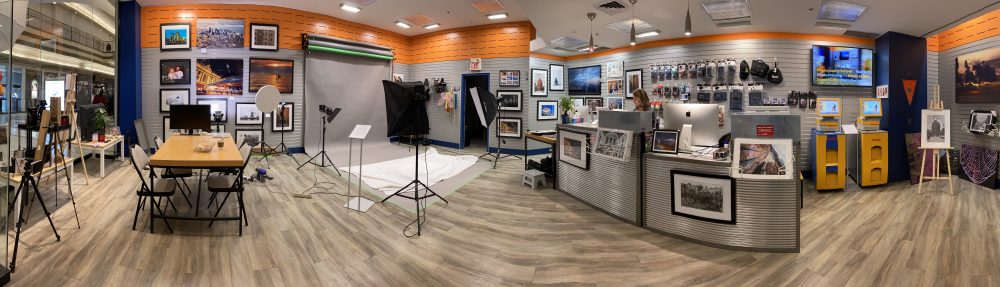
As you probably know, I teach beginning Photographers at Henry’s School of Imaging. Yesterday I taught a dozen new photographers “Point and Shoot Basics” in Mississauga.

I also present to camera clubs, as in here recently in Scarborough:

In addition, I also teach pros and emerging pros, both in Oakville and in Toronto’s Distillery District. The new February/March schedule is up, right here. My advanced flash course, where among other things I teach all the subtle little differences between e-TTL II and CLS/i-TTL; advanced light balancing techniques; when to use what modifier; and more, is very popular with wedding pros.

Both these types of training remind me how important user interfaces are. Why call a focus mode “AI Servo” if you could call it “continuous focus”? Why call metering “3D Colour Matrix” when “Smart Metering” would be understood more readily by your market?

Ever read your camera manual? Did you learn a lot? I see thousands of students ever year and if one thing is clear, it is that camera makers could communicate much, much better. First they would have to give the job of designing terms to User Interface experts and writer, not to engineers.