Light is what you make it

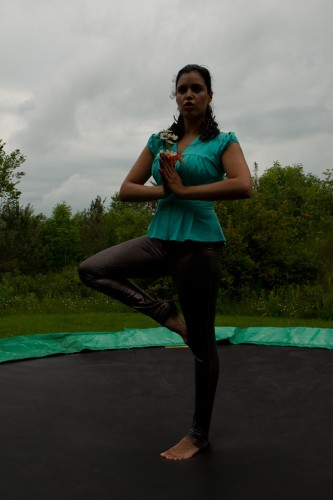
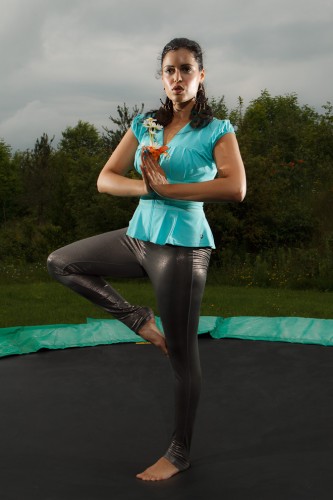
Night time? No.I took this shot in open daylight, last Saturday during the Advanced Flash course Joseph and I taught at Mono, Ontario:
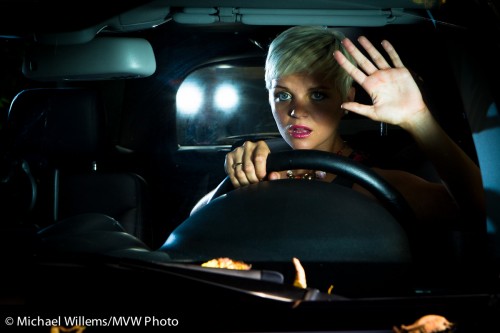
Scary Drive (Photo Michael Willems)

Scary Drive (Photo Michael Willems)

The lesson here is not how that is done (it is involved, and needs speedlites, pocketwizards, reflectors, light stands, and my SUV), but it is that it can be done. Daylight can look like a scary stormy night.

On the advanced light course we teach you the details – but even before that, you can start playing with flash. Right now. Using one or more external flashes (not the pop-up).

And you should. Because flash can:

  • Make flat surfaces round;
  • Separate subjects from backgrounds;
  • Make dull subjects sharp;
  • Make wrinkled surfaces flat;
  • Make cold surfaces warm;
  • Make blurry motion sharp;
  • Make day into night;
  • Direct the eyes where they otherwise would not go;
  • Give you nice catchlights in the eyes;
  • …even create cars where there aren’t any.

That’s why this blog is called “Speedlighter” – speedlights and other flashes can be the most useful tool a photographer has, after the camera.

So my advice:

  • Get yourself one or more speedlites;
  • Find a way to fire them off-camera: TTL, flash cable, or pocketwizards;
  • Get some modifiers;
  • Stay tuned here, take a course: learn how they all work;
  • And above all, keep shooting.

And your photos will go up to the next level of professionalism and creativity.
Flash why?

Why do we use flash?

For “Uncle Fred” reasons? Those are the obvious reasons.  Like “it’s too dark”, “I need faster shutter speeds”, or for sophisticated Uncle Fred, “I want to fill in a backlit subject”.

All those are good reasons. but”for artistic reasons” is a better answer, if you want to make your images good. And The Speedlighter aims to make his images good.

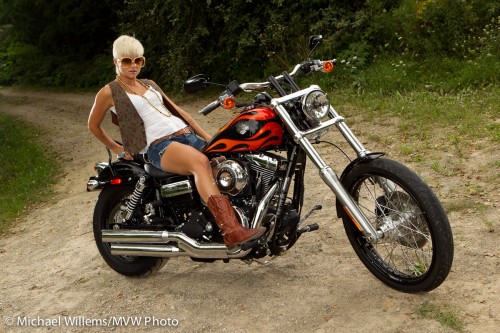
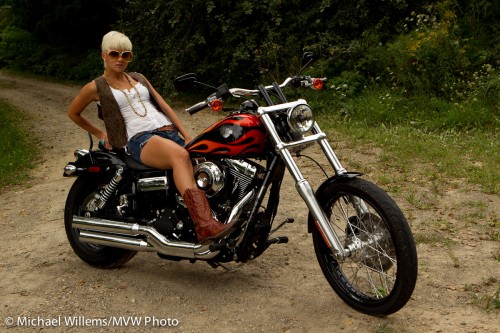
Take this snapshot of model Lindsay at last Saturday’s advanced light workshop:

Model Lindsay, lit by available light

Model Lindsay, lit by available light

Okay, I guess. I guess. Not bad. But not great, either. Dull.

So let’s add a bit of light!

Add three small flashes set up the right way, and you get this:

Model Lindsay, lit by available plus flash light (photo Michael Willems)

Model Lindsay, lit by available plus flash light

Look at both images larger. The second one is much better because:

  1. She is now “bright pixels”. Willems’s Dictum says (yes I know that is double) that “bright pixels are sharp pixels”. When you light something with flash it is sharp, for reasons I have outlined on this blog before.
  2. Her face is well lit.
  3. The bike is now without too-dark shadow areas.
  4. She is separated from the background by the edge light
  5. The edge light adds contracts and interest.
  6. Instead of being dull, the bike has interesting and sparkling highlights (check both mirrors, and the rear mudguard).

That is better. And all that was needed was three speedlights, four Pocketwizards, and three Flashzebra cables. And a light meter. And lots of batteries. And the creative and technical knowledge to put it all together.

Oh and a model and a Harley. But those are optional: this light lesson applies even to your brother driving a Smart.

Flashes: to clone, or not to clone?

I received the following question via email:

I have been following your posts since the Spring Camera show in Toronto. I have loved all of your tips and comments.

I would like to know your opinion on a 3rd party flash or your general opinion on 3rd party flashes. I am thinking of getting the Opteka EF-600 DG Super EO-TTL II for just over $100 the reviews are good and the promotional information says it works with other canon flashes if I wish to get brand name in the future and use this one as a slave. This will be my first flash for a Canon Rebel XT. I was also thinking of getting Opteka FL-50AF E-TTL II but with it only being able to tilt I do not think it will suit my needs as I learn to do more with flash.

I would like to know if it is better to save the money and go for the cheaper version or bite the bullet and go for the canon brand.

Oh yeah, I like this question. It is the kind of question we all struggle with.

I agree you need a flash that swivels and turns. A 430EX, 580EX, or a clone of either of those, in other words.

I have worked a little with some of the clone flashes, though not that very one, and here is my take on this:

Pros:

  • Much cheaper. Much!

Cons:

  • Not guaranteed to be as compatible in every situation (complex TTL).
  • Quality control and warranties may or may not be as good, so there is some uncertainty.
  • The interface is sometimes simpler (which is not always a bad thing!)
  • Not all features may be supported (eg high-speed flash, auto flash head zoom: I have seen some clones that did not support these).
  • If you have a problem, Canon will not help, and nor in all likelihood will the maker of the third-party flash.

Bear in mind that of you use flashes in manual mode (which often enough you will, once you master flash), then it makes no difference what flash you have, since you will not use TTL at all in that situation.

Knowing all this, I would say: (drum roll):

  • Make sure you have one flash that is made by Canon. If flash is important to you, that should be your first flash; if not, and you are experimenting, then it can be your second or third flash, whenever you get around to this.
  • Other flashes, try the clones.
  • Particularly if you shoot manual flash, and have many flashes, equip yourself with clones.

So in your case: “it depends”. If you want to be sure, get the 430EX. If you want to play, then by all means start with a clone and once you are happy, add a canon and make the clone your second flash.

Do make sure the offer is genuine, and do try the flash in the store to make sure you are happy. Take a few test shots. Opteka and Nissin (and various such OEM labels)  are “off brands”; Metz is a good brand. Off brands do not have to be bad, but they are not necessarily good either.

Creative light

There is just one more spot open for the all-day Creative Flash course in Mono, Ontario, an hour north of Toronto, Saturday.

Using a professional model and pro lighting equipment on Canon, Nikon and other camera brands, Joseph Marranca and I will teach our students to take shots not like this:

Tara Elizabeth

Tara Elizabeth

But instead like this:

Tara Elizabeth

Tara Elizabeth

You see how important light is? That’s what these workshops are about, to make users comfortable with the technical and creative aspects of light,

And they are about going home with portfolio shots.

And about having fun with cameras, all day!

Afternoon = Gel

Another flash tip for you today.

Later afternoon pictures. You can make them look better by adding your own “golden hour” glow. Like this:

Patio at dusk, photo by Michael Willems

Patio at dusk, photo by Michael Willems

To take a picture like this, you might do the following:

  • Use an on-camera flash while there is still light;
  • First set your camera’s exposure (ISO, aperture, shutter) to get a nice background sky. Ignore the foreground for now.
  • Then position yourself such that there is no close subject (remember the inverse square law).
  • Use a half CTO gel on the flash (I used a Honl Photo half CTO gel on the speedstrap on my 580EX);
  • White balance to “Flash”.
  • Take a test shot. If the flash is too bright or too dark, use Flash compensation (+ or 1) to adjust. If the background is not right, adjust ISO, shutter or aperture.
  • A wide angle lens makes it easier.

And Bob’s your uncle: nice colours.

Studio tips

Two studio/product lighting tips for you, prompted by me shooting a few product shots just now for upcoming reviews. Shots like this:

Panasonic GF1, photo Michael Willems

Panasonic GF1, photo Michael Willems

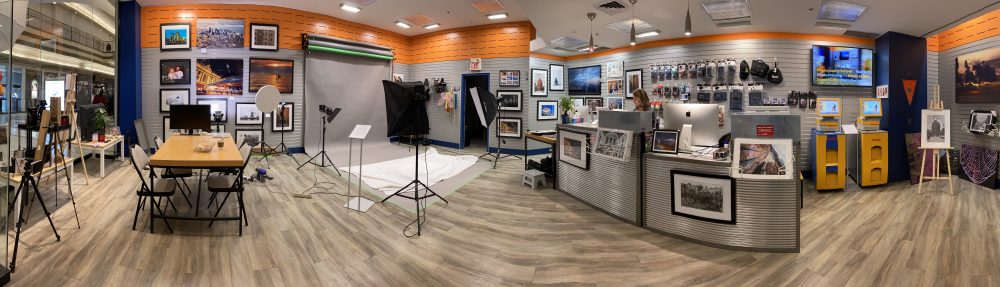
That was taken here:

Product Photo

Product Photo Setup

Which, when seen from behind, looks like this:

Product Setup

Product Setup, with background flash

So what are the tips?

First, avoid stray light, especially on your background. Saturation means “how little white light is mixed in”. A saturated colour has no white mixed in. An unsaturated colour has much white mixed in.

So use a grey backdrop if you can, or just use distance and directional light. Of course since I am using an umbrella and a softbox, much light will stray. So I keep the background far away (you all remember the inverse square law).

So, not this:

Product, too much background light

Product, too much background light

But more like this.

Product, less background light

Product, less background light

Then set your camera to what you like (f/9 and 1/125th for me), and get the background right.

First take a picture with no flash, to ensure that is black; then shoot while activating the background light only. Now get the flash power right: too little and you get a dark background; too much and it turns white. For me, I found this about right:

Product, only background light

Product, only background light

Then you get the rest right, i.e. set the right power for your main lights, and finally, shoot the shot.

Second tip: always use a brush or compressed air to clean your product. Otherwise, hours of photoshopping will result.

KISS: Simple, again

Today, another shot in the “Keeping it simple” series.

Relatively simple, anyway:

Evanna Mills, photo Michael Willems

Model Evanna Mills, photo Michael Willems

For this photo, taken during our last Creative Lighting workshop, I could have used large strobes with softboxes and portable lead-acid batteries. Instead, I used two simple speedlites.

  • The main light: a Canon 580EX II flash fitted with a Honl Traveller 8 Softbox. Inside that softbox, a half CTO gel.
  • The hair light: a Canon 430EX flash with a Honl Photo 1/4″ grid.
  • Both flashes on cheap, simple stands.
  • Camera on manual/ 1/160th second, f/9, and set to “Flash” white balance.

This is simple and can be reproduced easily and consistently.

I used Pocketwizards and manual settings to fire the lights, because that way I was able to use any flash (even a very cheap one!) and to hand the Pocketwizard to each student in turn to shoot the shot and get consistent results immediately, but I could equally well have used TTL.

The next Creative Lighting workshop in Mono is August 14.

Less can be more

Less can be more. We sometimes make things complicated as photographers: we get gear-itis. Yeah, me too.

But you can keep it simple. Richard Avedon shot much of his work with a view camera and a white sheet on the shady side of a building. Period. For the longest time, Robert Mapplethorpe shot with a simple Polaroid camera with no settings to speak of.

So while I teach complex lighting, and I teach making complex technologies like TTL understandable, sometimes it can be simple.

Look, for example, at this recent shot of model Lindsay:

Model Lindsay, photo by Michael Willems

Lindsay, photo by Michael Willems, 2010

This is simple how?

  • A simple background. A white wall. I love white walls.
  • Simple lighting equipment. Just one flash, namely a 580EX speedlite on the camera.
  • Simple lighting setup. That flash was aimed at the wall and ceiling behind me. Using TTL, so no metering was necessary (just flash exposure compensation of about +1.3 stops)
  • Simple colour (namely: no colour. I love black and white).
  • Simple clothing. White top for high-key effect. Jeans for a contrasty dark area.
  • Simple pose.
  • Simple post work (just slight exposure adjustments as needed and skin fixes where necessary).

Sometimes less really is more. Don’t you think?

So here is your assignment, should you wish to accept it: find a white room and shoot a high-key portrait like this. Aim the flash behind you. Expose well: to the right. Have fun!

Autofocus assist: will it work?

My Canon speedlites (like the Nikon flashes) have an “Autofocus Assist Mode”, where a red pattern of lines emerges from the red square at the front. I am talking about big flashes, like my 580EX 2:

580ex2 Flash

580ex2 Flash

The flash emits the red beam when needed to help the camera focus. This happens:

  1. When it is dark
  2. When the subject has too little contrast (try focusing on a blank wall).

It is cleverly linked to the focus spot: when you are using a focus spot that can detect horizontal lines, it will emit horizontal lines; when using a focus spot that can detect vertical lines, it will emit vertical lines.

But when does it not work?

  1. When it is not dark and the subject is not low contrast. If the camera can focus without the assist light, it will. Why waste battery power?
  2. When you are not using “One Shot” focus (Nikon calls it AF-S). The red light helps the camera lock focus: when you are in a mode that does not lock (namely manual focus or AI Servo/AF-C focus), it will not try.
  3. When you are using a focus point that cannot be reached by the red pattern (think wide angle lens).

Hope that helps. Flash can seem very complicated, but if you know all these little things, it gets a lot easier to use.

Have you ever seen the rain?

Evanna Mills, photo by Michael Willems

Evanna Mills, photo by Michael Willems

Model Evanna Mills, photographed on yesterday’s Pro Workshop featuring Joseph Marranca and myself. Liz Valenta did the make-up.

It was raining.

Actually, it was a garden hose.

Lit mainly from behind, plus additional fill from the front. With the exposure set manually to create a dark background. The lights were both simple speedlites, fired using a pocketwizard.

And here’s one more. Now I am shining that back light through the black umbrella, making it almost white:

Evanna Mills, photo by Michael Willems

Evanna Mills, photo by Michael Willems

You see how much you can do using very simple means? This is what we teach on workshops, and it is also what photographers should keep in mind at all times.Simple technique can do a lot.